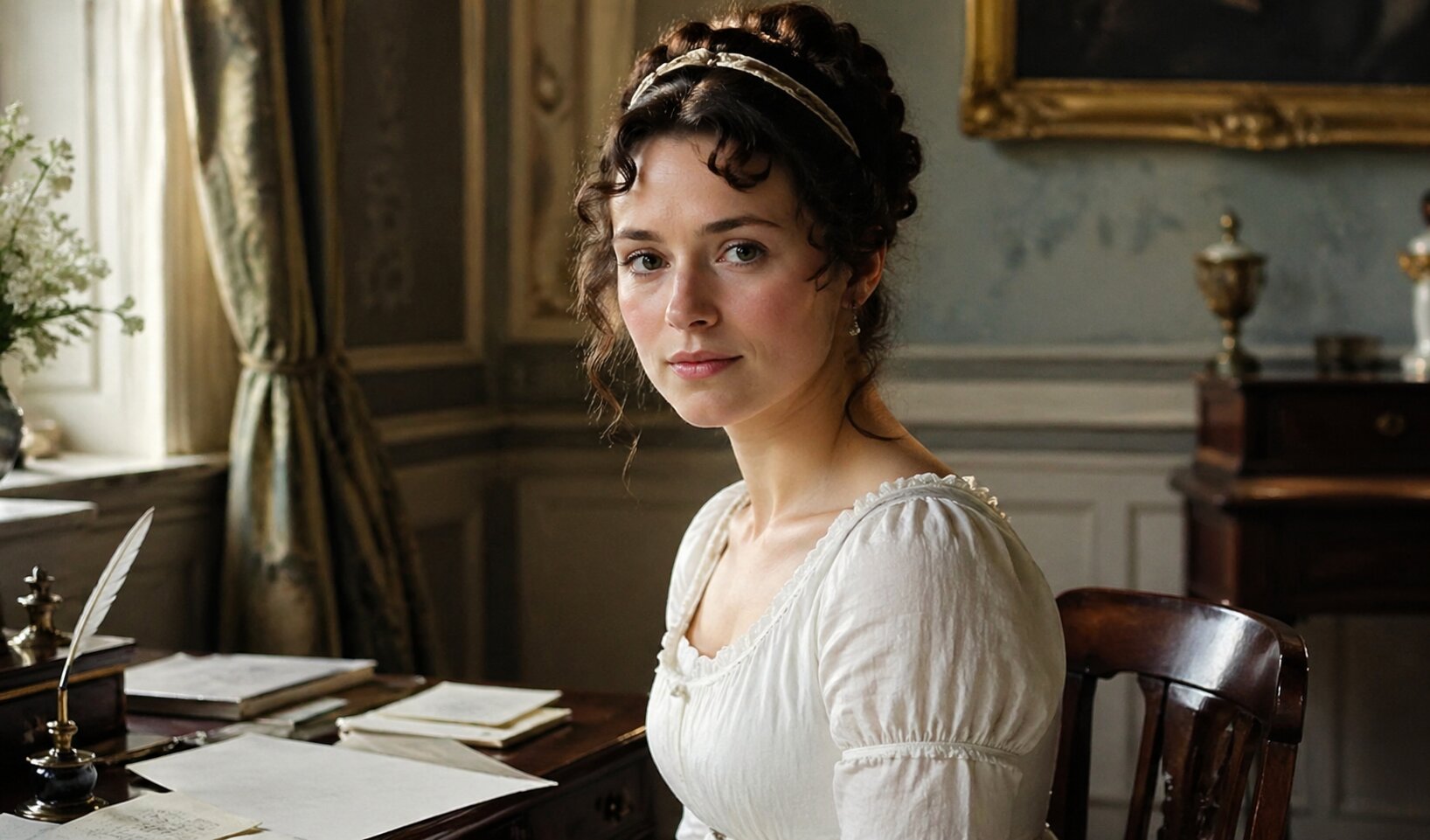
Jane Austen lived a short, quiet life, but she became one of the most powerful voices in English literature.
She did not write about wars, kings, empires, or grand adventures.
She wrote about families, marriages, money, manners, pride, foolishness, love, and human self-deception.
Yet through those ordinary subjects, she revealed something extraordinary: people do not need dramatic lives to be deeply interesting.
Jane Austen was born on December 16, 1775, in Steventon, Hampshire, England, and died on July 18, 1817, in Winchester at the age of 41.
She published only four novels during her lifetime: Sense and Sensibility, Pride and Prejudice, Mansfield Park, and Emma.
Two more novels, Northanger Abbey and Persuasion, were published after her death.
Together, these six novels made her one of the most loved and studied authors in the world.
A Childhood Surrounded by Books, Conversation, and Observation
Jane Austen was born into a large family.
Her father, Reverend George Austen, was a clergyman, and her mother, Cassandra Leigh Austen, came from a well-connected family.
Jane had six brothers and one sister, Cassandra, who became her closest friend and lifelong companion.
The Austen home was lively, intelligent, and full of reading.
Her father encouraged learning, and Jane had access to books from an early age.
This mattered greatly, because formal education for women in the late 18th century was limited.
Jane and Cassandra briefly attended school, but much of Jane’s education happened at home through reading, family discussion, and observation.
That home environment shaped her future as a writer.
She grew up watching how people spoke, behaved, flirted, judged, boasted, misunderstood, and hid their true feelings behind polite language.
Later, those observations became the raw material of her fiction.
The Young Writer Who Loved Wit and Satire
Jane Austen began writing when she was young.
Her early writings, often called her juvenilia, were playful, sharp, and comic.
They showed that she already understood how ridiculous people could be when they took themselves too seriously.
She enjoyed parodying popular sentimental fiction of her time, especially stories filled with exaggerated emotions, dramatic fainting, and unrealistic romance.
This early training helped her develop one of her greatest gifts: the ability to laugh at human weakness without becoming cruel.
Austen’s humor is gentle on the surface, but extremely sharp underneath.
She could expose vanity, foolishness, snobbery, and hypocrisy with just one sentence.
Life in the World of the Gentry
Jane Austen lived mostly among the rural clergy and minor landed gentry of southern England.
This was not the world of the very poor or the very rich.
It was the world of respectable families who had social status but often depended on inheritance, marriage, and careful financial decisions.
That world became the setting for most of her novels.
In Austen’s society, marriage was not only a romantic decision.
For many women, it was also an economic necessity.
A woman without independent wealth had few professional options.
This is why marriage in Austen’s novels is never just about love.
It is also about survival, dignity, compatibility, family pressure, money, and moral judgment.
That is what makes her love stories so powerful.
They are romantic, but they are never foolish.
Bath, Loss, and Uncertainty
In 1801, Jane Austen’s father retired, and the family moved from Steventon to Bath.
This move was emotionally difficult for Jane.
Steventon had been her home, her creative ground, and the place where much of her early writing had developed.
Bath later appeared in her novels, especially Northanger Abbey and Persuasion, but her years there were not especially productive.
After her father died in 1805, Jane, her mother, and Cassandra faced financial uncertainty.
Because women’s legal and financial independence was limited, their security depended heavily on male relatives.
This reality gave Austen a clear understanding of women’s vulnerability in a polite society that often pretended to be fair.
Her novels may look elegant from the outside, but beneath the elegance is a serious concern with power, money, and choice.
Chawton: The Cottage Where Her Genius Flowered
A major turning point came in 1809.
Jane, her mother, Cassandra, and their friend Martha Lloyd moved into a cottage in Chawton, provided by Jane’s brother Edward.
This home gave Austen the stability she needed.
At Chawton, she revised earlier works and wrote with renewed energy.
This was the period in which her major novels reached publication.
Sense and Sensibility appeared in 1811.
Pride and Prejudice followed in 1813.
Mansfield Park came in 1814.
Emma was published in 1815.
Austen’s name did not appear openly on these books at first.
Sense and Sensibility was published “By a Lady,” reflecting the limits placed on women writers at the time.
Still, her reputation began to grow.
Readers admired her wit, realism, and insight into social life.
Pride and Prejudice: Her Most Famous Work
Pride and Prejudice is Austen’s most famous novel.
At the center of the story are Elizabeth Bennet and Mr. Darcy, two intelligent people who must overcome pride, prejudice, misunderstanding, and self-deception.
Elizabeth is lively, witty, and independent.
Darcy is reserved, proud, and socially powerful.
Their romance works because both characters must change.
Elizabeth must learn that her first impressions are not always correct.
Darcy must learn humility and emotional openness.
That is why the novel remains so beloved.
It is not simply about finding the right person.
It is about becoming worthy of love.
Emma: The Comedy of a Clever Woman Who Misreads Everyone
Emma is one of Austen’s most brilliant achievements.
Its heroine, Emma Woodhouse, is rich, clever, confident, and deeply mistaken about other people.
Unlike many Austen heroines, Emma does not need to marry for money.
Her problem is not insecurity.
Her problem is overconfidence.
She believes she understands everyone’s feelings better than they understand themselves.
Of course, she does not.
The genius of Emma is that Austen makes us enjoy Emma’s intelligence while also seeing her errors.
It is a novel about imagination, class, vanity, and the danger of interfering in other people’s lives.
Persuasion: A Mature Novel About Regret and Second Chances
Persuasion was published after Austen’s death.
It has a quieter, more mature tone than her earlier novels.
Its heroine, Anne Elliot, is older than many Austen heroines and carries the pain of a lost love.
Years earlier, Anne was persuaded to reject Captain Wentworth because he lacked fortune and social position.
When he returns, successful and still wounded, both must face the emotional cost of pride, regret, and silence.
Persuasion is powerful because it understands that love is not always young, loud, or immediate.
Sometimes love survives through time, disappointment, and memory.
A Writer of Love, But Not a Blind Romantic
Jane Austen is often described as a romantic novelist, but that label is incomplete.
She wrote about love, but she was never naïve about it.
In her novels, love must be tested by character.
A charming man may be dangerous.
A proud man may be honorable.
A silly marriage may become a lifetime punishment.
A financially secure match may still be emotionally empty.
Austen understood that marriage could bring happiness, but only when affection, respect, judgment, and moral character came together.
That is why her novels still feel modern.
She knew that attraction is not enough.
Her Style: Elegant, Clear, and Deadly Sharp
Austen’s writing style is famous for its balance.
Her sentences are elegant but not heavy.
Her humor is sharp but controlled.
Her moral judgment is firm but rarely preachy.
She mastered free indirect style, a technique that blends the narrator’s voice with a character’s thoughts.
This allows readers to enter a character’s mind while still seeing that character’s mistakes.
Austen uses this brilliantly.
We often understand a character from the inside and judge them from the outside at the same time.
That is one reason her novels are so psychologically rich.
Illness and Death
In 1816, Jane Austen’s health began to decline.
She continued writing despite weakness and illness.
She started a final unfinished novel, now known as Sanditon.
In 1817, she traveled to Winchester for medical treatment.
She died there on July 18, 1817, at only 41 years old.
She was buried in Winchester Cathedral.
At the time of her death, she was respected, but not yet the global literary icon she would later become.
Why Jane Austen Still Matters
Jane Austen still matters because she understood human nature with rare precision.
She knew that people often misunderstand themselves.
She knew that social politeness can hide cruelty.
She knew that money influences love more than people like to admit.
She knew that intelligence without humility can become foolishness.
She knew that good judgment is one of the foundations of a good life.
Her world had carriages, letters, country houses, and formal dances.
But her emotional world is still ours.
We still misread people.
We still confuse charm with character.
We still struggle between love and status.
We still make decisions based on pride, fear, hope, and pressure.
That is why Austen has never gone out of style.
The Legacy of Jane Austen
Jane Austen completed only six major novels, but her influence is enormous.
Her works have inspired films, television adaptations, modern retellings, literary criticism, fan communities, and endless debate.
In 2025, readers around the world marked the 250th anniversary of her birth, showing how deeply her work continues to matter across cultures and generations.
She is admired not because she wrote loudly, but because she saw clearly.
She did not need a large stage.
She turned drawing rooms, dinner tables, letters, visits, and marriages into deep studies of human behavior.
Jane Austen proved that ordinary life, when observed by a great mind, is never ordinary.
Final Thought
Jane Austen’s life was outwardly modest, but her imagination was vast.
She did not travel widely, hold public office, or live a dramatic public life.
Instead, she watched carefully, thought deeply, and wrote brilliantly.
Her genius was not in making life seem larger than it is.
Her genius was in showing that life is already large enough, if we pay attention.