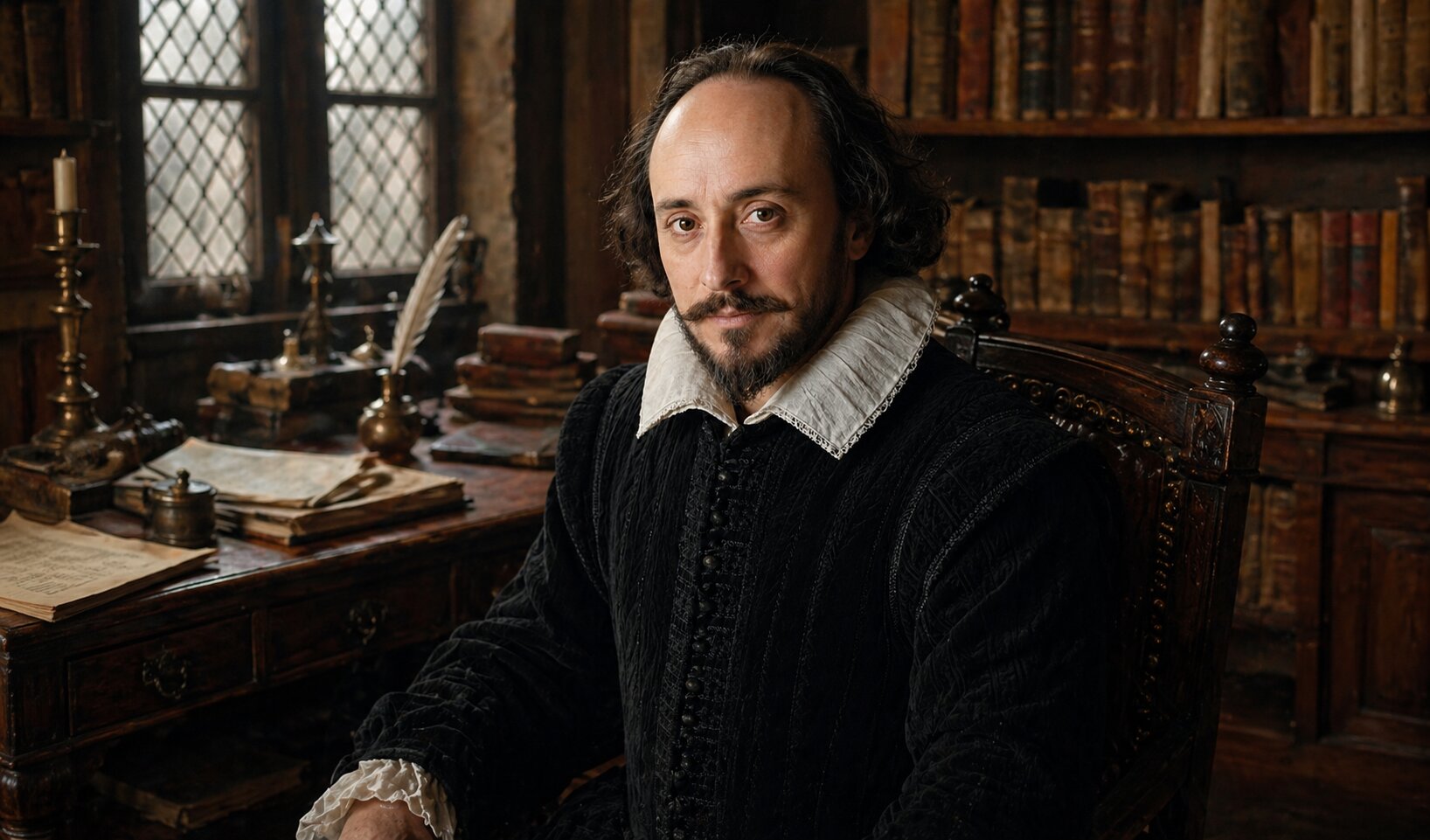
Here are 25 interesting facts about William Shakespeare, the legendary playwright and poet:
- Birth
William Shakespeare was born in Stratford-upon-Avon, England, in 1564, likely on April 23, though his exact birthdate is unknown.
He was baptized on April 26, 1564.
- Parents
His father, John Shakespeare, was a glove-maker and town official, and his mother, Mary Arden, came from a prominent local family.
- Education
Shakespeare attended the local King’s New School in Stratford, where he studied Latin, literature, and rhetoric.
- Marriage
At 18, Shakespeare married Anne Hathaway, who was 26.
They married in 1582.
- Children
Shakespeare and Anne had three children: Susanna, born in 1583, and twins Hamnet and Judith, born in 1585.
Hamnet died at age 11.
- Lost Years
Between 1585 and 1592, little is known about Shakespeare’s life.
These are often called his “Lost Years.”
- The London Move
By 1592, Shakespeare had moved to London and established himself as a playwright and actor.
- First Recognition
Shakespeare was criticized by playwright Robert Greene in 1592, who called him an “upstart crow”—evidence of his growing success.
- The Globe Theatre
Shakespeare was part-owner of The Globe Theatre, built in 1599.
It became the home for many of his plays.
- Prolific Writer
Shakespeare wrote 39 plays, 154 sonnets, and two long narrative poems over his career.
- Famous Plays
His most famous works include:
Tragedies: Hamlet, Macbeth, King Lear, Othello
Comedies: A Midsummer Night’s Dream, Twelfth Night, As You Like It
Histories: Henry V, Richard III
- Inventor of Words
Shakespeare is credited with inventing or popularizing over 1,700 words in the English language, such as “bedroom,” “lonely,” “gossip,” and “swagger.”
- The Sonnets
His 154 sonnets, published in 1609, explore themes of love, beauty, time, and mortality.
- “To Be or Not to Be”
This line from Hamlet is one of the most quoted in literary history, reflecting existential contemplation.
- Collaborative Works
Some plays, such as Henry VIII, were written in collaboration with other playwrights, like John Fletcher.
- The First Folio
After Shakespeare’s death, his friends compiled 36 of his plays into the First Folio in 1623, preserving many works that might have otherwise been lost.
- Acting Career
Shakespeare acted in some of his own plays and was a member of the acting company The Lord Chamberlain’s Men, later renamed The King’s Men.
- Royal Patronage
Shakespeare performed for Queen Elizabeth I and later for King James I, who greatly admired his work.
- Death
Shakespeare died on April 23, 1616, his likely birthday, in Stratford-upon-Avon, at the age of 52.
- The Curse on His Grave
His tombstone in Stratford bears an epitaph warning against moving his bones:
“Blessed be the man that spares these stones, and cursed be he that moves my bones.”
- Global Influence
Shakespeare’s works have been translated into over 100 languages and are performed more often than those of any other playwright.
- Shakespeare in Space
In 1998, the Royal Shakespeare Company performed Henry V for astronauts aboard the International Space Station.
- The “Shakespeare Authorship Question”
Some theorists speculate that Shakespeare didn’t write his works, proposing alternatives like Christopher Marlowe or Edward de Vere.
However, most scholars reject this.
- Timeless Themes
Shakespeare’s plays address universal themes like love, jealousy, ambition, betrayal, and mortality, making them relevant across centuries.
- Modern Impact
Shakespeare’s phrases and works influence modern literature, film, and pop culture.
Movies like The Lion King are inspired by Hamlet, and his quotes are often referenced in daily language.