Some people live one life.
Benjamin Franklin seemed to live many.
He was a printer, writer, inventor, scientist, diplomat, philosopher, businessman, civic leader, and one of the Founding Fathers of the United States.
In an age before electricity lit homes, before modern newspapers shaped public opinion, and before America became an independent nation, Franklin stood at the center of ideas, invention, and public life.
His genius was not limited to one field.
That is what makes Benjamin Franklin so fascinating.
He was not merely a man of talent.
He was a man of curiosity.
A Humble Beginning in Boston
Benjamin Franklin was born on January 17, 1706, in Boston, Massachusetts.
He was the 15th of 17 children, born into a large family where wealth and privilege were limited.
His formal education did not last long, but that never stopped him from learning.
In fact, Franklin became one of the greatest examples of self-education in history.
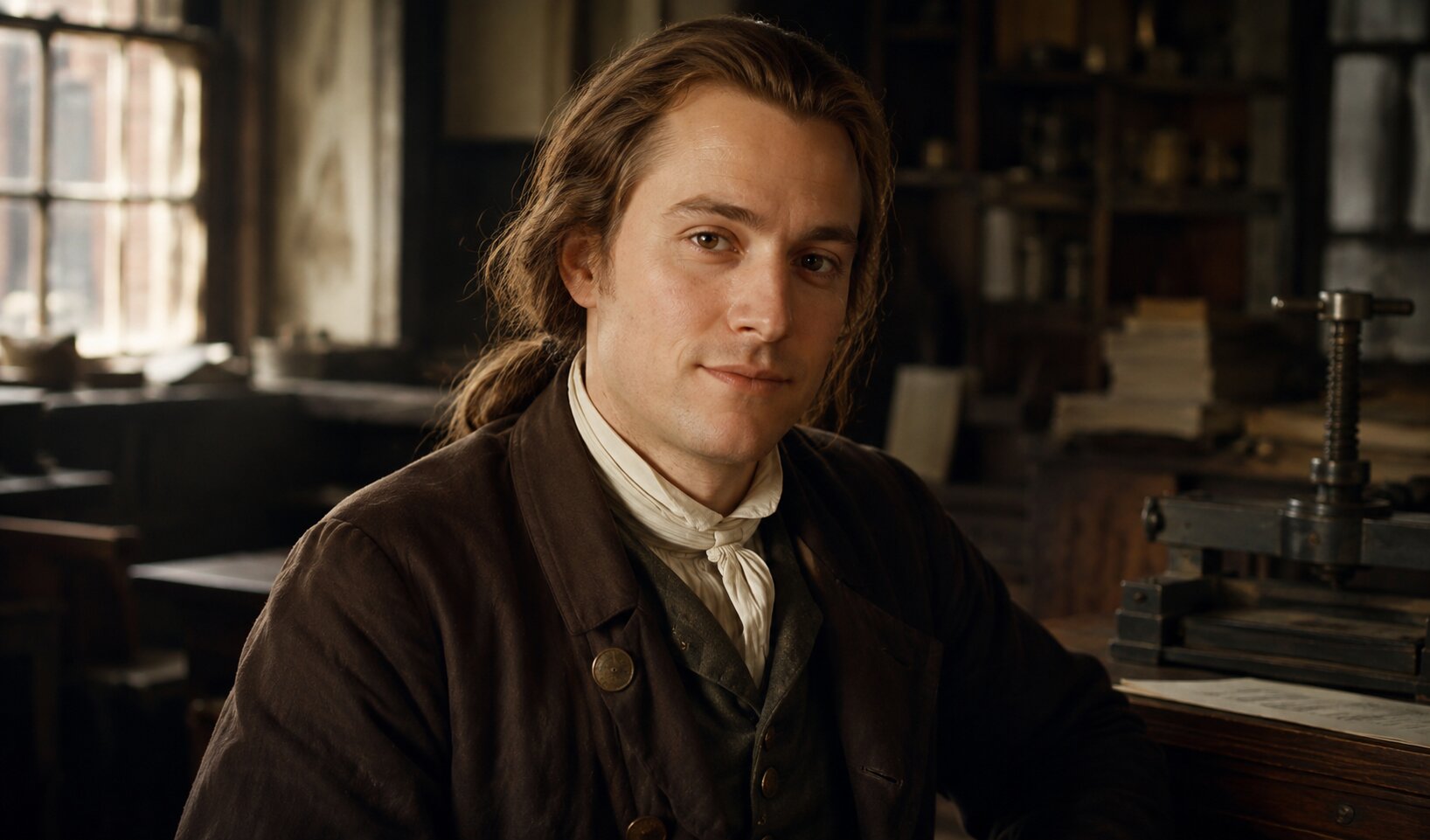
At the age of 12, he became an apprentice to his older brother James, who was a printer.
This apprenticeship introduced him to books, newspapers, arguments, politics, and the power of the written word.
But life under his brother was difficult.
At 17, Franklin ran away to Philadelphia, seeking independence and a new beginning.
That decision changed his life.
In Philadelphia, Franklin transformed himself from a runaway apprentice into one of the most respected men in the colonies.
The Power of Self-Education
Franklin’s greatness came from his hunger to improve himself.
He read constantly.
He studied writing, science, philosophy, business, and public affairs.
He did not wait for a university to make him educated.
He made himself educated.
This is one of the most inspiring parts of Franklin’s life.
He proved that learning is not limited to classrooms.
A curious mind, disciplined habits, and a willingness to work hard can open extraordinary doors.
Franklin’s life reminds us that self-education is not a second-rate education.
Sometimes, it is the most powerful kind.
The Printer Who Became a Public Voice
Franklin first rose to prominence through printing and publishing.
He purchased The Pennsylvania Gazette and turned it into one of the most successful newspapers in colonial America.
Through journalism, he shaped public conversation.
He also published Poor Richard’s Almanack, which became famous for its practical advice, humor, weather forecasts, and memorable sayings.
Many of Franklin’s maxims still survive today.
One of the most famous is:
“Early to bed and early to rise, makes a man healthy, wealthy, and wise.”
His writing was simple, clever, and practical.
He knew how to speak to ordinary people.
That was one of his greatest strengths.
Franklin did not write only for scholars or politicians.
He wrote for citizens.
Franklin the Inventor
Benjamin Franklin’s imagination was deeply practical.
He did not invent things merely to impress others.
He invented things to solve problems.
He created the lightning rod, which helped protect buildings from lightning strikes.
This invention alone saved countless homes, churches, and public buildings from fire and destruction.
He designed bifocal glasses because he needed help seeing both near and far.
Instead of switching between two pairs of glasses, he created one pair that could do both.
He developed the Franklin stove, a more efficient wood-burning stove that provided better heat while using less fuel.
He invented the glass harmonica, a musical instrument that became popular in Europe and inspired composers such as Mozart.
Even as a young man, Franklin experimented with swimming fins for the hands to improve speed in the water.
This tells us something important about him.
Franklin saw everyday problems as invitations to think.
Where others complained, he experimented.
Franklin the Scientist
Benjamin Franklin’s scientific curiosity was legendary.
He is most famous for his experiments with electricity.
His kite experiment demonstrated the connection between lightning and electricity, helping people better understand one of nature’s most powerful forces.
His work helped shape the vocabulary and early understanding of electricity.
He contributed to ideas about electrical charge and helped develop concepts that later scientists would build upon.
Franklin also studied weather, ocean currents, and navigation.
His mapping of the Gulf Stream helped ships travel more efficiently across the Atlantic Ocean.
This was typical of Franklin.
Even his science had a public purpose.
He wanted knowledge to be useful.
A Builder of Civic Life
Franklin believed that a good society required active citizens.
He did not simply talk about public service.
He built institutions.
He helped establish one of the first volunteer fire departments in Philadelphia.
He founded the Library Company of Philadelphia, often considered the first successful lending library in America.
He helped establish what later became the University of Pennsylvania.
He also helped found the American Philosophical Society, an organization dedicated to the advancement of science and knowledge.
These contributions show another side of Franklin’s genius.
He understood that civilization is built through institutions.
Libraries, schools, fire departments, newspapers, and scientific societies may not sound dramatic, but they shape the daily life of a nation.
Franklin was not only a founder of America politically.
He was a founder of American civic culture.
Franklin the Diplomat
Franklin’s political role was just as significant as his scientific and civic work.
He helped draft and signed the Declaration of Independence in 1776.
He later played an important role in the Constitutional Convention of 1787.
But perhaps his greatest political achievement was his diplomacy in France.
During the American Revolution, the colonies desperately needed help against Great Britain.
Franklin went to France and used his charm, intelligence, reputation, and political skill to secure French support.
That support was crucial to the American victory.
Franklin understood people.
He understood timing.
He understood persuasion.
He was not just a thinker.
He was a negotiator.
The Albany Plan and the Idea of Union
Long before the United States became a nation, Franklin understood the need for unity among the colonies.
His Albany Plan of Union proposed a way for the colonies to cooperate under a common structure.
Although the plan was not adopted, it showed Franklin’s ability to think beyond local interests.
He saw that divided colonies would remain weak.
United colonies could become powerful.
That idea later became central to the American Revolution and the creation of the United States.
Franklin was often ahead of his time because he could see patterns before others did.
The Autobiography and the Art of Self-Improvement
Franklin’s Autobiography remains one of the great classics of American literature.
It is not merely the story of a man’s life.
It is a guide to discipline, ambition, character, and self-improvement.
Franklin believed that people could shape themselves through habits.
He famously developed a system of personal virtues, trying to improve qualities such as industry, frugality, humility, and temperance.
He was not perfect, and he knew it.
That is part of what makes him interesting.
Franklin did not present himself as a saint.
He presented himself as a work in progress.
That idea still feels modern.
A Man of Practical Wisdom
Franklin’s wisdom was not abstract.
It was rooted in daily life.
He believed in work, thrift, honesty, curiosity, and public service.
He valued knowledge, but he also valued usefulness.
His sayings became popular because they were memorable and practical.
Franklin understood that wisdom must be livable.
It must help people make better choices, manage time, build character, and serve society.
This is why his words have survived for centuries.
They are not just clever.
They are useful.
Franklin’s Final Years and Lasting Legacy
Benjamin Franklin died on April 17, 1790, in Philadelphia.
More than 20,000 people attended his funeral.
That extraordinary public mourning showed how deeply he had influenced his time.
But Franklin’s legacy did not end with his death.
His ideas continue to live in science, politics, education, journalism, and civic life.
He helped create the intellectual and moral atmosphere of early America.
He showed that one person could be many things.
A writer could be a scientist.
A businessman could be a philosopher.
An inventor could be a diplomat.
A private citizen could become a public servant.
Why Benjamin Franklin Still Matters
Benjamin Franklin matters because he represents the power of an active mind.
He did not accept the world as it was.
He questioned it.
He studied it.
He improved it.
He did not separate knowledge from action.
For Franklin, learning had to lead somewhere.
It had to improve life, society, government, or character.
In today’s world, where people are often pressured to specialize narrowly, Franklin reminds us of the beauty of being broadly curious.
He reminds us that intelligence is not just about knowing things.
It is about connecting things.
It is about solving problems.
It is about serving others.
Benjamin Franklin was not great because he did one thing well.
He was great because he refused to stop learning, refused to stop building, and refused to stop contributing.
That is why he remains one of the most remarkable figures in American history.
And that is why his life still inspires the world.