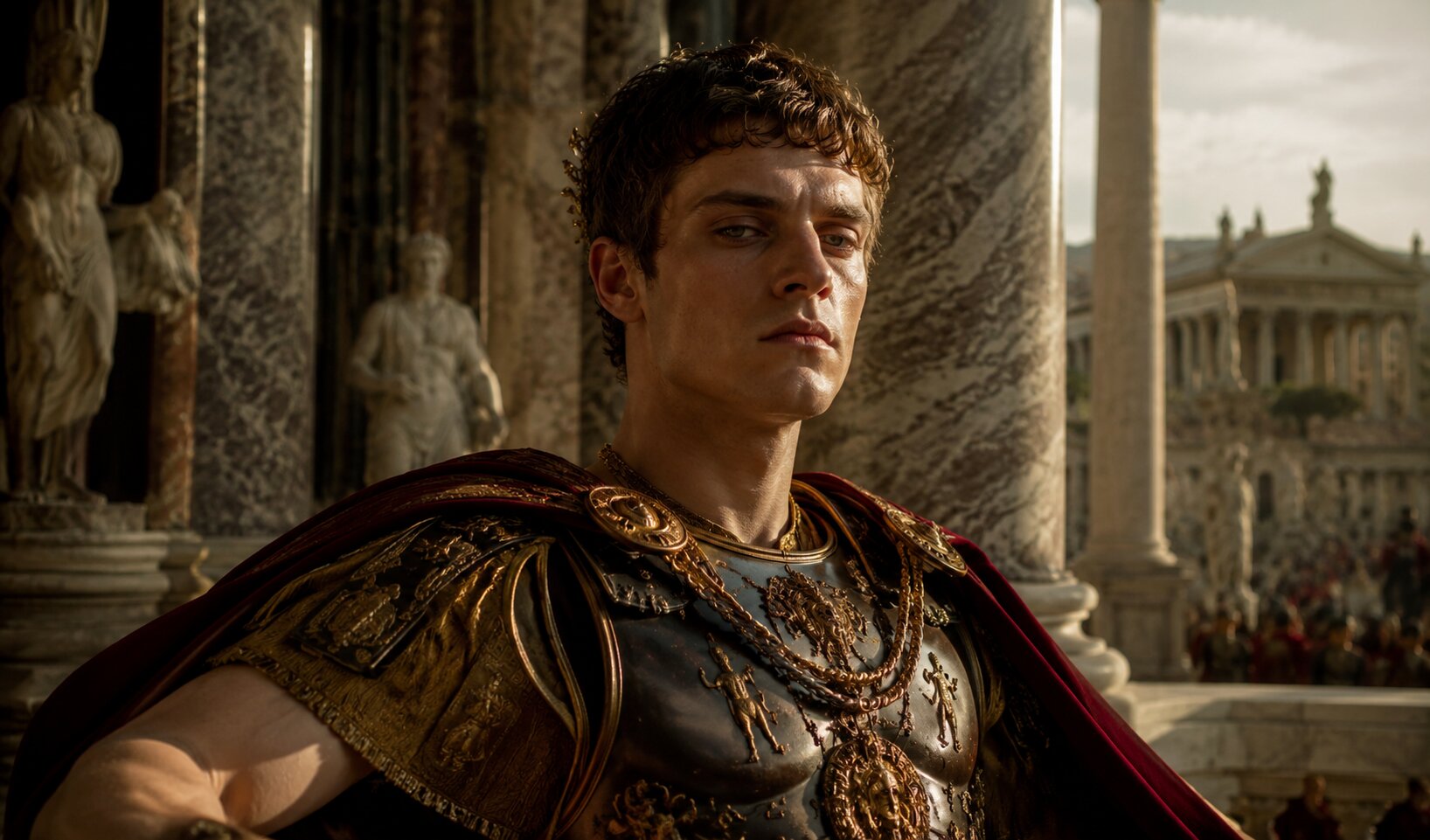
Few Roman emperors have left behind a reputation as dark, strange, and unforgettable as Caligula.
His name has become a symbol of madness, cruelty, excess, and absolute power gone wrong.
But Caligula was not born as a monster in the eyes of Rome.
He began as a beloved child of a celebrated military family, adored by the Roman people and seen as a hopeful new beginning after the gloomy rule of Emperor Tiberius.
His story is one of the most dramatic reversals in Roman history: a young emperor welcomed with joy, transformed into a ruler feared by senators, soldiers, nobles, and ordinary citizens alike.
The Boy Called “Little Boots”
Caligula was born Gaius Julius Caesar Augustus Germanicus in AD 12.
He was the son of Germanicus, one of Rome’s most admired generals, and Agrippina the Elder, a granddaughter of Emperor Augustus.
As a young boy, Gaius often accompanied his father on military campaigns.
The soldiers loved him because he wore a miniature soldier’s uniform, including small military boots called caligae.
From that nickname came the name by which history remembers him: Caligula, meaning “Little Boots.”
It was a cute nickname in childhood, but Caligula reportedly hated it as an adult.
A Prince Raised in Danger
Caligula’s early life was filled with tragedy and suspicion.
His father Germanicus died suddenly, and many Romans believed he had been poisoned.
His mother Agrippina later fell out of favor with Emperor Tiberius and was exiled.
Several members of Caligula’s family were imprisoned, starved, or forced into death.
Caligula survived by learning how to hide his feelings.
He lived under Tiberius on the island of Capri, a dangerous place where one wrong word could mean death.
This childhood of fear may have shaped the man he later became.
Rome Welcomes a New Emperor
When Tiberius died in AD 37, Caligula became emperor at the age of 24.
Rome celebrated.
The people saw him as the son of Germanicus, the noble prince who would restore honor, generosity, and youth to the empire.
At first, Caligula seemed to fulfill those hopes.
He gave bonuses to soldiers, released prisoners, organized public games, and honored his family.
The Roman people praised him as a fresh and generous ruler.
For a brief moment, it looked as if Rome had found a bright new emperor.
The Illness That Changed Everything
Only a few months into his reign, Caligula became seriously ill.
Ancient writers describe a dramatic change after his recovery.
The charming young emperor became suspicious, cruel, arrogant, and unpredictable.
Some historians believe he may have suffered from a severe medical condition, emotional trauma, political paranoia, or simply the corrupting effects of unchecked power.
Whatever the cause, Caligula’s reign quickly became darker.
He began executing rivals, humiliating senators, and treating Rome’s elite as enemies.
The emperor who had once been loved now became feared.
Power Without Limits
Caligula ruled as if the empire existed for his personal pleasure.
He spent enormous sums on games, spectacles, luxury, and building projects.
He loved theatrical displays of power.
He demanded public admiration and reportedly wanted to be worshiped like a living god.
To Roman sensibilities, this was deeply disturbing.
Romans accepted emperors as powerful rulers, but openly acting like a god violated old republican traditions and offended many aristocrats.
Caligula seemed to enjoy destroying the dignity of Rome’s ruling class.
He insulted senators, forced nobles into humiliating situations, and made it clear that their status meant nothing before him.
The Horse Named Incitatus
One of the most famous stories about Caligula concerns his favorite horse, Incitatus.
Ancient writers claimed that Caligula loved the horse so much that he gave it a marble stable, fine decorations, servants, and even planned to make it a consul.
Whether this story is literally true is uncertain.
It may have been exaggerated by hostile historians.
But the story captures something important about Caligula’s image.
To the Romans, it symbolized a ruler who mocked the political system and treated the highest offices of the empire as a joke.
Whether he actually planned to make his horse consul or simply used the idea to insult the Senate, the message was the same: Caligula believed power belonged to him alone.
Cruelty as Entertainment
Caligula’s reputation for cruelty became legendary.
Ancient sources accuse him of ordering executions for minor offenses, watching torture with pleasure, and forcing people to witness the suffering of their friends or relatives.
He reportedly enjoyed fear as a tool of rule.
He once wished, according to the ancient historian Suetonius, that the Roman people had only “one neck” so he could strike them all at once.
Even if some of these stories were exaggerated, they reflect how deeply hated and feared he became.
For the Senate and the Roman elite, Caligula represented the nightmare of monarchy without restraint.
The Problem with Ancient Sources
It is important to remember that much of what we know about Caligula comes from writers who disliked him.
Roman historians such as Suetonius, Cassius Dio, and Tacitus wrote from elite perspectives.
They often judged emperors by how they treated the Senate.
A ruler who humiliated senators was likely to be described in the worst possible terms.
This does not mean Caligula was innocent.
His assassination after only four years in power shows that many powerful Romans saw him as dangerous.
But it does mean we should read the wildest stories with caution.
Some may be true.
Some may be political propaganda.
Some may be exaggerations built around a real pattern of cruelty and instability.
Caligula and the Theater of Rule
One of the most fascinating things about Caligula is how theatrical his reign became.
He seemed to understand power as performance.
He used costumes, ceremonies, public spectacles, sudden violence, and shocking gestures to dominate Roman imagination.
He did not simply want obedience.
He wanted awe.
He wanted people to feel that normal rules no longer applied.
In this sense, Caligula was not just a cruel ruler.
He was a warning about what happens when politics becomes personal drama, when fear replaces law, and when one man’s ego becomes the center of the state.
The Assassination
By AD 41, Caligula had made too many enemies.
Members of the Praetorian Guard, the emperor’s own bodyguard, joined a conspiracy against him.
He was assassinated in a passageway beneath the imperial palace.
He was only 28 years old.
His wife and young daughter were also killed, ending his immediate family line.
After his death, Rome briefly considered restoring the Republic, but the imperial system survived.
The Praetorian Guard soon found Caligula’s uncle Claudius and declared him emperor.
The empire moved on, but Caligula’s name remained stained forever.
Why Caligula Still Fascinates Us
Caligula fascinates us because he represents one of history’s most chilling questions: what happens when a ruler has nearly unlimited power and no moral restraint?
His reign lasted less than four years, yet his reputation has lasted nearly two thousand years.
He is remembered not for military conquest, administrative reform, or wise leadership, but for excess, cruelty, and madness.
Still, the deeper lesson of Caligula is not simply that one emperor was insane or evil.
The deeper lesson is that political systems matter.
When power is concentrated in one person, the character of that person becomes the fate of millions.
Rome gave Caligula the power of a god.
According to history, he began to believe it.
Conclusion
Caligula’s life is a tragic and terrifying chapter in the story of Rome.
He rose to power as the beloved son of a heroic family.
He began his reign with hope and popularity.
But within a few years, he became a symbol of tyranny, cruelty, and imperial madness.
Whether every shocking story about him is true or not, Caligula’s legacy remains powerful because it speaks to a timeless danger.
Power without limits can turn government into theater, citizens into spectators, and fear into the language of rule.
Caligula did not rule Rome for long.
But he ruled long enough to become one of history’s most unforgettable warnings.