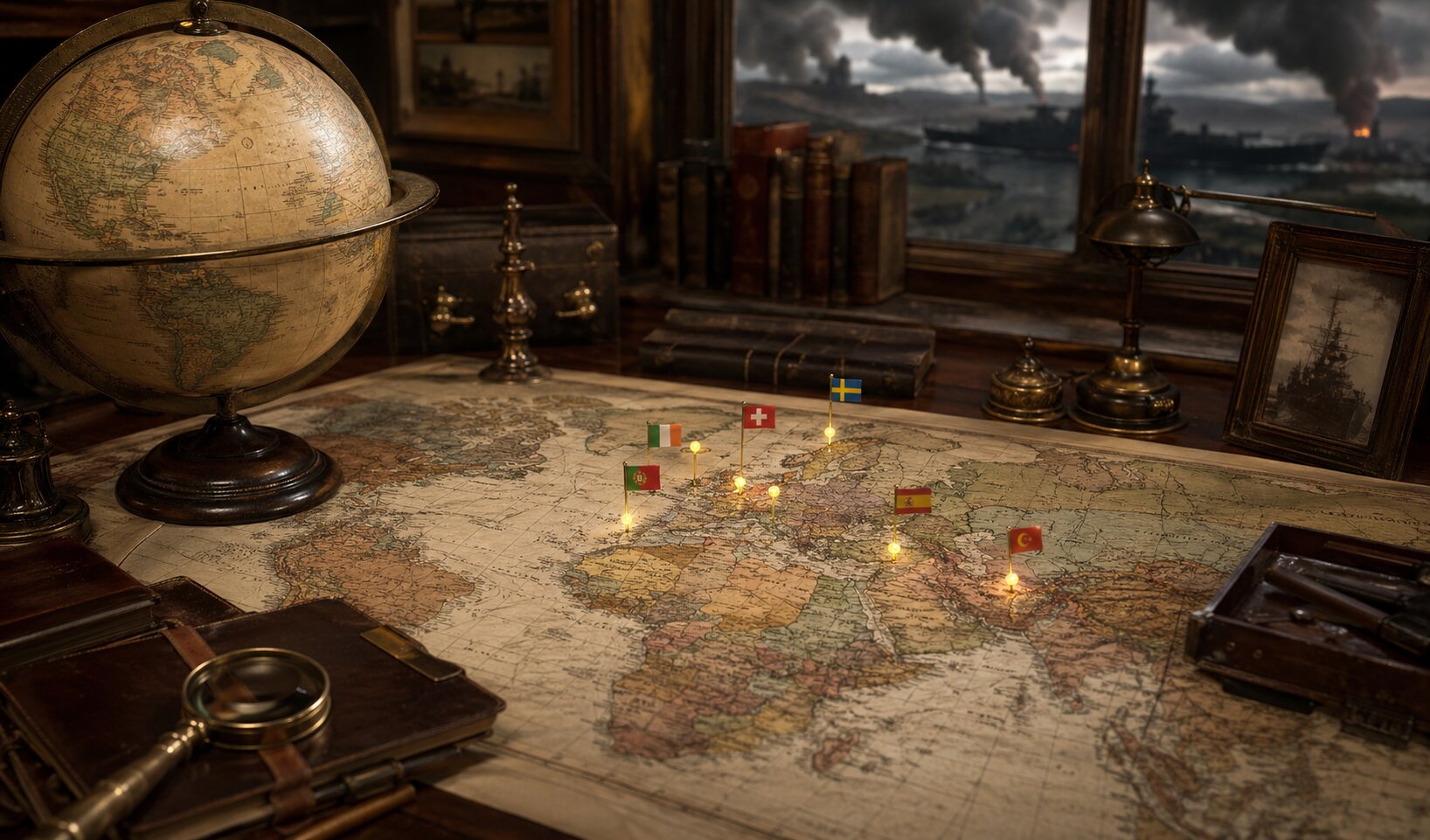
Many countries tried to stay neutral during World War II, but “not involved” is tricky because some neutral countries still traded with belligerents, allowed limited military transit, gave refuge, or were pressured by nearby powers.
World War II lasted from 1939 to 1945, and true neutrality became harder as the war expanded.
Major Countries That Stayed Officially Neutral
| Country | Why It Stayed Out | Important Note |
|---|---|---|
| Switzerland | Wanted to protect its independence; had a long tradition of neutrality; was surrounded by Axis-controlled territory and relied on strong defense preparation. | It remained neutral but traded with both sides and was under constant pressure from Nazi Germany. |
| Sweden | Wanted to avoid invasion and protect its population; balanced relations with Germany and the Allies. | It supplied iron ore to Germany early in the war but later helped the Allies more openly. |
| Spain | The country was exhausted after the Spanish Civil War [1936–1939]; Francisco Franco’s government was sympathetic to the Axis but too weak to enter the war. | Spain sent the “Blue Division” volunteers to fight alongside Germany against the Soviet Union, so it was not completely detached. |
| Portugal | Had a long alliance with Britain but wanted to avoid direct war; its dictator António de Oliveira Salazar followed cautious neutrality. | Portugal later allowed the Allies to use bases in the Azores, which helped in the Atlantic war. |
| Ireland | Wanted independence from British foreign policy; many Irish people did not want to fight in another British war. | Ireland remained neutral, though many Irish citizens volunteered for British forces. |
| Turkey | Tried to avoid being pulled into war by either Germany or the Allies; wanted to protect itself geographically between Europe, the Middle East, and the Soviet Union. | Turkey declared war on Germany and Japan only in February 1945, near the end, mainly to join the postwar order. |
| Afghanistan | Remote location, limited military power, and desire to avoid foreign domination. | It stayed neutral throughout the war. |
| Saudi Arabia | Limited military capacity and desire to avoid regional instability. | It declared war on Germany and Japan in 1945, very late in the war. |
| Yemen | Isolated and less connected to the main theaters of war. | It remained largely outside the conflict. |
| Tibet | Geographically isolated and politically separate in practice at the time. | It stayed neutral, though its international status was complicated. |
| Andorra, Liechtenstein, San Marino, Monaco | Small states with limited military capacity; survival depended on avoiding conflict. | Some were affected by nearby occupation or pressure from larger powers. |
Neutral Countries in the Americas
Many Latin American countries were neutral at first, but several eventually joined the Allies, especially after pressure from the United States and after Axis submarine activity in the Atlantic.
Some countries stayed neutral for most of the war or entered only at the very end.
| Country | Why It Stayed Out or Delayed Entry |
|---|---|
| Argentina | Had strong internal divisions, economic ties with both sides, and military leaders who wanted neutrality. It declared war on Germany and Japan only in March 1945. |
| Chile | Tried to maintain trade and avoid conflict; broke relations with the Axis in 1943 and declared war on Japan in 1945. |
| Paraguay | Limited strategic role and desire to avoid foreign entanglement; declared war very late. |
Why Countries Stayed Neutral
1. Fear of invasion
Small or strategically exposed countries knew that joining one side could trigger immediate attack.
Switzerland, Sweden, Portugal, Ireland, and Turkey all had to think carefully about survival.
2. Military weakness
Some countries did not have the military strength to fight a major world power.
For them, neutrality was not idealism; it was self-preservation.
3. Economic survival
Neutral countries often depended on trade with both sides.
Sweden sold iron ore, Switzerland handled financial transactions, and Portugal had resources and Atlantic bases that both sides cared about.
4. Recent trauma
Spain had just gone through a brutal civil war.
Its economy, military, and society were too damaged for another major conflict.
5. Geography
Some countries were far from the main fighting zones.
Afghanistan, Yemen, and some Latin American countries had fewer direct reasons to enter.
6. Political balancing
Some governments sympathized with one side but feared the cost of joining.
Spain leaned toward the Axis, while Portugal leaned toward Britain, but both avoided full entry.
Important Clarification
Neutral did not always mean morally neutral or completely uninvolved.
Some “neutral” countries helped one side more than the other, accepted refugees, traded strategic materials, allowed intelligence activity, or declared war only when the outcome was already clear.
So the better answer is: many countries avoided direct military participation, but very few were completely untouched by World War II.