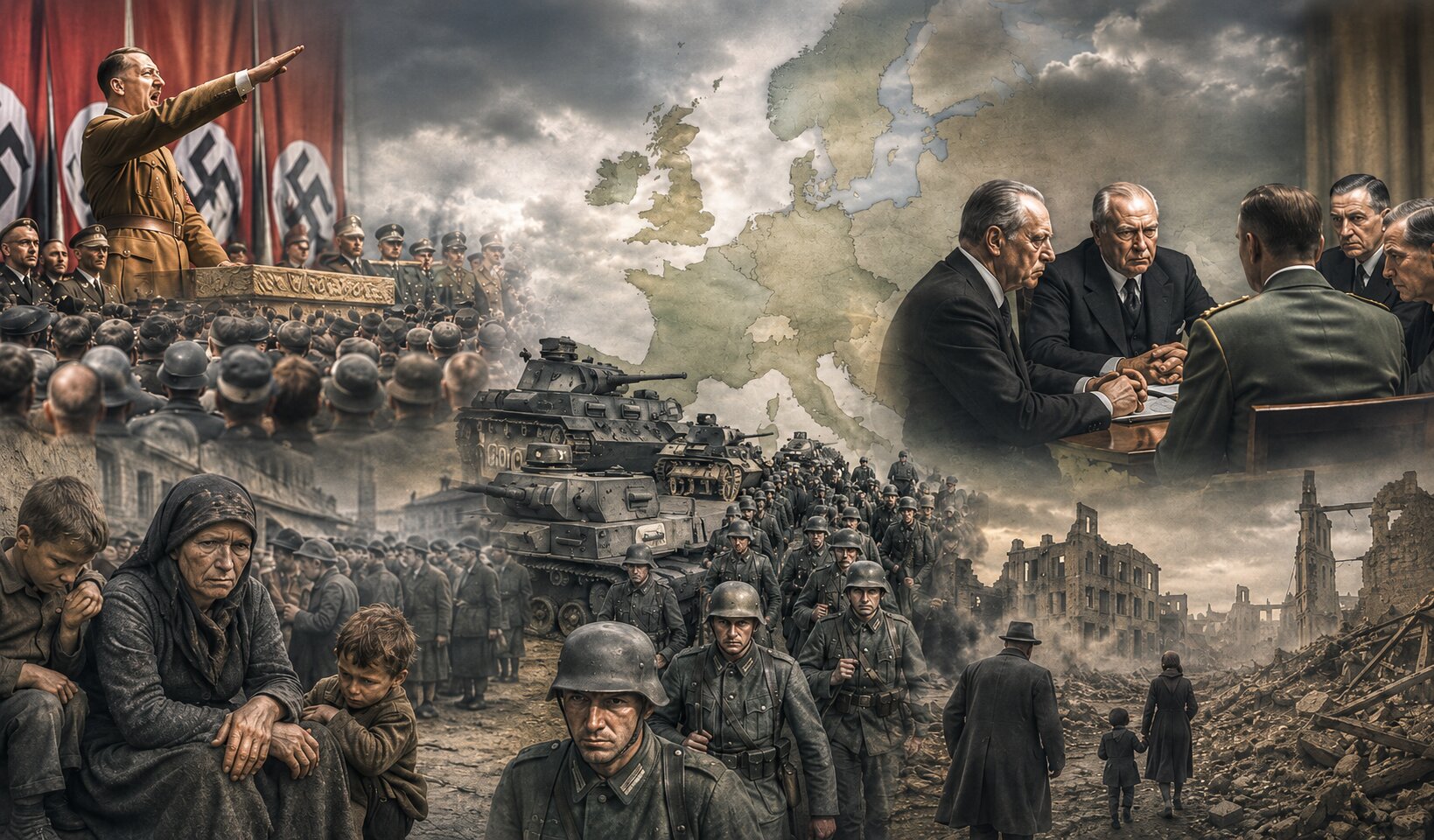
World War II did not begin because of one single event. It was the result of many political, economic, military, and ideological failures after World War I.
1. The Treaty of Versailles created anger in Germany
After World War I, Germany was forced to accept blame for the war, pay heavy reparations, give up territory, and reduce its military.
Many Germans felt humiliated and betrayed.
Adolf Hitler used this anger to gain support by promising to restore Germany’s pride, rebuild the military, and reverse the treaty.
2. The Great Depression created desperation
The Great Depression of the 1930s caused massive unemployment, poverty, and fear across the world.
In Germany, the economic crisis helped extremist parties grow.
People who were desperate for stability became more willing to support strong leaders who promised jobs, order, and national greatness.
3. Rise of dictatorships
Several aggressive dictators came to power before World War II:
Germany: Adolf Hitler and the Nazi Party
Italy: Benito Mussolini and the Fascist Party
Japan: Militarist leaders who wanted to expand Japan’s empire in Asia
These leaders believed in military strength, nationalism, expansion, and obedience to the state.
4. Failure of the League of Nations
The League of Nations was created after World War I to prevent another major war.
But it had no strong military power and could not stop aggressive countries.
When Japan invaded Manchuria, Italy invaded Ethiopia, and Germany began expanding, the League failed to take serious action.
This made dictators believe they could act without consequences.
5. Appeasement encouraged Hitler
Britain and France followed a policy called appeasement.
That means they allowed Hitler to take certain actions, hoping this would avoid another war.
For example, they allowed Germany to take the Sudetenland from Czechoslovakia in 1938.
Instead of satisfying Hitler, appeasement made him more confident.
6. German expansionism
Hitler wanted more land for Germany, especially in Eastern Europe.
He called this idea Lebensraum, meaning “living space.”
Germany rebuilt its military, occupied the Rhineland, annexed Austria, took parts of Czechoslovakia, and finally invaded Poland.
The invasion of Poland on September 1, 1939, directly triggered World War II in Europe.
7. Japanese expansion in Asia
Japan wanted natural resources, markets, and territory.
It invaded Manchuria in 1931 and expanded deeper into China in 1937.
Japan’s aggression eventually brought it into conflict with the United States, Britain, China, and other powers.
The attack on Pearl Harbor on December 7, 1941, brought the United States fully into World War II.
8. Italian aggression
Italy wanted to rebuild something like the old Roman Empire.
Mussolini invaded Ethiopia in 1935 and later joined forces with Hitler.
Italy’s aggression added to the instability in Europe and strengthened the Axis alliance.
9. Weakness of democratic countries after World War I
Britain, France, and the United States were tired of war.
Many people did not want another conflict.
This made democratic governments slow to confront dictators early, when they might have been easier to stop.
10. Extreme nationalism and racism
World War II was also driven by dangerous ideologies.
Nazi Germany promoted racism, antisemitism, and the belief that some groups were superior to others.
Japanese militarists believed Japan had the right to dominate Asia.
These ideologies justified conquest, violence, and mass suffering.
The immediate cause
The immediate cause of World War II was Germany’s invasion of Poland on September 1, 1939.
Two days later, on September 3, 1939, Britain and France declared war on Germany.
In simple terms
World War II happened because the peace after World War I was unstable, the Great Depression made people desperate, dictators came to power, aggressive countries expanded, and other nations failed to stop them early.
The war was caused by a dangerous combination of humiliation, economic crisis, weak international response, militarism, nationalism, racism, and territorial ambition.