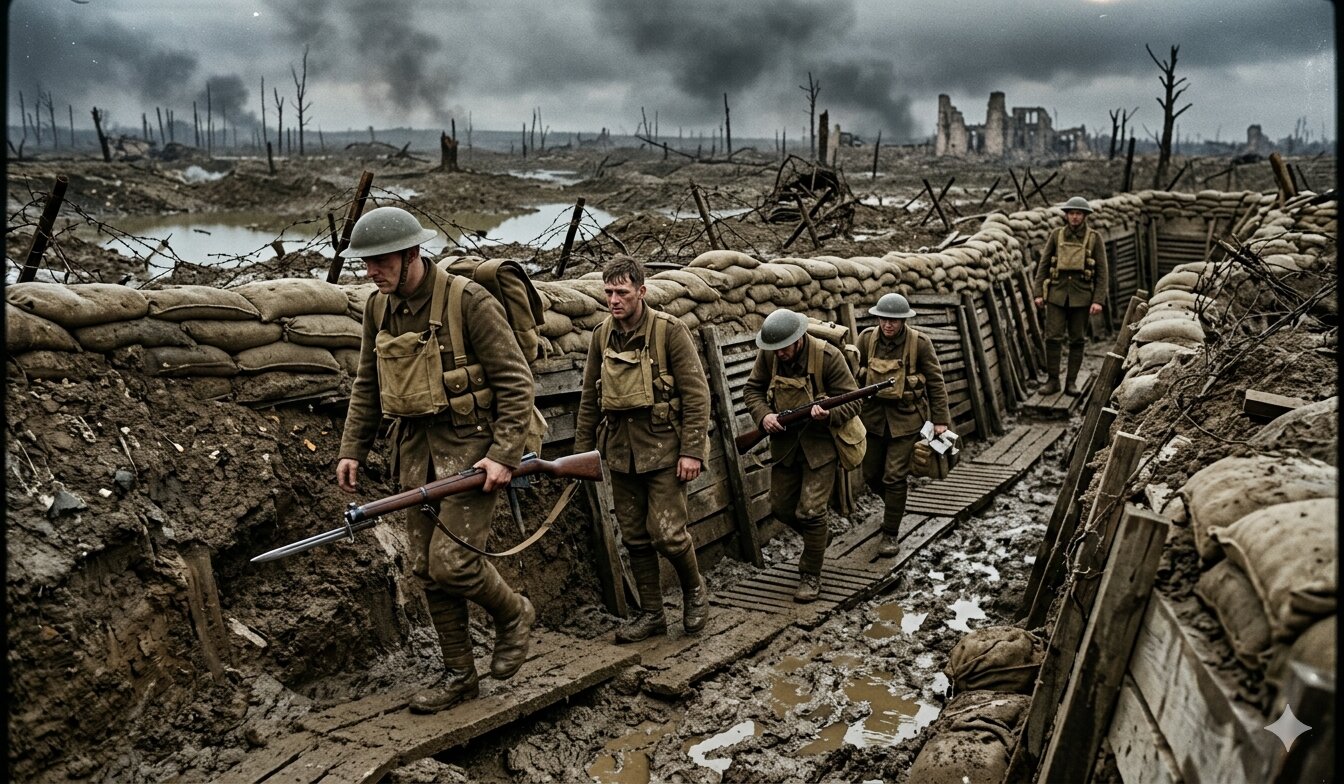
World War I began in 1914, but its causes had been building for many years.
The simplest way to understand it is this: Europe had become a place full of tension, pride, fear, weapons, alliances, and unresolved conflicts. One assassination lit the match.
1. Militarism
Many European countries were building large armies and navies before the war.
Germany, Britain, France, Russia, and Austria-Hungary all believed military strength was necessary for survival and prestige.
This created a dangerous mindset: countries began preparing for war so intensely that war started to feel almost inevitable.
2. Alliance System
Europe was divided into rival alliances.
One side included Germany, Austria-Hungary, and Italy, known as the Triple Alliance.
The other side included France, Russia, and Britain, known as the Triple Entente.
These alliances meant that a conflict between two countries could quickly pull in many others.
That is exactly what happened after Austria-Hungary moved against Serbia.
3. Imperialism
European powers were competing for colonies, resources, and global influence.
Britain and France already had large empires.
Germany, which had unified later, wanted more colonies and more international power.
This competition created jealousy, suspicion, and rivalry, especially between Germany and Britain, and between Germany and France.
4. Nationalism
National pride was very strong across Europe.
Many countries believed they were superior or deserved more power.
In the Balkans, nationalism was especially explosive.
Serbian nationalists wanted to unite Slavic peoples, including those living inside Austria-Hungary.
Austria-Hungary saw this as a threat to its empire.
5. The Balkan Crisis
The Balkans were one of the most unstable regions in Europe.
The Ottoman Empire was weakening, and different groups wanted independence or control.
Serbia wanted to expand its influence.
Austria-Hungary wanted to stop Serbian nationalism from spreading.
Russia supported Serbia because of shared Slavic identity and political interests.
This made the Balkans a dangerous flashpoint.
6. Assassination of Archduke Franz Ferdinand
The immediate cause of World War I was the assassination of Archduke Franz Ferdinand, heir to the Austro-Hungarian throne.
He was killed on June 28, 1914, in Sarajevo by Gavrilo Princip, a Bosnian Serb nationalist.
Austria-Hungary blamed Serbia and issued a harsh ultimatum.
When Serbia did not fully accept all demands, Austria-Hungary declared war on Serbia.
7. The Chain Reaction
After Austria-Hungary declared war on Serbia, the alliance system pulled other countries in.
Russia supported Serbia.
Germany supported Austria-Hungary.
France supported Russia.
Germany invaded Belgium to attack France.
Britain then entered the war because Belgium’s neutrality had been violated.
What began as a regional conflict became a world war.
In Simple Terms
The causes of World War I can be remembered with the word MAIN:
M — Militarism
A — Alliances
I — Imperialism
N — Nationalism
The assassination of Franz Ferdinand was the spark, but the deeper causes were the tensions already built into Europe’s political system.
Final Summary
World War I happened because European countries were heavily armed, divided into alliances, competing for empire, filled with nationalist pride, and deeply suspicious of one another.
The assassination in Sarajevo did not create all these problems.
It simply triggered a crisis that Europe’s leaders failed to control.