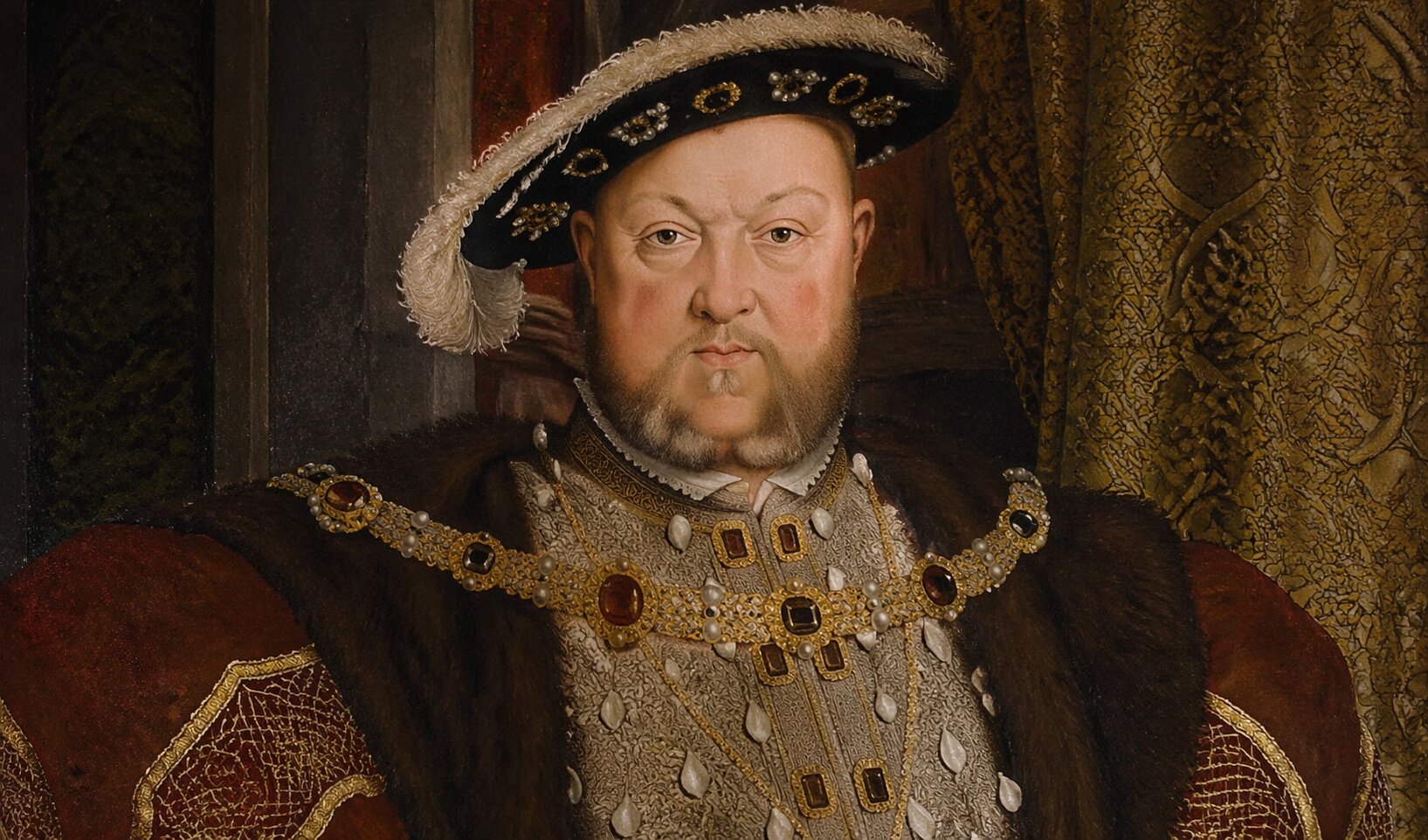
Few kings in history have become as famous for their marriages as Henry VIII of England.
When most people hear his name, they do not first think of government, war, or religion.
They think of the six women who became his queens, and of the strange, dramatic, and often tragic ends that awaited them.
Henry VIII’s love life was not just royal gossip.
It changed the history of England.
His desire for a male heir, his frustration with marriage, and his determination to bend both church and law to his will helped trigger the English Reformation, broke England away from the authority of the Pope, and altered the destiny of the monarchy forever.
His six wives are often remembered through the famous rhyme: divorced, beheaded, died, divorced, beheaded, survived.
But behind that simple line lies a much more fascinating story filled with ambition, fear, romance, political intrigue, humiliation, endurance, and survival.
This is the story of Henry VIII and the fate of his six wives.
The King Who Wanted an Heir
Henry VIII was born in 1491 and became king in 1509.
He was young, athletic, handsome, intelligent, and full of confidence.
In the early years of his reign, he looked every bit the golden prince.
He loved music, hunting, dancing, and displays of royal magnificence.
He also believed deeply in the importance of dynasty.
For a king, marriage was never just about affection.
It was about power, alliances, and above all, producing a male heir.
The Tudor dynasty was still relatively new.
Henry’s father, Henry VII, had won the throne only after years of civil conflict known as the Wars of the Roses.
That meant the royal line still felt insecure.
Henry VIII believed he needed a legitimate son to secure the future of the kingdom.
That desire shaped the lives of every woman he married.
Wife One: Catherine of Aragon
Henry’s first wife was Catherine of Aragon.
She was no ordinary bride.
Catherine was the daughter of two of the most powerful monarchs in Europe, Ferdinand of Aragon and Isabella of Castile, the rulers who had united Spain and sponsored Christopher Columbus.
She had first come to England to marry Henry’s older brother, Arthur.
But Arthur died only months after their marriage.
To preserve the alliance with Spain, Catherine later married Henry after he became king.
At first, theirs seemed like a strong and respectable marriage.
Catherine was intelligent, dignified, educated, and deeply religious.
She was also politically capable.
When Henry went to war in France, Catherine even acted as regent in England.
She was admired by many and carried herself with the calm authority of a true queen.
The great problem was succession.
Catherine became pregnant several times, but most of her children either died before birth or in infancy.
Only one child survived: a daughter, Mary, who would later become Queen Mary I.
Henry grew increasingly obsessed with the lack of a son.
Over time, his disappointment turned into resentment.
He began to convince himself that the marriage was cursed.
Because Catherine had once been married to his brother, Henry argued that the union had violated divine law.
He quoted scripture to support his claim that a man who married his brother’s widow would remain childless.
Whether this was sincere religious anxiety or a convenient excuse is still debated, but one thing is clear: Henry wanted out.
By this time, he had become captivated by another woman at court, Anne Boleyn.
Catherine, however, refused to step aside quietly.
She insisted that her marriage to Arthur had never been fully consummated and that her marriage to Henry was lawful and valid.
She would not agree to an annulment.
What followed became known as the King’s Great Matter.
Henry tried for years to persuade the Pope to cancel the marriage, but the Pope refused.
The issue dragged on, frustrated Henry, and eventually pushed him toward a historic break with Rome.
In the end, Henry had Catherine removed from court and stripped of her status as queen.
She was isolated from her daughter Mary and forced to live apart from the royal center of power.
She never accepted Henry’s second marriage, never admitted that she had ceased to be queen, and remained steadfast to the end.
Catherine died in 1536.
Though she had been cast aside, history has often remembered her with sympathy and respect.
She lost her crown, but never her dignity.
Wife Two: Anne Boleyn
Anne Boleyn was perhaps the most famous of Henry’s wives.
She was not a foreign princess like Catherine.
She was an English noblewoman, clever, lively, fashionable, and unlike many women at court, unwilling to become merely the king’s mistress.
That refusal seems to have increased Henry’s desire for her.
Anne was witty, cultured, and politically aware.
She had spent time in the courts of Europe and brought with her a sophistication that made her stand out.
Henry became obsessed.
He wrote her passionate letters and pursued her for years.
She offered something Catherine no longer could: the possibility of a fresh marriage and, Henry hoped, a son.
Anne’s rise was dramatic, but it came at an enormous cost.
To marry her, Henry did something extraordinary.
He rejected papal authority, declared himself supreme head of the Church in England, and created the path for the English Reformation.
This was not simply a romantic decision.
It was a revolution in church and state.
Henry and Anne married in secret in 1533, and she was crowned queen shortly afterward.
But the triumph quickly turned sour.
Instead of a son, Anne gave birth to a daughter, Elizabeth, who would later become one of England’s greatest queens.
For Henry, however, this was not the outcome he wanted.
Anne later suffered miscarriages, including the loss of a male child.
Her position became fragile.
The king’s affection cooled.
Court enemies gathered around her.
Anne had once been the woman Henry would overturn a kingdom for.
Soon she became the woman blamed for his disappointment.
In 1536, Anne was arrested and accused of adultery, incest, and treason.
The charges were sensational.
She was said to have committed adultery with several men, including her own brother, George Boleyn.
Most historians today believe the accusations were either false or wildly exaggerated, created to destroy her and clear the way for Henry to marry again.
Anne was tried, condemned, and taken to the Tower of London.
She was executed by sword, rather than by axe, in May 1536.
She was probably in her mid-thirties.
Her downfall was as swift as her rise.
Anne Boleyn’s story remains one of the most haunting in English history.
She helped change the religious future of England, gave birth to Elizabeth I, and yet died disgraced by the same king who had once pursued her so fiercely.
Wife Three: Jane Seymour
Just days after Anne Boleyn’s execution, Henry became engaged to Jane Seymour.
The speed alone tells a grim story.
Jane had served as a lady-in-waiting to both Catherine of Aragon and Anne Boleyn.
Compared with Anne, she seemed quieter, gentler, and more conventional.
Whether she was truly meek or simply more cautious is hard to say, but Henry appears to have found her comforting after the storms of his second marriage.
Jane did what Catherine and Anne had not been able to do.
In 1537, she gave birth to a son, Edward.
At last, Henry had the male heir he had long desired.
This achievement elevated Jane in Henry’s memory above all his other wives.
But her triumph was brief.
Not long after giving birth, Jane fell ill, most likely from complications related to childbirth.
She died twelve days later.
She was the only one of Henry’s wives to give him the son he desperately wanted, and she was the only wife he seems to have remembered without bitterness.
Henry was genuinely affected by her death.
When he himself died in 1547, he was buried beside Jane.
In death, she received an honor none of the others did.
Her fate was the shortest and perhaps the saddest in a different way.
She got the crown, gave the king his heir, and then lost her life almost immediately afterward.
Wife Four: Anne of Cleves
After Jane’s death, Henry remained unmarried for a time.
But politics again demanded a match.
England’s religious and diplomatic position was uncertain, and Thomas Cromwell, Henry’s chief minister, promoted a marriage alliance with the German duchy of Cleves.
The chosen bride was Anne of Cleves.
Henry agreed after seeing a flattering portrait painted by Hans Holbein.
That portrait has become famous because it set up one of history’s most awkward royal meetings.
When Anne arrived in England in 1540, Henry was deeply disappointed.
Whether Anne was truly less attractive than expected or whether Henry simply reacted badly because of his own age, health, and vanity, the result was the same.
He found her unappealing and resented the match.
The marriage went ahead anyway, but Henry quickly sought to escape it.
Unlike Catherine of Aragon, Anne of Cleves did not fight.
She accepted the annulment with practicality and good sense.
That decision likely saved her life.
The marriage was declared invalid on the grounds that it had never been properly consummated and because of Anne’s prior contractual obligations elsewhere.
Anne was given a generous settlement, multiple residences, and the respectful title of the king’s “beloved sister.”
She remained in England, lived comfortably, and stayed on surprisingly good terms with Henry and even with his children.
In many ways, Anne of Cleves was the wisest survivor of the six.
She recognized the danger of resistance and chose security over status.
Her marriage to Henry lasted only about six months, but she outlived him.
Among all his wives, she handled disaster with perhaps the greatest practical intelligence.
Wife Five: Catherine Howard
If Anne of Cleves represented caution, Catherine Howard represented youthful recklessness, or perhaps youthful vulnerability in a deadly court.
Catherine Howard was very young, probably a teenager, when she married Henry in 1540.
Henry, by then, was aging, overweight, and increasingly unhealthy.
He found in Catherine a kind of renewed excitement.
She was lively, charming, and much younger than he was.
To Henry, she seemed like a return to youth.
He called her his “rose without a thorn.”
But Catherine’s past, and perhaps her conduct as queen, soon became dangerous.
Before marriage, she had been involved in relationships that later became the subject of scandal.
Worse still, while queen, she appears to have engaged in secret meetings with Thomas Culpeper, one of the king’s courtiers.
Whether this relationship was adulterous in the full sense remains debated, but in Henry’s court even suspicion could be fatal.
Once accusations surfaced, Catherine’s position collapsed.
The king was devastated and furious.
Parliament passed a bill making it treason for a queen to conceal unchaste conduct before marriage.
Catherine was arrested, stripped of honor, and imprisoned in the Tower.
In 1542, she was executed.
She was likely only around nineteen or twenty years old.
Her fall is especially tragic because of her youth.
Some historians see her as foolish.
Others see her as a vulnerable young woman raised in a careless environment and then thrown into one of the most dangerous courts in Europe.
Either way, she became another victim of Henry’s brutal world.
Wife Six: Catherine Parr
Henry’s final wife was Catherine Parr.
She was very different from Catherine Howard.
Mature, educated, thoughtful, and twice widowed, Catherine Parr entered marriage with experience and intelligence.
By the time she married Henry in 1543, the king was older, ill, and difficult.
His leg ulcer caused him constant pain, and his temper had become more frightening.
Marrying him at this stage required tact, patience, and political skill.
Catherine Parr had all three.
She became less a romantic partner and more a nurse, companion, and stabilizing presence.
She helped reconcile Henry with his daughters Mary and Elizabeth, which proved significant for the future succession.
She also took an interest in religion and learning, and she published works under her own name, something unusual for a queen at the time.
But even Catherine Parr was not entirely safe.
Her religious opinions leaned toward Protestant reform, and these views made her enemies.
At one point, there was a serious attempt to arrest her for her beliefs.
Catherine managed to save herself with a mixture of humility and intelligence.
When Henry challenged her in conversation, she presented herself not as a theological rival but as a loving wife seeking only to distract and comfort him.
The strategy worked.
She survived.
That single fact makes her stand out.
In a court where queens could be discarded, disgraced, or killed, Catherine Parr lived through the marriage and outlasted the king.
After Henry’s death, she married Thomas Seymour, the brother of Jane Seymour.
But even her later life was not entirely peaceful.
She died in 1548 after childbirth.
Still, in the context of Henry’s wives, she is remembered as the one who survived the king himself.
What the Six Wives Reveal About Henry VIII
The story of the six wives is also the story of Henry himself.
At the start of his reign, he appeared promising, energetic, and admired.
Over time, he became suspicious, authoritarian, self-justifying, and increasingly cruel.
His marriages reflect that transformation.
His early desire for a secure dynasty became an obsession.
His charm hardened into ego.
His confidence became tyranny.
He demanded loyalty, but gave little mercy.
He wanted love, obedience, fertility, and political usefulness all at once.
Any wife who failed to satisfy those demands risked ruin.
Yet Henry was not a cartoon villain.
He was a complex ruler living in a brutal age.
Kingship in the sixteenth century was inseparable from succession, religion, and state survival.
That does not excuse his conduct, but it helps explain why marriage for him was never merely personal.
Still, the wreckage left behind is undeniable.
Two wives were executed.
Two were cast aside.
One died after delivering what he most wanted.
Only one escaped him alive.
That is not just a romantic disaster.
It is a portrait of power without restraint.
Why the Story Still Fascinates Us
Henry VIII and his six wives continue to fascinate because the story has everything.
It has love, betrayal, ambition, religion, sex, power, politics, and death.
It reads at times like a historical epic and at times like a psychological drama.
There is also something timeless in it.
The wives represent different human responses to power: resistance, ambition, patience, adaptation, recklessness, and intelligence.
Henry represents the danger of unchecked authority combined with personal obsession.
And because the consequences were not confined to the palace, the story matters far beyond gossip.
These marriages changed England.
They affected the church, the crown, the succession, foreign alliances, and the future of Europe.
The fate of six women became entangled with the fate of a nation.
Final Thoughts
Henry VIII is remembered as the king with six wives.
But that phrase, repeated so casually, should never make us forget the human cost behind it.
Catherine of Aragon lost her crown but kept her honor.
Anne Boleyn won a kingdom-changing marriage and lost her head.
Jane Seymour gave Henry his son and died almost immediately after.
Anne of Cleves turned royal rejection into a comfortable survival.
Catherine Howard rose young and fell young.
Catherine Parr used intelligence and tact to outlive one of history’s most dangerous husbands.
Together, the six wives form one of the most unforgettable chapters in royal history.
Their lives were shaped by one king’s desires, but their stories became far larger than him.
In the end, Henry VIII may have held the crown, but it is the fate of his six wives that has immortalized his reign.