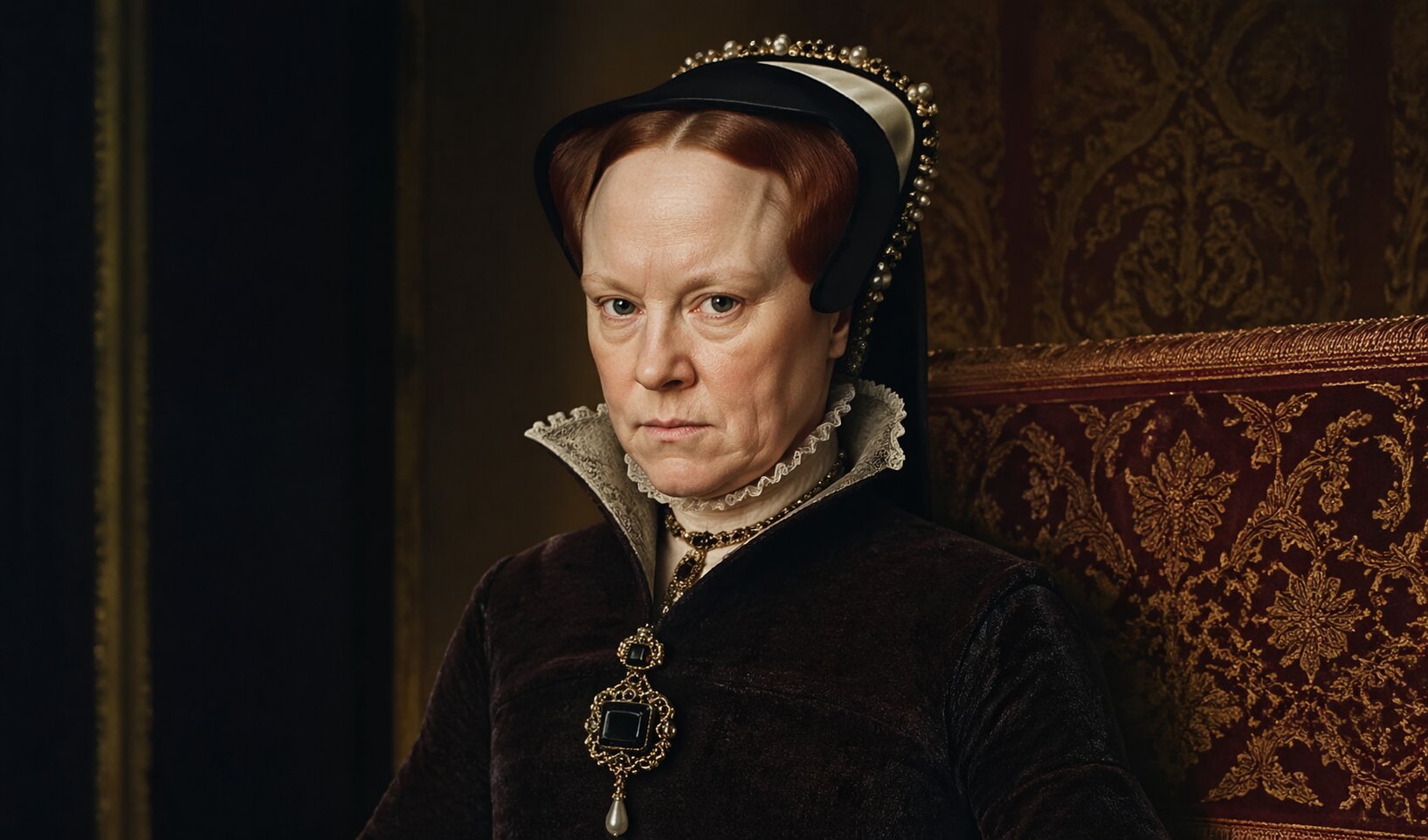
The Girl Born for Glory
Mary Tudor entered the world in 1516 as a princess of enormous importance.
She was the daughter of King Henry VIII of England and his first wife, Catherine of Aragon, and for a time she seemed destined for a brilliant and secure future.
She was intelligent, well educated, musically talented, and raised with the dignity expected of a future queen.
As a child, she was admired across Europe.
Foreign ambassadors praised her manners, her learning, and her seriousness, and many believed she would become one of the most important royal women of her age.
But Mary was born into a palace where love could turn into danger overnight.
Her father’s hunger for a male heir, and later his hunger for control, would tear apart her family, her faith, and her peace of mind.
The little princess who was once cherished would grow into a woman shaped by humiliation, fear, and loss.
That suffering would leave deep marks on the queen history remembers as Bloody Mary.
A Father Changes Everything
For many years, Henry VIII was married to Catherine of Aragon, and Mary was their only surviving child.
That fact haunted Henry.
He wanted a son to secure the Tudor dynasty, and when Catherine could not give him one, he began looking for a way out of the marriage.
His desire soon became obsession.
Henry convinced himself that his marriage had displeased God and that this was why he had no surviving male heir.
He asked the Pope to annul the marriage.
When the Pope refused, Henry did something revolutionary.
He broke from the Roman Catholic Church and declared himself head of the Church of England.
This was not merely a family argument.
It was a political and religious earthquake.
Mary’s world collapsed with it.
Her mother was cast aside.
Anne Boleyn, Henry’s new love, took Catherine’s place.
Mary, once the king’s beloved daughter, was declared illegitimate.
She was no longer treated as a princess in the full sense.
She was separated from her mother and forbidden from seeing her.
That wound never really healed.
Mary adored Catherine of Aragon.
She saw her as the true queen, a noble and pious woman cruelly wronged.
To Mary, her father’s actions were not just unjust.
They were sinful.
And from that moment on, religion, family pain, and royal authority became tangled together in her soul.
The Princess Who Was Forced to Bend
Mary did not surrender easily.
She refused to accept that her mother’s marriage had been invalid.
She refused to acknowledge Anne Boleyn as queen.
She refused, at first, to submit to the religious changes that had stripped the Pope of power in England.
That refusal was dangerous.
Henry VIII could be generous, but he could also be terrifying.
Mary endured intense pressure.
She was threatened, isolated, and made to understand that resistance could cost her everything, perhaps even her life.
Eventually, she signed documents acknowledging her father as supreme head of the Church of England and admitting that she had been born illegitimate.
It was one of the most bitter defeats of her life.
She signed, but she did not forget.
The humiliation sank deep into her heart.
Mary learned that survival in the Tudor court sometimes required outward surrender and inward silence.
She also learned to distrust those in power, even those closest to her.
That lesson would stay with her long after her father died.
The Shadow of Younger Siblings
Anne Boleyn eventually gave Henry a daughter, Elizabeth.
Later, after more marriages, Henry finally had the son he wanted, Edward.
Mary’s place in the royal family became even more fragile.
She was older than both Elizabeth and Edward, yet politics kept shifting around her.
Under Henry’s later years, Mary’s status improved somewhat, and she was restored to the line of succession, though not declared legitimate.
Still, she remained deeply committed to Catholicism, even as England moved farther into Protestant reform.
When Henry died in 1547, the crown passed to young Edward VI.
Edward was firmly Protestant, and under his rule England became even more aggressively Protestant.
For Mary, this was a second wound.
The religion she loved, the religion of her mother, was being dismantled before her eyes.
Yet Mary did not hide her beliefs.
She openly heard Catholic Mass in her household.
This angered Edward’s government, which wanted religious uniformity.
She resisted again, and once again she lived under political pressure.
But by now Mary was no longer a helpless child.
She was a determined adult with royal blood, foreign connections, and a strong sense of divine duty.
A Crown Almost Stolen
Edward VI fell gravely ill in his teens.
Because he was Protestant and feared that his Catholic half-sister Mary would undo the Reformation, he and his advisers tried to block her from the throne.
Instead, they named Lady Jane Grey as Edward’s successor.
Jane was intelligent, noble, and tragically caught in a power game larger than herself.
For a few dramatic days in July 1553, Jane was proclaimed queen.
But Mary moved quickly.
She did not hide.
She rode into action.
Gathering supporters from East Anglia, she called on nobles, officials, and ordinary people to back her lawful claim.
It was one of the most remarkable moments of her life.
The woman who had spent years being pushed aside suddenly became the center of national resistance.
The country rallied to her.
Support for Jane collapsed.
Mary entered London in triumph.
Crowds welcomed her with excitement and relief.
At last, after years of insult and uncertainty, she was queen.
She was the first woman to rule England in her own right and actually be crowned as such.
It was a historic victory.
For Mary, it must have felt like justice.
The wronged daughter had finally risen.
The Queen with a Mission
Mary did not see her crown as a prize.
She saw it as a duty given by God.
She believed she had been spared and elevated for a reason.
That reason, in her mind, was to restore England to the Catholic faith.
She believed Protestantism had led England into error and rebellion.
She believed souls were at stake.
To modern minds, religion is often treated as a private matter.
To sixteenth-century rulers, religion was the foundation of society, morality, and eternal salvation.
Mary was not trying, in her own eyes, to be cruel for cruelty’s sake.
She believed she was saving her kingdom from spiritual disaster.
That conviction made her dangerous.
A ruler who believes she is carrying out God’s work can justify terrible things.
Mary reversed Protestant laws and reestablished papal authority.
Catholic worship returned.
Old practices were revived.
For conservative Catholics, this felt like healing.
For Protestants, it felt like fear closing in.
And then came the decision that would define her name forever.
Why She Became “Bloody Mary”
Mary ordered the persecution of Protestants who refused to return to Catholicism.
Under laws against heresy, hundreds were arrested.
Many were burned at the stake.
Among the victims were ordinary men and women, as well as prominent Protestant bishops such as Hugh Latimer, Nicholas Ridley, and Thomas Cranmer.
The burnings shocked the country.
Execution by fire was public, slow, and horrifying.
It did not merely punish the condemned.
It made a spectacle of terror.
Mary and her advisers likely thought such punishments would crush resistance and restore obedience.
Instead, they created martyrs.
Stories of the burnings spread widely.
Later, Protestant writer John Foxe would immortalize these victims in accounts that deeply shaped English memory.
That memory was devastating for Mary.
Other Tudor rulers also killed opponents.
Her father Henry VIII executed Catholics and Protestants.
Her sister Elizabeth I later executed Catholics seen as threats.
But Mary’s persecutions became especially infamous because of their scale, their method, and the power of Protestant storytelling afterward.
The name Bloody Mary was born not simply from what she did, but from how history chose to remember it.
Still, the blood was real.
Around 280 Protestants were burned during her reign.
That number was enough to stain her forever.
The Marriage That England Feared
Mary also faced enormous pressure to marry.
A queen without a husband or child raised dangerous questions about succession and political stability.
Mary chose Philip of Spain, son of the powerful Holy Roman Emperor Charles V.
It made sense politically.
Philip was Catholic, royal, and connected to one of the strongest dynasties in Europe.
But the match was deeply unpopular in England.
Many feared that England would become a puppet of Spain.
Many disliked the idea of a foreign prince influencing English politics.
Many simply did not want their queen overshadowed.
A rebellion broke out in 1554 under Sir Thomas Wyatt.
The rebels partly aimed to stop the Spanish marriage.
Mary responded firmly.
She gave a famous speech at the Guildhall in London, presenting herself as the rightful queen and defender of the realm.
It was one of her strongest public moments.
She showed courage and political instinct.
The rebellion failed.
Lady Jane Grey, who had been left alive after her brief claim to the throne, was now seen as too dangerous to spare.
Mary ordered her execution.
Jane was young, intelligent, and, by many accounts, innocent of ambition.
Her death added another sadness to Mary’s reign.
Mary married Philip anyway.
But the marriage brought her little happiness.
Philip spent much of his time away.
He treated the union largely as a matter of diplomacy.
Mary loved him far more than he loved her.
That imbalance would become painfully obvious.
The Cruel Hope of Motherhood
One of the greatest tragedies of Mary’s life was her desperate hope for a child.
She longed for an heir.
A son, especially, would secure the Catholic future of England and justify her marriage.
Soon after marrying Philip, Mary seemed to become pregnant.
Her court rejoiced.
Preparations were made.
People waited for the birth.
And waited.
No child came.
It was a false pregnancy.
Whether caused by illness, hormonal disturbance, or deep psychological longing, it was a cruel humiliation.
A second false pregnancy may have followed later.
For a woman whose entire childhood had been shaped by her father’s obsession with producing a male heir, the irony was brutal.
Mary had been rejected because her mother produced no son.
Now Mary herself could not produce the child who might save her religious settlement and secure her place in history.
Her body, like her political fortune, seemed to betray her.
The emotional pain must have been immense.
A Queen Losing Ground
As Mary’s reign continued, problems multiplied.
The burnings did not bring religious unity.
They hardened opposition.
Her marriage did not give her love or security.
It made many English subjects suspicious.
Her hopes for a child dissolved.
England also suffered military and diplomatic embarrassment.
In 1558, England lost Calais, its last possession on the French mainland.
This was a symbolic disaster.
English rulers had held Calais for more than two centuries.
Its loss was a blow to national pride and to Mary’s reputation.
According to legend, Mary later said that when she died, the word Calais would be found written on her heart.
Whether or not she said those exact words, the sentiment captured the mood of defeat surrounding her final months.
By then she was increasingly ill, weary, and disappointed.
She had wanted to restore the old faith, strengthen the crown, bear an heir, and leave England united.
Instead, she found herself isolated, childless, and under growing criticism.
Her Final Days
Mary I died on November 17, 1558, at the age of forty-two.
Her reign had lasted just over five years.
She was succeeded by her half-sister Elizabeth I.
That succession changed everything.
Elizabeth was Protestant, politically gifted, and destined for a long and celebrated reign.
Mary’s work was quickly undone.
England returned to Protestantism.
As Elizabeth’s legend grew, Mary’s reputation darkened even more.
History often loves contrast.
Elizabeth became Gloriana.
Mary became Bloody Mary.
Yet the truth is more complicated than a simple villain on one side and a hero on the other.
Mary was not mad in the childish way later legends sometimes suggest.
She was not merely a monster wandering through history with fire in her hands.
She was a woman formed by a brutal father, a broken childhood, relentless religious conflict, dynastic anxiety, and profound loneliness.
She could be courageous, intelligent, stubborn, and deeply sincere.
She could also be harsh, rigid, and tragically destructive.
Was Mary a Villain or a Victim?
Mary I remains one of the most debated rulers in English history.
Some see her as a cruel fanatic whose persecutions justify every dark word said about her.
Others see her as a tragic queen judged more harshly than male rulers who were equally violent.
Both views contain some truth.
She was a victim of enormous injustice in her youth.
She was humiliated by her father, separated from her mother, denied her status, and forced to betray her conscience.
But suffering does not automatically make a ruler merciful.
When Mary finally had power, she used it in ways that caused fear and death.
That is the central tragedy of her life.
The wounded child became a wounded queen, and the queen tried to heal the nation with fire.
It did not work.
Instead, it turned her into one of history’s darkest symbols.
The Lasting Image of Bloody Mary
Mary I ruled only briefly, but she left a lasting scar on English memory.
Her reign became a warning story about religious extremism, political miscalculation, and the damage that personal pain can do when joined to absolute power.
Yet she was also a pioneer, though not in the way she hoped.
She proved that a woman could claim and hold the English crown in her own right.
She showed courage in the face of conspiracies and rebellion.
She governed in a world that doubted female authority at every turn.
But those achievements are almost always overshadowed by the flames of Smithfield and the victims of her religious policy.
That is why Mary I still fascinates people.
She was not a simple tyrant.
She was a tragic queen whose wounds became part of her rule.
And that is what makes her story unforgettable.