Imagine you are standing on a busy street in ancient Athens.
Merchants are shouting. Politicians are scheming. Fortunes are rising and collapsing. People are chasing pleasure, status, safety, and applause—just as they do now.
And in the middle of all that noise, a man begins teaching something strange.
He tells people that peace does not come from controlling the world.
It comes from controlling themselves.
That man was Zeno of Citium, and what he began around 300 BCE would grow into one of the toughest, clearest, and most practical philosophies ever built: Stoicism.
Stoicism was born in Greece, sharpened in Rome, and tested in the real world—not in quiet classrooms, but in courts, battlefields, exile, political betrayal, grief, illness, and death.
That is why it still matters.
Stoicism does not promise comfort.
It promises strength.
It does not tell you life will be easy.
It teaches you how not to fall apart when life is hard.
Where Stoicism Began
Zeno did not set out to create a famous philosophy.
Like many turning points in history, this one seems to have started with disaster.
According to tradition, Zeno was a merchant whose life changed after a shipwreck. He lost his cargo, his plans, and the life he thought he was building. Out of that wreckage, he turned toward philosophy.
There is something deeply Stoic about that beginning.
The philosophy itself was born the same way it teaches people to live: when loss comes, do not collapse—learn.
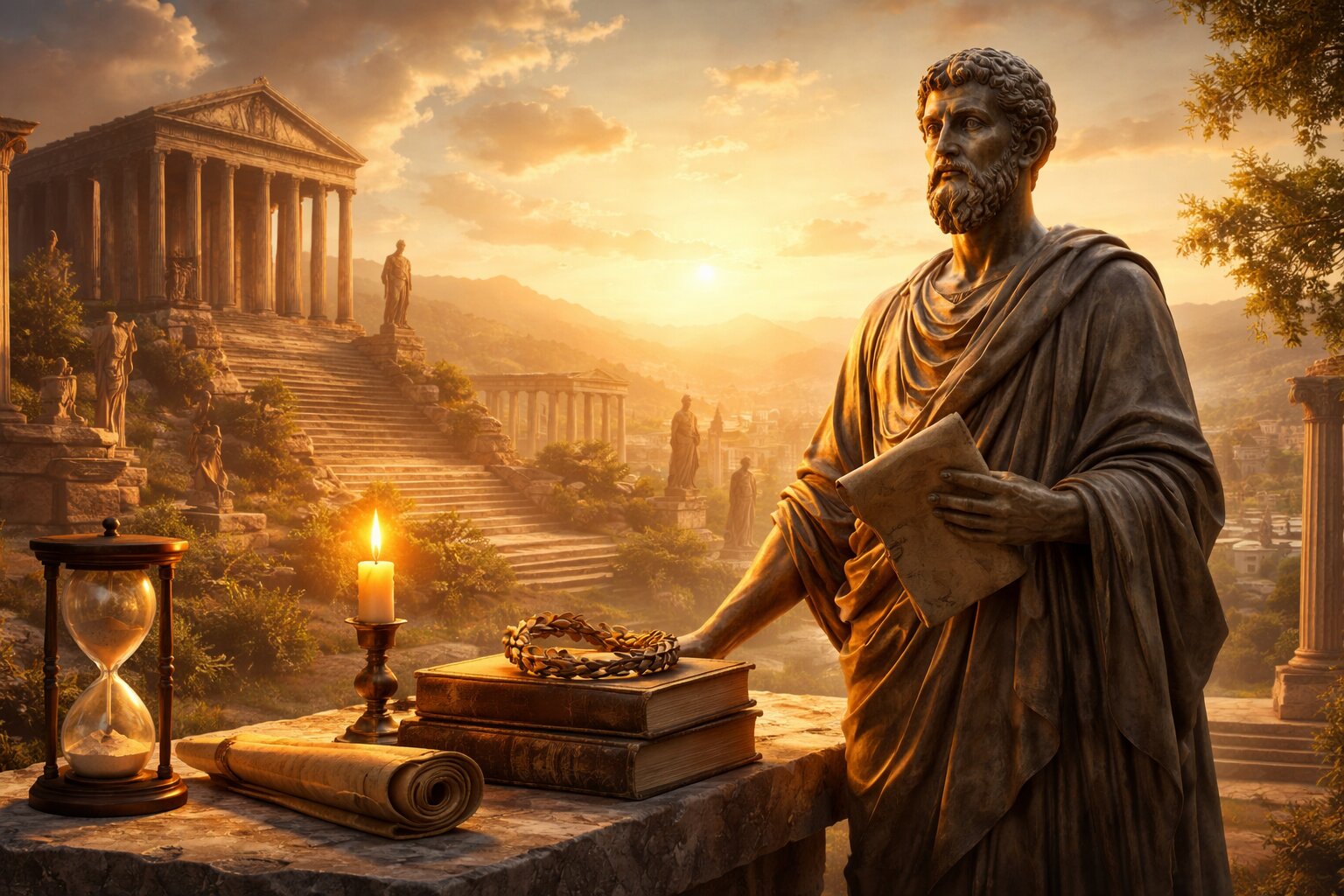
Zeno began teaching in Athens, reportedly near a painted colonnade called the Stoa Poikile. That is where the school got its name.
From that porch came a philosophy that would later shape slaves, statesmen, emperors, soldiers, writers, and ordinary people trying to stay steady in an unstable world.
The Big Idea: Virtue Is the Highest Good
Most people think a good life means having the right circumstances.
Good job. Good health. Good marriage. Good income. Good reputation. Good timing.
Stoicism says that is fragile thinking.
Because if your peace depends on circumstances, then your peace can be taken from you at any moment.
The Stoics built their philosophy on a harder foundation.
They said the highest good is virtue.
Not pleasure.
Not wealth.
Not power.
Not fame.
Virtue, for the Stoics, meant excellence of character. A person lives well not because life is comfortable, but because he or she acts well inside whatever life brings.
That one idea changes the whole map.
The good life is no longer something the world gives you.
It becomes something you build from within.
The Four Pillars of a Stoic Life
The Stoics did not speak vaguely about “being good.” They gave virtue structure.
They emphasized four cardinal virtues:
Wisdom
Wisdom is the ability to see clearly.
It means judging well, thinking carefully, and not being carried away by appearances, gossip, panic, or impulse.
A wise person asks: What is really happening here?
Not: What am I afraid is happening?
Courage
Courage is not loudness. It is not theatrical confidence.
It is the willingness to face pain, fear, uncertainty, embarrassment, or loss without abandoning what is right.
Stoic courage is quiet.
It stands its ground.
Justice
Justice means dealing fairly with others and recognizing that you are part of a larger human community.
For the Stoics, morality was never just private self-improvement. It was also about how you treat other people—honestly, honorably, and with a sense of duty.
Temperance
Temperance is self-command.
It is the ability to resist excess, control appetite, and refuse to become a slave to desire.
In Stoicism, freedom does not mean doing whatever you want.
It means not being ruled by what you want.
Live According to Nature
This is one of the most misunderstood Stoic ideas.
When Stoics said we should live “according to nature,” they did not mean wandering into the woods or rejecting civilization.
They meant living in alignment with reality.
Accepting the way the world actually works.
Accepting that change is constant.
Accepting that people disappoint.
Accepting that bodies age.
Accepting that death is not a glitch in life, but part of life itself.
To live according to nature is to stop demanding that reality behave like your preferences.
That is not passivity.
It is clarity.
And clarity is power.
The Idea That Made Stoicism Famous: Control What You Can
If Stoicism has one principle that still hits people like a slap of cold water, it is this:
Some things are in your control. Some things are not.
That is the Stoic dichotomy of control.
Your judgments, choices, attitudes, actions, and responses—those are yours.
Other people’s opinions, the weather, politics, luck, aging, traffic, betrayal, illness, and most of what happens outside your mind—those are not.
This sounds simple.
It is not.
Most human misery comes from confusing the two.
We try to control what cannot be controlled.
We neglect what can.
We obsess over outcomes, while ignoring character.
We monitor the crowd, while failing to govern ourselves.
Stoicism tells you to bring your attention back home.
Not because the outside world does not matter.
But because your real power begins where your responsibility begins.
Stoicism and the Inner Battlefield
The Stoics understood something modern people often discover too late: the loudest battles are not always external.
A person can have a comfortable house, a stable job, and a functioning life—and still be tortured by anger, envy, anxiety, fear, shame, and restlessness.
Stoicism is, in part, a philosophy of inner observation.
Before mindfulness became a fashionable word, Stoics were already practicing close attention to thought and emotion.
They believed you should notice your reactions before they harden into action.
Notice the story you are telling yourself.
Notice the insult that keeps replaying in your head.
Notice the craving, the panic, the self-pity, the fantasy.
Then question it.
This is one of Stoicism’s greatest strengths.
It does not merely say, “Be calm.”
It teaches you to examine the ideas that are making you uncalm.
Hardship Is Not the End of the Story
Stoicism was never designed for perfect days.
It was built for the bad ones.
For illness.
For humiliation.
For financial loss.
For grief.
For injustice.
For the moments when life does not ask your permission before it hits you.
The Stoics did not romanticize suffering, but they did refuse to waste it.
They believed adversity reveals character—and, more importantly, builds it.
Hardship becomes a training ground.
An insult becomes a test of restraint.
A loss becomes a test of perspective.
A fear becomes a test of courage.
A setback becomes a test of endurance.
This is why Stoicism still speaks so powerfully to people under pressure.
It does not ask, “How do I avoid all difficulty?”
It asks, “Who do I become when difficulty arrives?”
Memento Mori: Remember That You Will Die
At first glance, this sounds grim.
It is actually one of the most life-giving Stoic ideas.
Memento mori means, “Remember that you will die.”
The Stoics used this not to become morbid, but to become awake.
Death, in Stoicism, is not merely an ending to be feared. It is a fact that clarifies everything.
It strips away triviality.
It exposes waste.
It makes vanity look smaller.
It makes time feel precious.
A person who truly remembers death does not live more darkly.
He lives more deliberately.
He wastes less time pretending.
He is less likely to postpone what matters.
He becomes harder to distract with nonsense.
In that sense, memento mori is not a philosophy of death.
It is a philosophy of urgency.
Your Role Matters
Stoicism is not just about surviving your own emotions.
It is also about how you show up in the lives of others.
The Stoics believed that every person occupies roles: parent, child, friend, citizen, spouse, teacher, leader, neighbor, colleague.
And each role carries obligations.
This is often called Stoic role ethics.
The question is not merely, “How do I feel?”
It is, “What does virtue require from me here?”
What does a good father do?
What does a just ruler do?
What does a decent friend do?
What does an honorable person do when no one is watching?
This gives Stoicism a moral seriousness that many self-help systems lack.
It is not obsessed only with personal peace.
It is concerned with duty.
The Romans Took Stoicism and Made It Immortal
Stoicism began in Greece, but Rome gave it some of its most unforgettable voices.
Epictetus was born a slave and became one of Stoicism’s clearest teachers. His message was blunt, disciplined, and deeply liberating: you may be limited in body or circumstance, but your judgment is still your own.
Seneca, wealthy and politically entangled, wrote about anger, mortality, suffering, and the foolishness of luxury with a sharpness that still feels modern.
And then there was Marcus Aurelius, the Roman emperor who spent his nights writing private reflections to himself—reminders to stay humble, rational, dutiful, and calm while carrying the weight of an empire.
That image alone explains why Stoicism endures.
Not a philosopher in isolation.
Not a monk removed from life.
An emperor, surrounded by war, disease, betrayal, responsibility, and power, telling himself to remain decent.
That is Stoicism in its purest form.
Not escape.
Steadiness.
Why Stoicism Still Feels So Modern
Stoicism has lasted because human beings have not changed as much as they like to think.
The technology is different.
The anxieties are not.
We still want control over uncontrollable things.
We still break ourselves chasing status.
We still overreact to insult.
We still fear death while wasting life.
We still confuse comfort with happiness.
We still think peace will arrive once the world behaves.
Stoicism cuts through all of that.
It tells you that your peace cannot depend on a perfectly obedient universe.
It tells you that character matters more than applause.
It tells you that suffering is not always meaningless.
It tells you that discipline is freedom.
And it tells you that if you want a better life, start by becoming a better person—not by waiting for better circumstances.
The Real Gift of Stoicism
Stoicism does not make you emotionless.
That is one of the biggest misconceptions about it.
It does not turn a person into stone.
It turns a person into steel.
Steel can bend without breaking.
Steel can withstand pressure.
Steel can be tested by fire and come out stronger.
That is what Stoicism offers.
Not numbness.
Not detachment from life.
But a way to live with composure, dignity, clarity, and moral strength in a world that constantly tries to pull you into panic.
Conclusion
Stoicism began on a porch in ancient Greece, but it survived because it speaks to permanent human problems.
What do we do with pain?
How do we face loss?
How do we endure uncertainty?
How do we act well when life is unfair?
How do we stop being ruled by fear, anger, ego, and impulse?
The Stoics answered with a philosophy that is both severe and compassionate.
Focus on what you can control.
Accept what you cannot.
Live according to reality.
Practice virtue.
Remember death.
Do your duty.
And when hardship comes, meet it standing.
That is why Stoicism is not just an old philosophy.
It is a survival manual for serious people.