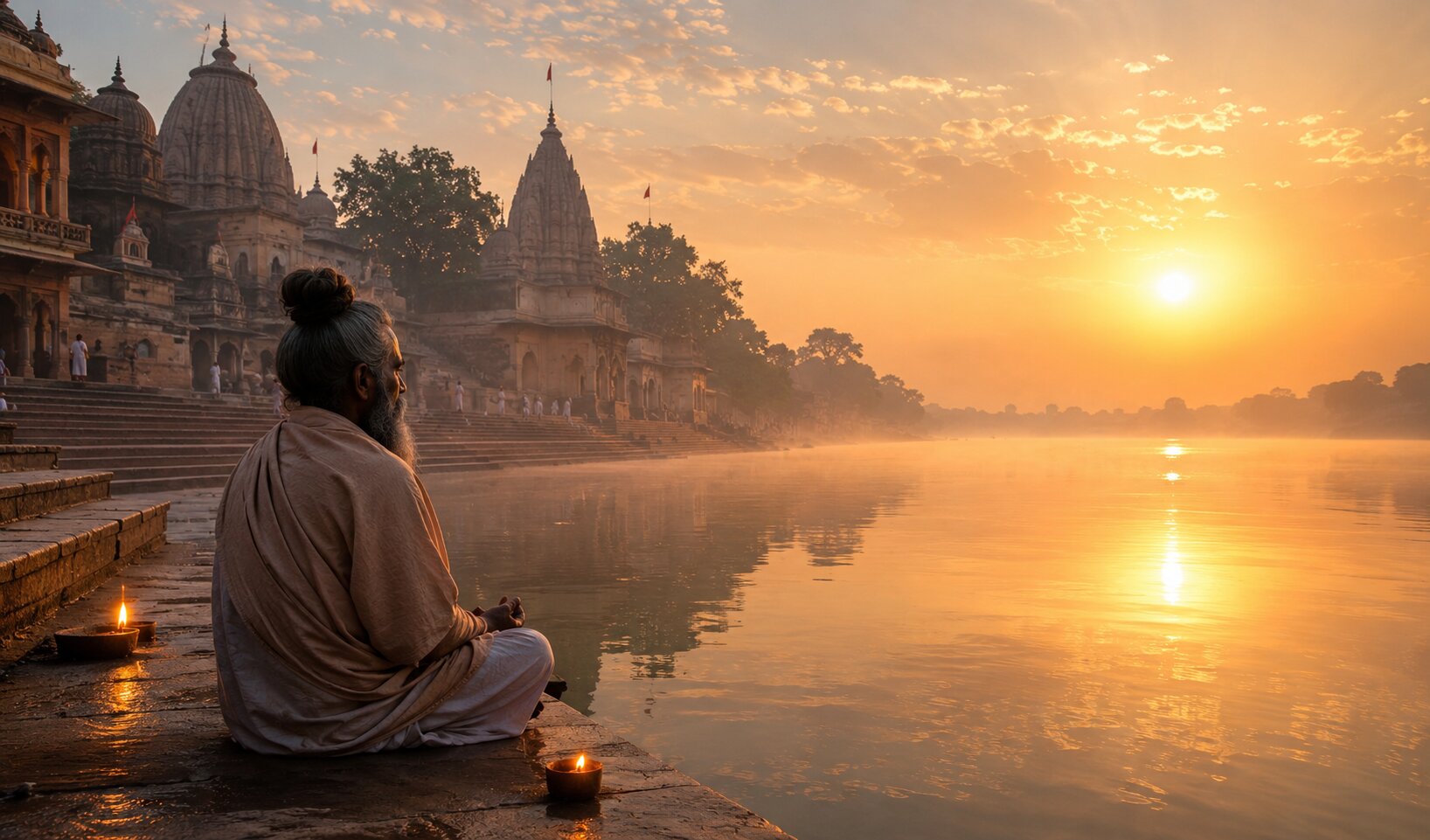
Advaita is one of the most profound schools of Indian philosophy.
The word “Advaita” means “not two.”
At its heart, Advaita teaches that the deepest reality is not divided into many separate things.
Behind the apparent differences of people, objects, thoughts, and experiences, there is one ultimate reality.
That reality is called Brahman.
Advaita is most closely associated with Adi Shankaracharya, the great Indian philosopher and spiritual teacher who systematized and popularized this tradition.
His teachings are rooted in the Upanishads, the Bhagavad Gita, and the Brahma Sutras, which together form the foundation of Vedanta philosophy.
1. Brahman Is the Ultimate Reality
The central principle of Advaita is that Brahman alone is ultimately real.
Brahman is not a god in the limited sense of a being sitting somewhere in the universe.
Brahman is the infinite, timeless, formless reality from which everything appears and into which everything resolves.
It is pure existence, pure consciousness, and pure fullness.
Advaita often describes Brahman as Sat-Chit-Ananda.
Sat means existence.
Chit means consciousness.
Ananda means bliss or fullness.
This does not mean Brahman “has” these qualities.
It means Brahman is existence itself, consciousness itself, and fullness itself.
2. The Self Is Not Separate from Brahman
Advaita’s most famous teaching is expressed in the Upanishadic statement: “Tat Tvam Asi,” meaning “You are That.”
The “That” refers to Brahman.
The “You” refers not to the body, mind, personality, job title, social identity, or personal history.
It refers to the deepest Self, called Atman.
According to Advaita, Atman and Brahman are not two different realities.
The true Self within us is the same ultimate reality that underlies the entire universe.
This is the boldest claim of Advaita: the individual self, when properly understood, is not separate from the infinite.
3. The World Is Real at One Level, but Not Ultimately Real
Advaita does not simply say the world does not exist.
That is a common misunderstanding.
The world clearly exists at the level of daily experience.
We feel pain, love, hunger, fear, joy, ambition, loss, and responsibility.
Advaita does not deny this practical reality.
Instead, it says the world is not ultimately real in the same way Brahman is real.
The world is changing.
Everything we see is temporary.
Bodies age.
Emotions pass.
Thoughts arise and disappear.
Relationships change.
Civilizations rise and fall.
Because everything in the world is dependent, changing, and temporary, Advaita says it does not have an independent ultimate reality.
It is real in experience, but not absolute in essence.
4. Maya Is the Power of Appearance
Advaita explains the experience of separation through the concept of Maya.
Maya is not simply “illusion” in the sense of something completely fake.
A better way to understand Maya is as the power of appearance.
Through Maya, the one reality appears as many.
The infinite appears as finite.
The unchanging appears as changing.
The indivisible appears as divided.
A classic example is mistaking a rope for a snake in dim light.
The snake is experienced as real for the person who sees it.
Fear arises.
The body reacts.
But when light is brought, the snake is understood to have never truly existed as a snake.
It was always a rope.
Similarly, Advaita says we mistake the world of separation as the final truth.
Spiritual knowledge is like bringing light into the room.
5. Ignorance Is the Root of Bondage
According to Advaita, human suffering is rooted in ignorance.
This ignorance is not a lack of information.
It is a mistaken identity.
We identify ourselves with the body, mind, emotions, memories, and social roles.
We say, “I am successful,” “I am a failure,” “I am hurt,” “I am superior,” “I am inferior,” “I am incomplete.”
Advaita asks: Who is this “I”?
Is the “I” the body?
The body keeps changing.
Is the “I” the mind?
The mind is full of changing thoughts.
Is the “I” emotion?
Emotions come and go.
Is the “I” memory?
Memory is selective and unstable.
Advaita points toward the witnessing consciousness behind all these experiences.
That witnessing awareness is constant while the experiences change.
The failure to recognize this true Self is called avidya, or ignorance.
6. Liberation Comes Through Self-Knowledge
The goal of Advaita is moksha, or liberation.
Moksha does not mean going to a different place after death.
It means freedom from false identification while living.
This freedom comes through knowledge.
Not ordinary knowledge.
Not book knowledge alone.
It is direct recognition of one’s true nature.
The seeker comes to understand: “I am not merely this body. I am not merely this restless mind. I am the awareness in which all experiences appear and disappear.”
This realization removes the fear, insecurity, and deep sense of incompleteness that come from identifying with the limited self.
7. The Path Includes Listening, Reflection, and Contemplation
Advaita traditionally describes three important steps in the spiritual journey.
The first is shravana, or listening.
This means listening to the teachings from scripture and a qualified teacher.
The second is manana, or reflection.
This means thinking deeply about the teaching and resolving doubts.
The third is nididhyasana, or contemplation.
This means meditating steadily on the truth until it becomes clear and firm in one’s own understanding.
Advaita is not blind belief.
It encourages inquiry.
It asks the seeker to examine experience carefully and discover what remains constant behind all change.
8. The Witness Consciousness Is Central
One of the most practical teachings of Advaita is the idea of the witness.
We experience thoughts, but we are aware of them.
We experience emotions, but we are aware of them.
We experience bodily sensations, but we are aware of them.
That awareness is not angry when anger appears.
It is not sad when sadness appears.
It is not confused when confusion appears.
It simply knows the presence of these experiences.
Advaita invites us to shift our identity from the changing contents of experience to the awareness that knows them.
This does not make a person passive or indifferent.
Rather, it creates inner freedom.
One can act in the world with clarity, compassion, and responsibility without being completely trapped by every mental wave.
9. Advaita Does Not Reject Devotion or Action
Some people think Advaita is only intellectual.
That is not accurate.
Advaita recognizes the value of devotion, ethics, meditation, and disciplined action.
Devotion helps purify the heart.
Ethical living reduces selfishness and agitation.
Meditation steadies the mind.
Selfless action weakens ego-centered thinking.
However, Advaita says these practices prepare the mind for knowledge.
The final liberation comes from knowing the truth of the Self.
In this sense, devotion and knowledge are not enemies.
They can support each other.
10. The Ego Is a Functional Tool, Not the True Self
Advaita does not say the ego must be violently destroyed.
In daily life, a functional sense of “I” is necessary.
We need it to speak, work, plan, protect the body, and maintain relationships.
The problem begins when we mistake this functional ego for our absolute identity.
The ego says, “I am separate. I am incomplete. I must constantly become something more to be whole.”
Advaita says this sense of lack is based on misunderstanding.
The true Self is already whole.
Spiritual maturity is not about becoming infinite.
It is about recognizing that the deepest Self was never limited in the first place.
11. Advaita Changes How We See Others
If the same reality exists as the essence of all beings, then other people are not ultimately separate from us.
This insight can become the foundation for compassion.
Hatred becomes harder when we see others as expressions of the same consciousness.
Jealousy weakens when we understand that the same fullness shines through all.
Pride softens when we realize the individual personality is not the final truth.
Advaita does not merely offer a metaphysical theory.
It offers a transformed way of seeing life.
12. The Practical Meaning of Advaita Today
Advaita remains relevant because modern life often strengthens the feeling of separation.
People define themselves by career, income, appearance, political identity, social status, and personal achievement.
This creates constant comparison and anxiety.
Advaita offers a deeper center.
It reminds us that our worth does not come from external success alone.
It does not come from praise, possessions, titles, or social approval.
At the deepest level, we are not incomplete beings trying to become whole.
We are already rooted in a reality that is whole.
This does not mean we stop working, learning, loving, or improving.
It means we do these things from inner fullness rather than inner emptiness.
Conclusion: The Wisdom of Not-Two
Advaita is the philosophy of non-duality.
It teaches that the deepest truth of existence is oneness.
Brahman is the ultimate reality.
Atman, the true Self, is not separate from Brahman.
The world of difference is experienced through Maya.
Suffering arises from ignorance of our true nature.
Liberation comes through self-knowledge.
The great promise of Advaita is that freedom is not something to be imported from outside.
It is discovered within.
The journey is not from weakness to strength, or from smallness to greatness.
It is from mistaken identity to clear recognition.
Advaita’s final message is simple, powerful, and transformative:
You are not merely a separate individual struggling in a divided world.
At the deepest level, you are the awareness in which the whole world appears.