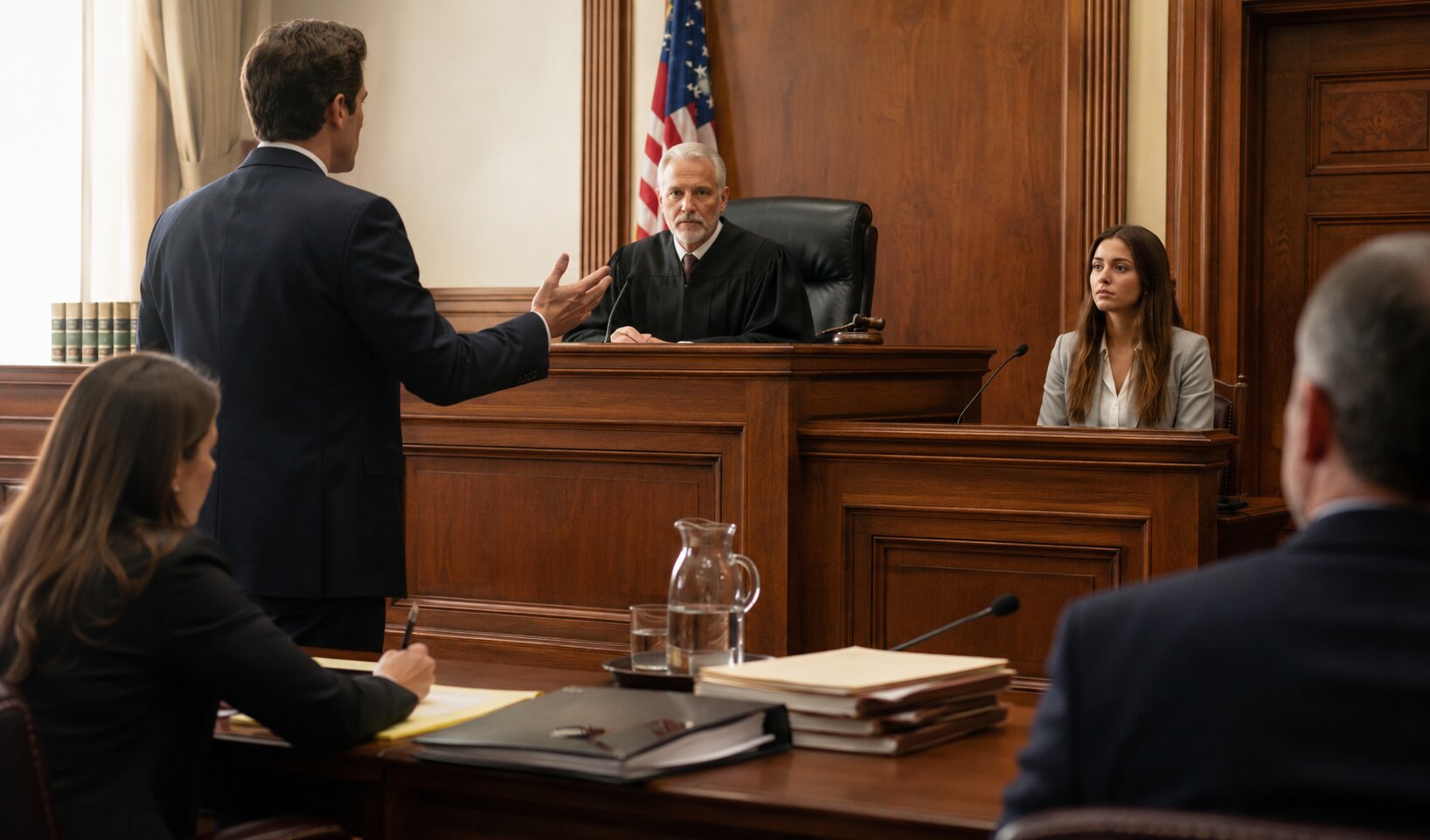
Courtroom objections are an important part of trial procedure.
They allow attorneys to challenge questions, answers, or evidence that may be improper, unfair, unclear, or legally inadmissible.
When a lawyer objects, the judge decides whether the objection is valid.
If the judge says “sustained,” the objection is accepted, and the question or answer is usually not allowed.
If the judge says “overruled,” the objection is rejected, and the witness may answer the question.
Below are 25 common courtroom objections used in U.S. courts, explained in simple language with examples.
1. Relevance
Relevance means the question must relate to the issues being decided in the case.
A question about something unrelated can be objected to because it does not help prove or disprove anything important.
Example:
“What did you eat for breakfast the day after the accident?”
2. Hearsay
Hearsay occurs when a witness repeats something someone else said outside of court to prove that the statement is true.
Example:
“My neighbor told me the defendant ran the red light.”
3. Leading
A leading question suggests the answer within the question itself.
This is usually not allowed during direct examination, although it is often allowed during cross-examination.
Example:
“You saw the defendant at 9 p.m., didn’t you?”
4. Speculation
Speculation happens when a witness is asked to guess about something they do not actually know.
Example:
“Why do you think the driver sped up?”
5. Lack of Personal Knowledge
A witness can only testify about things they personally saw, heard, experienced, or know directly.
Example:
“Describe what the manager discussed with the board when you weren’t in the room.”
6. Argumentative
An argumentative question is not really asking for facts.
Instead, it argues with the witness or tries to pressure them into agreeing with the lawyer’s point.
Example:
“Only an irresponsible person would drive that fast, right?”
7. Asked and Answered
This objection is used when a lawyer keeps asking the same question after the witness has already answered it.
Example:
“You said you left at 8 p.m. earlier, so you left at 8 p.m., correct?”
8. Compound Question
A compound question asks two or more questions at once.
This can confuse the witness and make the answer unclear.
Example:
“Did you see the car and was the light green?”
9. Misstates the Evidence
This objection applies when a lawyer inaccurately describes earlier testimony or evidence.
Example:
“When you said the car was red, you meant blue, correct?”
10. Assumes Facts Not in Evidence
This happens when a question assumes something has already been proven, even though it has not.
Example:
“When did you stop embezzling funds from the company?”
11. Calls for a Legal Conclusion
A witness generally cannot be asked to decide legal issues.
That is the responsibility of the judge or jury.
Example:
“Was the defendant negligent?”
12. Calls for an Expert Opinion
A regular witness cannot give expert-level opinions unless they have been properly qualified as an expert.
Example:
“Based on those lab results, what was the exact chemical composition?”
13. Improper Character Evidence
This objection is used when a lawyer tries to show that someone acted a certain way because of their general character or reputation.
Example:
“Isn’t it true the defendant is known for being violent?”
14. Badgering the Witness
Badgering occurs when questioning becomes hostile, repetitive, aggressive, or harassing.
Example:
Repeatedly shouting, “Answer the question! Answer it!”
15. Beyond the Scope
This objection is used when a lawyer asks questions outside the subject area allowed at that stage of examination.
Example:
If cross-examination focused only on the speed of the car, redirect should not suddenly move into unrelated financial motives.
16. Foundation or Lack of Foundation
Before certain evidence or testimony can be admitted, the lawyer must first establish basic background facts.
Example:
Asking a witness about a document before showing how the witness knows what the document is.
17. Authentication
Authentication means proving that a document, photo, message, recording, or other exhibit is genuine.
Example:
Offering a text message without first proving who sent it.
18. Privilege
Some communications are legally protected.
This includes attorney-client communications, certain medical communications, and other privileged relationships.
Example:
“What did your lawyer tell you to say?”
19. Cumulative
Cumulative evidence repeats the same point again and again without adding anything new.
Example:
Calling a tenth witness to testify to the exact same fact already established.
20. Improper Opinion
A lay witness may sometimes give basic observations, but they usually cannot offer opinions beyond ordinary perception.
Example:
“Based on his body language, do you think he committed fraud?”
21. Non-Responsive
A non-responsive answer goes beyond the question asked.
Example:
Question: “What time did you arrive?”
Answer: “I arrived at 9, and the defendant is a terrible driver.”
22. Narrative
A narrative question invites a long, uncontrolled story instead of a focused answer.
Example:
“Tell us everything that happened that week.”
23. Vague or Ambiguous
A vague or ambiguous question is unclear or can be interpreted in more than one way.
Example:
“When did you go there?”
The problem is that “there” is not clearly identified.
24. Improper Impeachment
Impeachment is the process of challenging a witness’s credibility.
However, it must be done correctly and according to court rules.
Example:
Confronting a witness with a prior statement without properly identifying or showing the statement.
25. Improper Lay Opinion on the Ultimate Issue
A non-expert witness generally should not give a conclusion that the jury must decide.
Example:
“Was the defendant guilty?”
What Happens After an Objection?
When a lawyer believes a question or answer is improper, they may stand and say something like:
“Objection, hearsay.”
The judge then rules on the objection.
If the judge says “sustained,” the lawyer’s objection is accepted.
If the judge says “overruled,” the lawyer’s objection is rejected, and the witness may answer.
Final Thought
Courtroom objections are not just dramatic moments from movies or television.
They are tools attorneys use to protect fairness, keep the trial focused, and ensure that the judge or jury hears only proper evidence.
Understanding common objections helps make the courtroom process much easier to follow.