Attila the Hun: The Man Who Made Rome Pay
Few conquerors left behind as much fear as Attila the Hun.
He did not build great cities or lasting institutions. He built pressure, tribute, and terror. His empire did not outlive him by long, but during his lifetime he forced both halves of the Roman world to take him seriously.
That is why his name endured.
A Steppe Warlord Rises
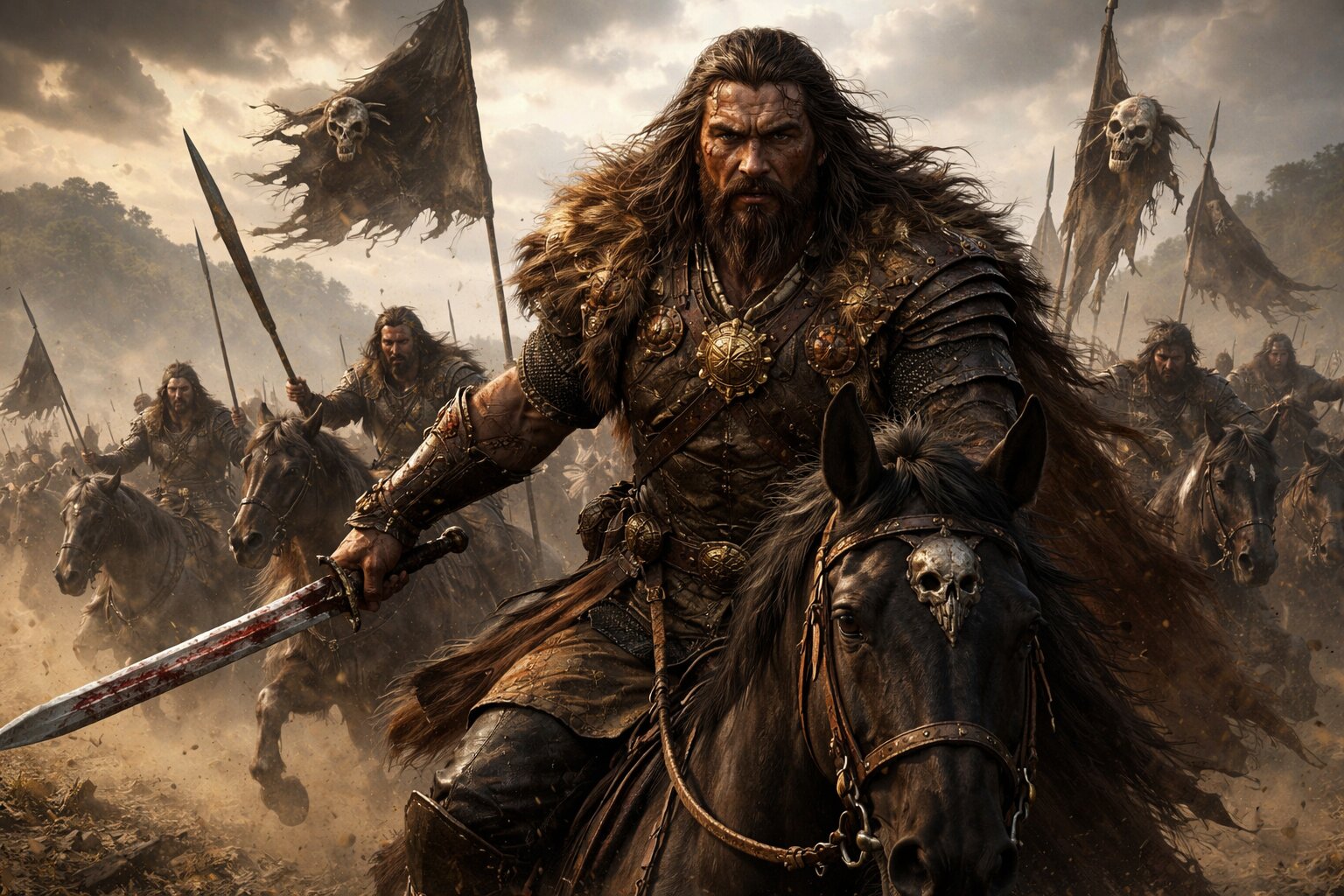
Attila was born in the early fifth century, likely around A.D. 406, into the ruling family of the Huns.
The Huns were nomadic horse warriors from the Eurasian steppe. To the Romans, they seemed fast, brutal, and unpredictable. They fought differently, moved differently, and came from a world the settled empires did not fully understand.
Attila first ruled with his brother Bleda. Together, they strengthened Hun power and pressured the Eastern Roman Empire. After Bleda disappeared from the record, likely killed on Attila’s orders, Attila ruled alone.
From then on, he became the face of Hun power.
Rome’s Weakness Was His Opportunity
Attila understood that Rome was still prestigious but no longer dominant.
The Eastern Roman Empire repeatedly paid him gold to avoid invasion. That was more than a financial victory. It was political humiliation. A people once dismissed as barbarians were now extracting tribute from the empire that had ruled the Mediterranean world.
Attila used that weakness well.
He combined raids, threats, and negotiation with precision. He knew when to attack and when to demand payment. He understood that fear could be turned into policy.
More Than a Raider
Attila was not just leading Hun horsemen on quick raids.
He controlled a larger power structure made up of Huns and subjected tribes. That made him more dangerous than a simple invader. He could direct a broad military coalition and use reputation as a weapon before battle even began.
Cities fell. Populations fled. Diplomats negotiated under pressure.
Often, Attila’s name reached people before his army did.
The Western Campaign
In A.D. 451, Attila invaded Gaul.
He had a convenient pretext: Honoria, sister of the Western Roman emperor Valentinian III, had apparently sent him a plea for help. Attila treated it as a marriage proposal and demanded half the Western Roman Empire as dowry.
Whether serious or opportunistic, it gave him cover for invasion.
His advance into Gaul was dangerous enough that the Roman general Flavius Aetius formed a coalition with the Visigoths and others to stop him. That led to the Battle of the Catalaunian Plains, one of the major battles of late antiquity.
Attila was checked there. He was not destroyed, but he did not get the decisive victory he wanted.
That mattered. It showed he could be resisted.
Italy and the Limits of Power
In A.D. 452, Attila invaded Italy and devastated cities in the north.
But he did not take Rome.
Why he turned back is still debated. Disease, famine, supply problems, military pressure, and diplomacy all likely played a role. The famous meeting with Pope Leo I became legendary, but practical realities were probably more important than symbolism.
Even so, the campaign confirmed the scale of the threat he posed.
He could reach the core of the Roman world.
A Brilliant Predator, Not a Builder
Attila was not a state-builder in the Roman sense.
He did not leave a durable administrative system or a lasting political order. But that should not hide his ability. He was highly effective at reading weakness, organizing force, extracting tribute, and using fear strategically.
He was not simply a destroyer.
He was a sharp political and military operator whose power rested on speed, intimidation, and personal authority.
His weakness was the same as his strength: everything depended on him.
The Sudden End
In A.D. 453, Attila died suddenly, reportedly on his wedding night after heavy drinking, possibly from a hemorrhage.
It was an unexpectedly ordinary end for a man with an extraordinary reputation.
After his death, his empire quickly fractured. Subject peoples rebelled. His sons failed to hold the coalition together. What looked enormous under one man turned out to be fragile without him.
That is often the test of greatness.
A lasting empire survives its founder. Attila’s did not.
Why He Still Matters
Attila remains important because he exposed how vulnerable Rome had become.
He came from the margins of the known world and forced the greatest empire of the age to bargain, pay, and retreat. He did not replace Rome, but he made clear that Rome was no longer untouchable.
That is his place in history.
Attila the Hun was not a civilizational architect. He was a warlord of rare force and clarity who saw weakness and exploited it without hesitation.
He did not build a world.
He shook one.