In late May 1940, Britain came frighteningly close to losing the army it would need to continue fighting Nazi Germany.
Hundreds of thousands of British and Allied soldiers were trapped along the coast of northern France, with German forces closing in.
The place where they gathered was a small French port on the English Channel:
Dunkirk.
What followed was one of the strangest episodes of World War II — a military disaster transformed into an extraordinary rescue.
More than 338,000 Allied soldiers escaped across the Channel, allowing Britain to survive one of the darkest moments in its history.
But Dunkirk was not a victory.
It was an escape from catastrophe.
The German Blitzkrieg Shocks Europe
On May 10, 1940, Germany invaded Belgium, the Netherlands, Luxembourg, and France.
British and French commanders expected the main German attack to come through Belgium.
So large Allied armies, including the British Expeditionary Force (BEF), moved north to confront the Germans.
That was exactly what the German plan encouraged them to do.
Meanwhile, Germany’s main armored force made a far more dangerous move.
German Panzer divisions drove through the heavily forested Ardennes, an area the Allies considered difficult for a major armored offensive.
They crossed the Meuse River near Sedan and then raced west toward the English Channel.
Instead of pushing directly toward Paris, the German tanks sliced behind the Allied armies in Belgium.
The result was devastating.
The Allied forces in northern France suddenly found themselves nearly surrounded.
By May 20, German units had reached the Channel.
The British army, along with large numbers of French and Belgian troops, was trapped.
The Trap Closes
German armored forces now swung north toward the remaining Allied forces.
The situation became increasingly desperate.
The British considered attempts to break south and reconnect with the main French armies, but German forces were advancing too quickly.
Soon there was only one realistic option:
Evacuation by sea.
The British began withdrawing toward Dunkirk.
Why Dunkirk?
Because it had a harbor, beaches, and — most importantly — it was relatively close to England.
The English coast was less than 50 miles away across the Channel.
But reaching Dunkirk did not mean safety.
Hundreds of thousands of men were being compressed into a shrinking perimeter while German forces approached from several directions.
If the Germans captured Dunkirk before the troops could escape, Britain could lose most of its professional army.
Then Hitler’s Tanks Stopped
On May 24, something unexpected happened.
German armored units approaching Dunkirk were ordered to halt.
For roughly two days, the Panzers did not continue their full advance.
The reason for the famous “halt order” remains debated.
Several factors probably contributed.
The German tanks had advanced extraordinarily quickly and needed maintenance, fuel, and reorganization. German commanders were also concerned about the marshy terrain around Dunkirk, which was considered unfavorable for tanks.
Senior German commanders worried about possible Allied counterattacks against their exposed formations.
At the same time, Luftwaffe commander Hermann Göring argued that his air force could help destroy the trapped Allied forces.
Hitler also approved the pause.
No single explanation completely resolves the controversy.
But the consequences were enormous.
The Allies gained precious time to strengthen the defensive perimeter around Dunkirk and organize an evacuation.
Operation Dynamo Begins
On May 26, Britain officially launched the evacuation.
It was called Operation Dynamo.
The operation was directed from underground naval headquarters beneath Dover Castle by Vice Admiral Bertram Ramsay.
The original expectations were bleak.
British planners feared they might be able to rescue only a fraction of the trapped troops.
Instead, the evacuation became far larger than anyone expected.
Royal Navy destroyers, transport ships, ferries, fishing boats, lifeboats, pleasure craft, yachts, and other vessels began crossing the Channel.
This collection became famous as the “Little Ships of Dunkirk.”
Hundreds of small civilian vessels participated.
But popular memory sometimes gives the impression that civilians in tiny boats rescued the entire army.
The reality was more complicated.
Most soldiers were transported across the Channel aboard larger naval and merchant vessels. The smaller boats often played a vital role ferrying soldiers from shallow beaches to the larger ships waiting offshore.
Together, the entire maritime effort became one of history’s most remarkable evacuations.
The Beaches Were Not Peaceful
The image of soldiers calmly standing in lines along the beaches can make Dunkirk appear almost orderly.
It was anything but.
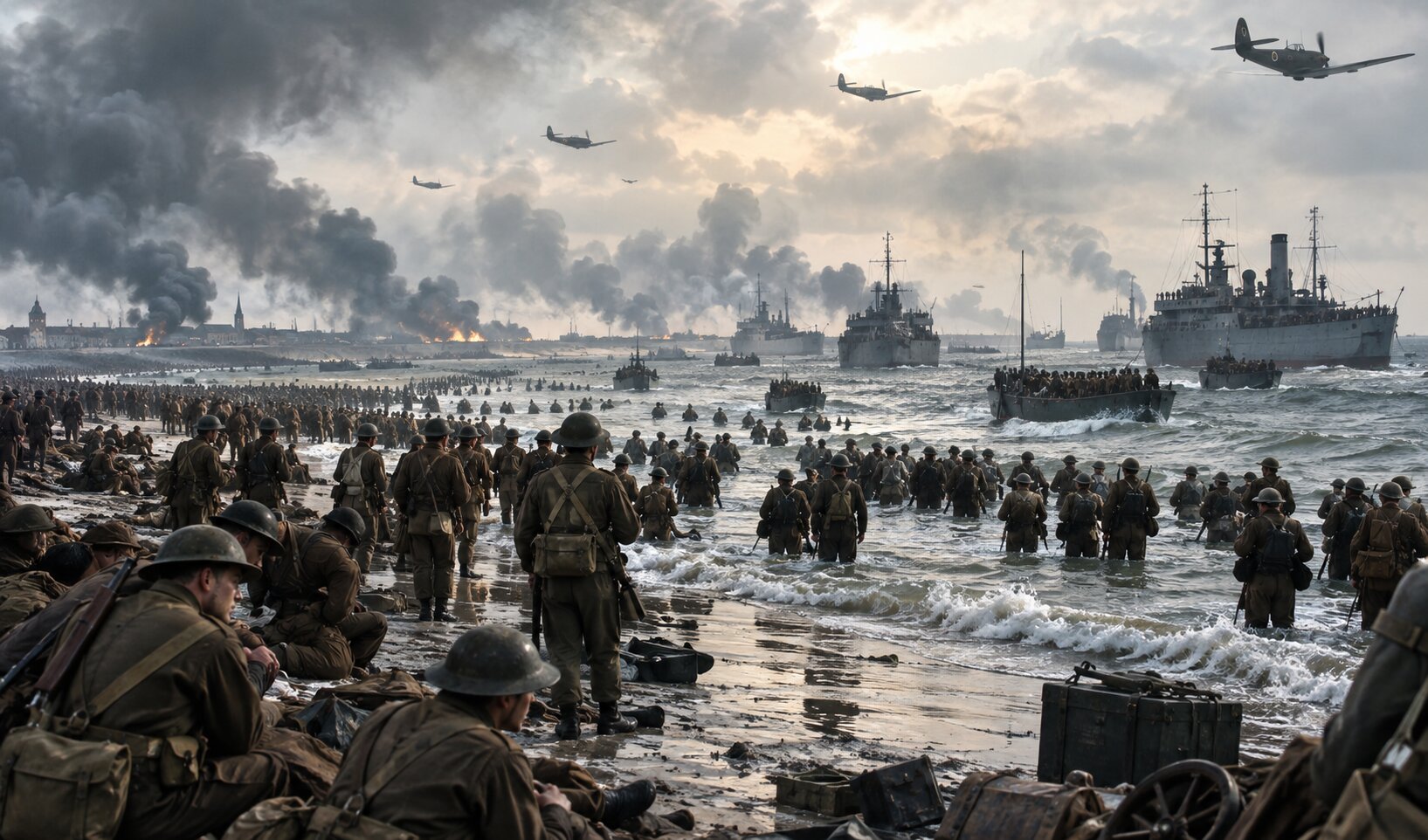
German aircraft bombed the harbor, beaches, ships, roads, and troop concentrations.
Smoke filled the sky.
Ships were sunk.
Men stood waist-deep in water waiting for boats.
Others waited for hours under the constant threat of air attack.
One of the evacuation’s most important structures was not even designed as a ship terminal.
Dunkirk harbor contained long breakwaters known as moles.
The East Mole became crucial because large ships could pull alongside it and load troops far faster than they could from the beaches.
Thousands of soldiers escaped from this improvised pier.
Where Was the Royal Air Force?
Some soldiers evacuated from Dunkirk later complained that they rarely saw British fighters overhead.
That created the impression that the Royal Air Force (RAF) had abandoned them.
It had not.
RAF Fighter Command fought intense battles with the Luftwaffe over northern France and the Channel.
Many of those battles occurred away from the beaches, where soldiers on the ground could not see them.
The RAF lost aircraft and pilots trying to prevent German bombers from attacking the evacuation fleet.
The Luftwaffe still inflicted serious damage, but German aircraft never gained complete control of the skies.
This mattered enormously.
Without fighter protection, evacuation ships would have been even more vulnerable.
The Forgotten Defenders of Dunkirk
The evacuation could not have succeeded without soldiers holding the Germans back on land.
British and French troops established a defensive perimeter around Dunkirk.
French units in particular continued fighting while the evacuation progressed.
As increasing numbers of British soldiers escaped, French forces remained behind defending parts of the perimeter.
During the final stages of the evacuation, large numbers of French troops were also transported to Britain.
Many would later return to France to continue fighting.
Others eventually joined the Free French forces after France surrendered.
Their role is sometimes overshadowed by the famous story of British evacuation, but Dunkirk was an Allied operation, not purely a British one.
338,000 Men Escape
The results exceeded almost every expectation.
Between May 26 and June 4, approximately 338,000 Allied troops were evacuated from Dunkirk.
The majority were British, but roughly 140,000 French and other Allied personnel were also rescued.
Britain had saved the core of its army.
But almost all of its heavy equipment had been left behind.
Thousands of vehicles, artillery pieces, machine guns, ammunition stocks, and enormous quantities of supplies were abandoned in France.
The men survived.
Much of the army’s equipment did not.
Churchill Refuses to Call It a Victory
When the evacuation ended, the British public celebrated.
Newspapers spoke of the “Dunkirk spirit” — courage, improvisation, endurance, and determination in the face of disaster.
Prime Minister Winston Churchill, however, warned against turning the evacuation into a military victory.
Britain had escaped from a battlefield it was losing.
France was still collapsing.
Only days later, German forces resumed their offensive southward.
Paris fell on June 14.
France signed an armistice on June 22.
Churchill understood that rescuing an army was not the same thing as defeating an enemy.
But saving that army made future resistance possible.
What If the British Army Had Been Captured?
This is what makes Dunkirk strategically important.
The soldiers rescued there formed the nucleus of Britain’s land forces.
If several hundred thousand experienced British soldiers had been killed or captured, Britain would have faced the next stage of the war in a dramatically weaker position.
Britain still had the Royal Navy.
It still had the RAF.
But losing most of the BEF could have severely weakened the country’s ability to defend itself and continue the war.
Instead, many of the soldiers evacuated from Dunkirk would later fight again.
British forces would return to continental Europe.
Four years later, on June 6, 1944, Allied armies landed in Normandy.
Among the forces returning to France were troops belonging to the same British military establishment that had narrowly escaped destruction in 1940.
Why Didn’t Germany Destroy Them?
Dunkirk produced one of World War II’s great historical questions:
Did Hitler deliberately allow the British army to escape?
There is no convincing evidence that Hitler intentionally spared Britain.
The evacuation resulted from a combination of factors:
German armored formations had outrun much of their supporting infantry.
Commanders were worried about terrain and mechanical exhaustion.
The German high command temporarily believed air power could finish the job.
Allied troops fought stubbornly around the Dunkirk perimeter.
The Royal Navy mounted an evacuation on a scale the Germans had not anticipated.
And the RAF prevented the Luftwaffe from having completely uncontested air superiority.
Dunkirk was therefore not the result of one mysterious decision.
It was the product of several German miscalculations combined with determined Allied resistance and an extraordinary naval evacuation.
A Defeat That Changed the War
Militarily, Dunkirk was part of one of Germany’s greatest victories.
Belgium had fallen.
France was collapsing.
The British army had been driven from continental Europe.
Germany had demonstrated the terrifying effectiveness of modern mobile warfare.
Yet Germany had failed to destroy Britain’s army.
That failure mattered.
Dunkirk did not defeat Hitler.
It did something more fundamental:
It gave Britain the ability to keep fighting.
Only weeks later, Germany would turn its attention toward Britain itself.
The next great confrontation would not take place on the beaches of France.
It would take place in the skies above Britain.
That struggle would become known as the Battle of Britain.
Dunkirk therefore stands as one of history’s strangest military moments — a battlefield defeat remembered not for surrender, but for survival.
Britain lost the campaign.
It lost enormous quantities of equipment.
France was about to fall.
Yet more than 338,000 soldiers crossed the Channel alive.
And sometimes in war, surviving today is what makes victory tomorrow possible.