For more than two decades, Nicolae Ceaușescu ruled Romania as a communist dictator.
His portraits hung everywhere. His speeches dominated television. The secret police watched ordinary citizens. Criticism of the government could cost a person his job, his freedom—or worse.
Ceaușescu appeared untouchable.
Then, in December 1989, his entire regime collapsed in barely ten days.
And on Christmas Day, Nicolae Ceaușescu and his wife Elena were executed by firing squad.
It was one of the most dramatic endings of any communist government in Eastern Europe.
A Country Living in Fear
Nicolae Ceaușescu became Romania’s communist leader in 1965.
At first, he cultivated an image of independence from the Soviet Union. Western governments even viewed him somewhat favorably because Romania occasionally resisted Moscow’s policies.
But inside Romania, Ceaușescu gradually constructed an increasingly authoritarian state.
His government developed an enormous personality cult.
Ceaușescu was portrayed as a brilliant national leader. His wife, Elena Ceaușescu, was promoted as an internationally important scientist despite serious questions about her academic credentials.
Meanwhile, the Securitate, Romania’s feared secret police, monitored the population.
People suspected that neighbors, coworkers and even friends might be government informants.
Open criticism of the regime was dangerous.
The Price of Ceaușescu’s Economic Experiment
During the 1970s Romania borrowed heavily from Western countries to finance industrial development.
By the early 1980s, Ceaușescu became determined to eliminate Romania’s foreign debt.
His solution was brutal austerity.
Much of Romania’s agricultural and industrial production was exported to generate foreign currency.
At home, ordinary Romanians faced shortages of:
- Food
- Electricity
- Heating
- Gasoline
- Medicine
- Consumer goods
During the cold Romanian winters, many families lived with limited heating.
Electricity was sometimes rationed.
Food could require long hours of waiting in line.
Yet state television continued presenting images of prosperity and celebrating Ceaușescu’s supposed achievements.
The contrast between official propaganda and everyday life became increasingly absurd.
Then Came 1989
Across Eastern Europe, communism was beginning to collapse.
In Poland, the communist government negotiated with the opposition.
Hungary began opening its borders.
In November 1989, the Berlin Wall fell.
Communist governments across Eastern Europe were disappearing with remarkable speed.
But Ceaușescu refused to change.
He believed Romania would be different.
Then something happened in the western Romanian city of Timișoara.
The Pastor Who Helped Ignite a Revolution
The immediate trigger involved a Hungarian Reformed pastor named László Tőkés.
Tőkés had publicly criticized the Romanian government.
Authorities attempted to remove him from his church residence.
On December 15, 1989, supporters gathered outside to prevent his eviction.
What began as a small protest quickly grew.
More residents joined.
Soon people were chanting against the communist government.
The demonstrations transformed into something far more dangerous for the regime.
People began shouting:
“Freedom!”
and
“Down with Ceaușescu!”
Security forces attempted to suppress the protests.
Shots were fired.
People were killed.
But instead of stopping the uprising, the violence intensified public anger.
Ceaușescu Makes a Fatal Mistake
Ceaușescu initially appeared to believe the disturbances could easily be controlled.
On December 21, the government organized a huge public rally in Bucharest.
The purpose was simple.
Thousands of workers were brought together to listen to Ceaușescu condemn the unrest and demonstrate public support for the government.
It was supposed to be another carefully staged communist propaganda event.
Television cameras broadcast the rally live.
Ceaușescu stood on the balcony of the Communist Party headquarters and began speaking.
Then something extraordinary happened.
The crowd stopped behaving according to the script.
Noise emerged from the audience.
People began shouting.
The dictator looked confused.
For several seconds, television viewers across Romania watched something they had rarely seen before:
Nicolae Ceaușescu did not know what to do.
He raised his hand and repeatedly attempted to calm the crowd.
But the shouting continued.
That moment became psychologically devastating to the regime.
Millions of Romanians suddenly realized something important.
Ceaușescu could be challenged.
The Revolution Reaches Bucharest
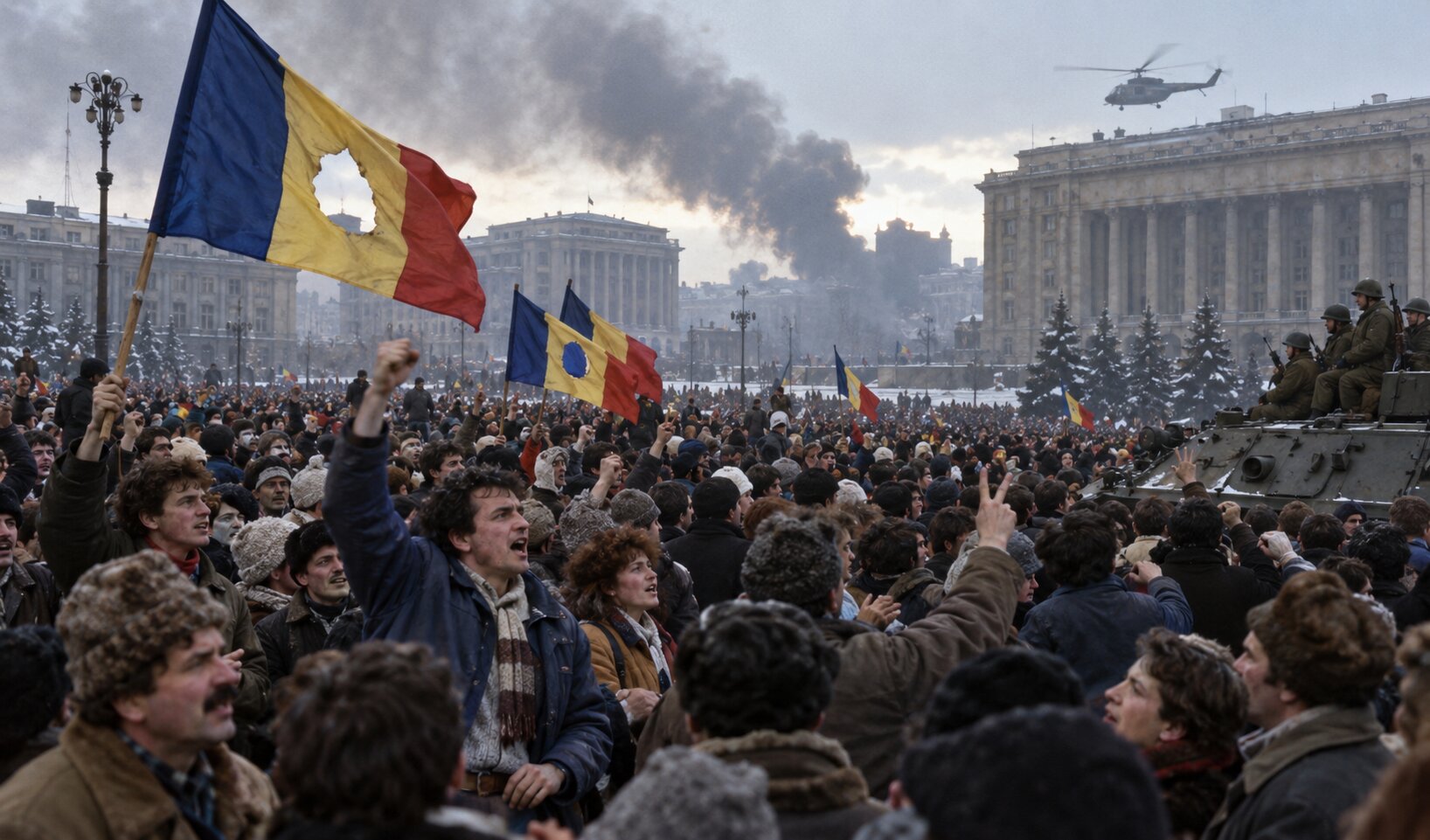
Protests spread throughout the capital.
During the night of December 21–22, demonstrators confronted security forces.
People were killed and wounded.
But the demonstrations continued growing.
Then came perhaps the most important development.
Parts of the Romanian military began refusing to defend the regime.
On December 22, Defense Minister Vasile Milea died under disputed circumstances, officially reported at the time as suicide.
Soon afterward, military units increasingly sided with the protesters.
Ceaușescu’s government was collapsing.
Huge crowds surrounded the Communist Party headquarters.
The Helicopter Escape
Ceaușescu and Elena fled the building by helicopter.
It became one of the most memorable images of the revolution:
A dictator who had controlled Romania for nearly a quarter century was suddenly escaping from his own capital.
But there was nowhere left to go.
The couple eventually abandoned the helicopter and attempted to continue by car.
Romanian authorities captured them near the town of Târgoviște.
They were taken to a military facility.
Meanwhile, Bucharest descended into confusion.
Gunfire continued.
Reports circulated that forces loyal to Ceaușescu were fighting the revolutionaries.
To this day, historians continue debating exactly who was responsible for much of the shooting that occurred after Ceaușescu fled.
Hundreds died during those chaotic days.
A Trial That Lasted Only Hours
On December 25, 1989—Christmas Day—Nicolae and Elena Ceaușescu were placed before a military tribunal.
The trial was extraordinarily fast.
They were accused of crimes including genocide and destruction of the national economy.
Ceaușescu repeatedly rejected the authority of the court.
He insisted that he remained the legitimate president of Romania.
The court convicted both of them.
They were sentenced to death.
Minutes later, soldiers escorted Nicolae and Elena Ceaușescu outside.
A firing squad opened fire.
The dictator and his wife were dead.
Television footage of their bodies was later broadcast to prove that Ceaușescu’s rule was truly over.
How Many People Died?
The Romanian Revolution was much more violent than many of the other revolutions that ended communist rule in Eastern Europe.
Official investigations have generally placed the death toll at more than 1,000 people, with several thousand others wounded.
Remarkably, many deaths occurred after Ceaușescu had already fled Bucharest.
The exact circumstances of those deaths remain one of the most controversial aspects of the revolution.
Confusion, misinformation, military confrontations and reports of supposed “terrorists” contributed to the chaos.
Who Took Power?
After Ceaușescu’s fall, a group called the National Salvation Front took control.
Its leading figure was Ion Iliescu, a former communist official who had previously fallen out with Ceaușescu.
Romania subsequently began transitioning toward multiparty democracy and a market economy.
But the transition was difficult.
Former communist officials continued to hold considerable influence, leading some Romanians to question whether the events of 1989 were entirely a spontaneous revolution or partly an internal seizure of power.
The historical debate continues.
The Revolution That Was Broadcast Live
One reason Romania’s revolution remains so fascinating is that much of it unfolded on television.
People watched Ceaușescu lose control of his rally.
They watched revolutionaries enter television studios.
They watched announcements that the dictatorship had collapsed.
And eventually they saw images confirming the deaths of Nicolae and Elena Ceaușescu.
It was almost as if an entire political system disintegrated in front of the television cameras.
The Final Irony
Only days before his downfall, Nicolae Ceaușescu appeared to control everything.
He controlled the Communist Party.
He controlled the media.
He controlled the police.
He controlled the security services.
His portraits covered the country.
Thousands applauded his speeches.
But authoritarian systems often contain a hidden weakness.
When fear disappears, obedience can disappear astonishingly quickly.
A small protest in Timișoara became a national uprising.
A carefully organized propaganda rally became a public humiliation.
An army ordered to protect the regime began siding with protesters.
And within days, one of Eastern Europe’s most powerful dictators was running toward a helicopter.
Ceaușescu ruled Romania for 24 years.
His final revolution lasted barely ten days.
And that may be the most striking lesson of the Romanian Revolution of 1989:
A government can appear permanent—right up until the moment people stop being afraid of it.