The French Revolution began with a powerful promise:
Liberty. Equality. Fraternity.
By 1793, however, those ideals had taken a terrifying turn.
France, which had overthrown its king in the name of freedom, entered a period in which thousands of people were arrested, tried, and executed as supposed enemies of the Revolution.
This period became known as the Reign of Terror.
And perhaps the most disturbing part of the story is this:
Many of the people who created the Terror eventually became its victims.
From Revolution to Chaos
In 1789, France was in deep crisis.
The government was nearly bankrupt. Food prices were high. Ordinary people carried much of the tax burden, while the monarchy, aristocracy, and clergy enjoyed privileges.
Anger exploded.
The Bastille prison was stormed on July 14, 1789, and the old political order began to collapse.
At first, revolutionaries hoped to create a constitutional monarchy.
But events moved rapidly.
King Louis XVI tried to flee France in 1791, badly damaging public trust in him. France soon went to war with Austria and Prussia, whose monarchies feared that revolutionary ideas might spread across Europe.
By 1792, the French monarchy was abolished.
France became a republic.
And in January 1793, Louis XVI was executed by guillotine.
France had crossed a point of no return.
France Surrounded by Enemies
The new French Republic faced danger from almost every direction.
Foreign armies were attacking France.
Inside the country, royalist uprisings threatened the revolutionary government.
Food shortages continued.
Inflation grew.
Different revolutionary factions accused each other of betrayal.
The leaders in Paris began to believe that the Revolution could survive only if its enemies were eliminated.
This atmosphere of fear created the conditions for the Terror.
Enter Robespierre
One of the most famous figures of this period was Maximilien Robespierre.
Robespierre was originally known as a serious lawyer and defender of revolutionary principles. He spoke against slavery, criticized political corruption, and supported expanded political participation.
But as the Revolution became more violent, Robespierre became closely associated with the idea that extraordinary measures were necessary to defend the Republic.
He became one of the dominant figures in the Committee of Public Safety, a powerful body created in 1793 to deal with war, rebellion, and internal enemies.
The Committee effectively became France’s emergency government.
Its mission was simple:
Save the Revolution at any cost.
Terror as Government Policy
Revolutionary leaders began using fear as a political weapon.
Under the Law of Suspects, authorities could arrest people believed to be enemies of the Revolution.
But who counted as an enemy?
That definition became dangerously broad.
A person might be suspected because of political opinions, family connections, social background, criticism of the government, or simply because someone accused them.
Revolutionary tribunals were established to try suspected enemies.
Trials could be extremely short.
The punishment was often death.
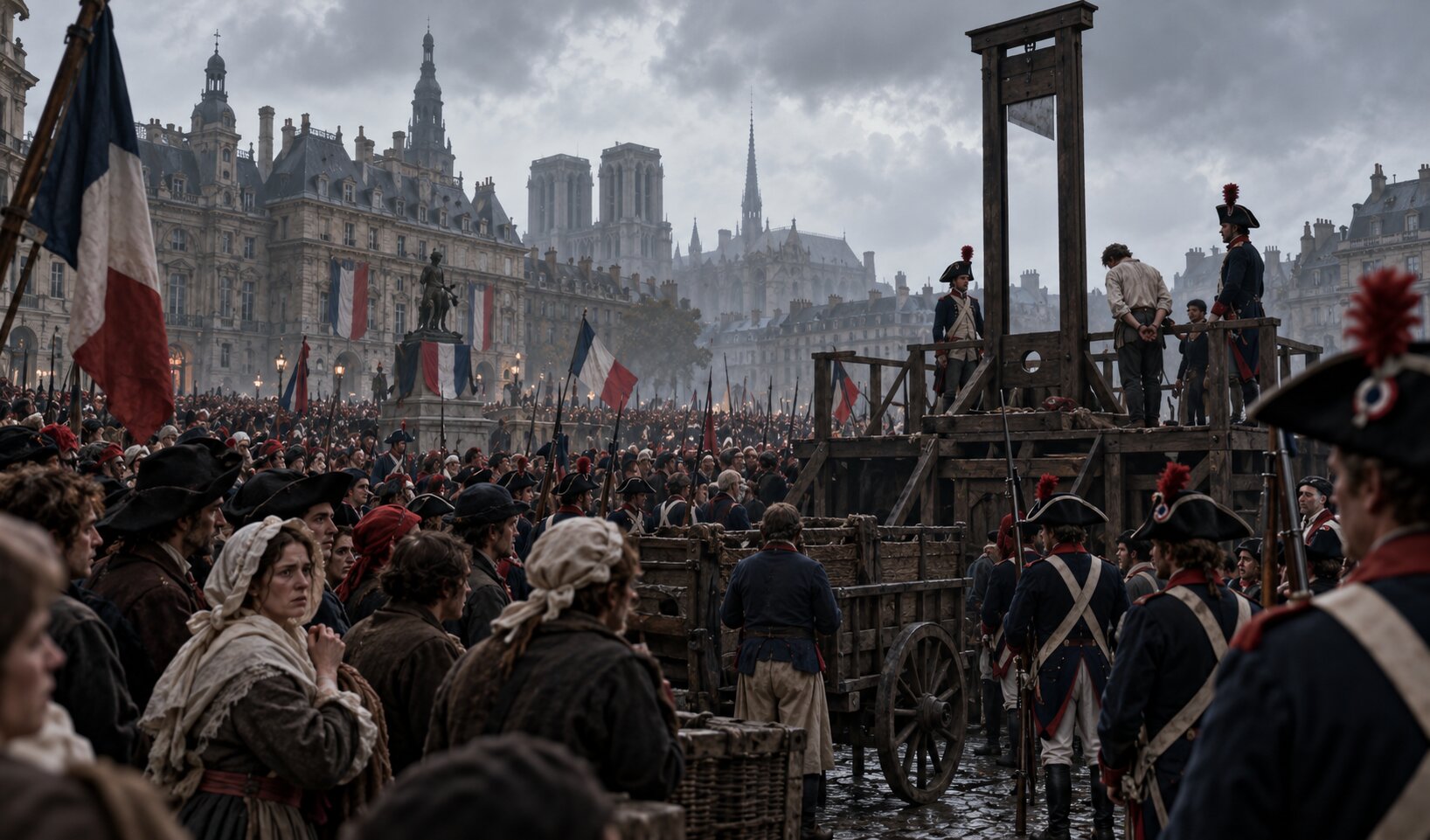
And the most famous instrument of execution was the guillotine.
The Guillotine
The guillotine was originally promoted as a more humane and equal method of execution.
Before the Revolution, execution methods often depended on social class. Nobles could receive relatively quick deaths by beheading, while common people sometimes suffered far more brutal punishments.
The guillotine was supposed to make execution swift and equal.
During the Terror, however, it became the symbol of revolutionary violence.
Crowds gathered to watch executions in public squares.
Carts carrying condemned prisoners moved through Paris toward the scaffold.
The blade fell again and again.
Among those executed was Marie Antoinette, the former queen of France, in October 1793.
But the victims were not only aristocrats.
Many were ordinary citizens, workers, priests, political activists, and even former revolutionaries.
Revolutionaries Began Killing Revolutionaries
This is where the Revolution became especially dangerous.
The Terror did not remain a simple conflict between revolutionaries and royalists.
Revolutionary factions began turning against one another.
The more radical leaders accused moderates of being too weak.
Other revolutionaries who demanded an end to the violence were accused of undermining the Republic.
One of the most famous victims was Georges Danton.
Danton had been one of the most important leaders of the Revolution.
But by 1794, he began arguing that the Terror should be reduced.
Robespierre and his allies viewed Danton and his supporters as a political threat.
Danton was arrested.
Before his execution, he reportedly told his executioner:
“Show my head to the people. It is worth seeing.”
On April 5, 1794, Danton was guillotined.
A man who had helped create revolutionary power had now been destroyed by it.
How Many People Died?
Approximately 17,000 people were officially executed during the Terror.
Thousands more died in prison or through mass killings and military repression.
Some regions experienced particularly brutal violence.
In the Vendée, for example, a massive rebellion against the revolutionary government led to a civil war in which tens of thousands died.
The Terror was therefore much larger than the executions carried out in Paris.
Robespierre’s Idea of Virtue and Terror
Robespierre believed that a republic required civic virtue.
But he also argued that during a revolution, virtue sometimes needed to be enforced through terror.
In one famous speech, he described terror as a form of swift and severe justice used to protect the Revolution.
This created a frightening political logic.
If the Revolution represented virtue…
and opponents of the Revolution represented corruption…
then eliminating opponents could be presented as morally necessary.
Once political disagreement became evidence of treason, almost anyone could become a target.
The Great Terror
In the summer of 1794, executions accelerated dramatically.
A new law reduced legal protections for defendants before the Revolutionary Tribunal.
The number of executions in Paris surged.
Fear spread even among members of the revolutionary government.
Politicians began asking themselves a dangerous question:
“Am I next?”
Robespierre increasingly spoke about conspirators and enemies without always naming them.
That made his colleagues nervous.
If he believed hidden enemies surrounded the Revolution, perhaps tomorrow he might accuse them.
Eventually, fear of Robespierre became stronger than fear of opposing him.
The Terror Devours Its Own Leader
On July 27, 1794, known in the Revolutionary calendar as 9 Thermidor, Robespierre’s political enemies moved against him.
He was shouted down in the National Convention.
He and several allies were arrested.
After a chaotic night, Robespierre was captured.
The following day, July 28, 1794, he was taken to the guillotine.
The man who had become the most famous symbol of the Terror was executed by the same machinery of revolutionary justice that he had helped defend.
Robespierre was only 36 years old.
His execution marked the effective end of the Reign of Terror.
The Great Irony
The French Revolution began with a rebellion against arbitrary royal power.
Yet only a few years later, revolutionary authorities created a system in which people could be imprisoned and executed on vague suspicions of disloyalty.
A revolution that proclaimed liberty created political repression.
A movement that demanded legal equality weakened legal protections.
A government that claimed to represent the people executed thousands of them.
And revolutionary leaders who eliminated their enemies eventually began eliminating one another.
Was the Terror Completely Irrational?
The situation was more complicated than simple madness.
France really was facing serious threats.
European monarchies were at war with the Republic.
There were genuine royalist conspiracies.
Civil war was raging in parts of the country.
The revolutionary government also successfully mobilized enormous armies and ultimately pushed foreign forces away from France.
Supporters of emergency measures argued that extraordinary circumstances required extraordinary action.
Critics, however, argued that legitimate security concerns became an excuse for political repression, arbitrary arrests, and escalating violence.
Historians continue to debate how much the Terror resulted from wartime necessity, revolutionary ideology, political rivalry, or institutional collapse.
Most likely, all of these forces played some role.
The Larger Lesson of the Reign of Terror
The Reign of Terror offers one of history’s clearest examples of how political fear can transform a movement.
When a society begins dividing everyone into two categories—
“Those who are with us”
and
“Those who are enemies”
—ordinary political disagreement can become dangerous.
When leaders claim that an emergency justifies abandoning normal legal protections, temporary measures can become permanent habits.
And when accusations become easier than evidence, fear can replace justice.
The French Revolution did transform Europe.
It weakened aristocratic privilege, promoted the idea of citizenship, spread concepts of legal equality, and challenged absolute monarchy.
But the Reign of Terror revealed the darker side of revolutionary politics.
The same movement could produce both:
The Declaration of the Rights of Man
and
the guillotine.
That contradiction is one reason the French Revolution continues to fascinate historians more than two centuries later.
It is not merely a story about kings, revolutions, or executions.
It is a warning about what can happen when political certainty combines with fear, emergency power, and the belief that eliminating opponents is necessary to create a better society.