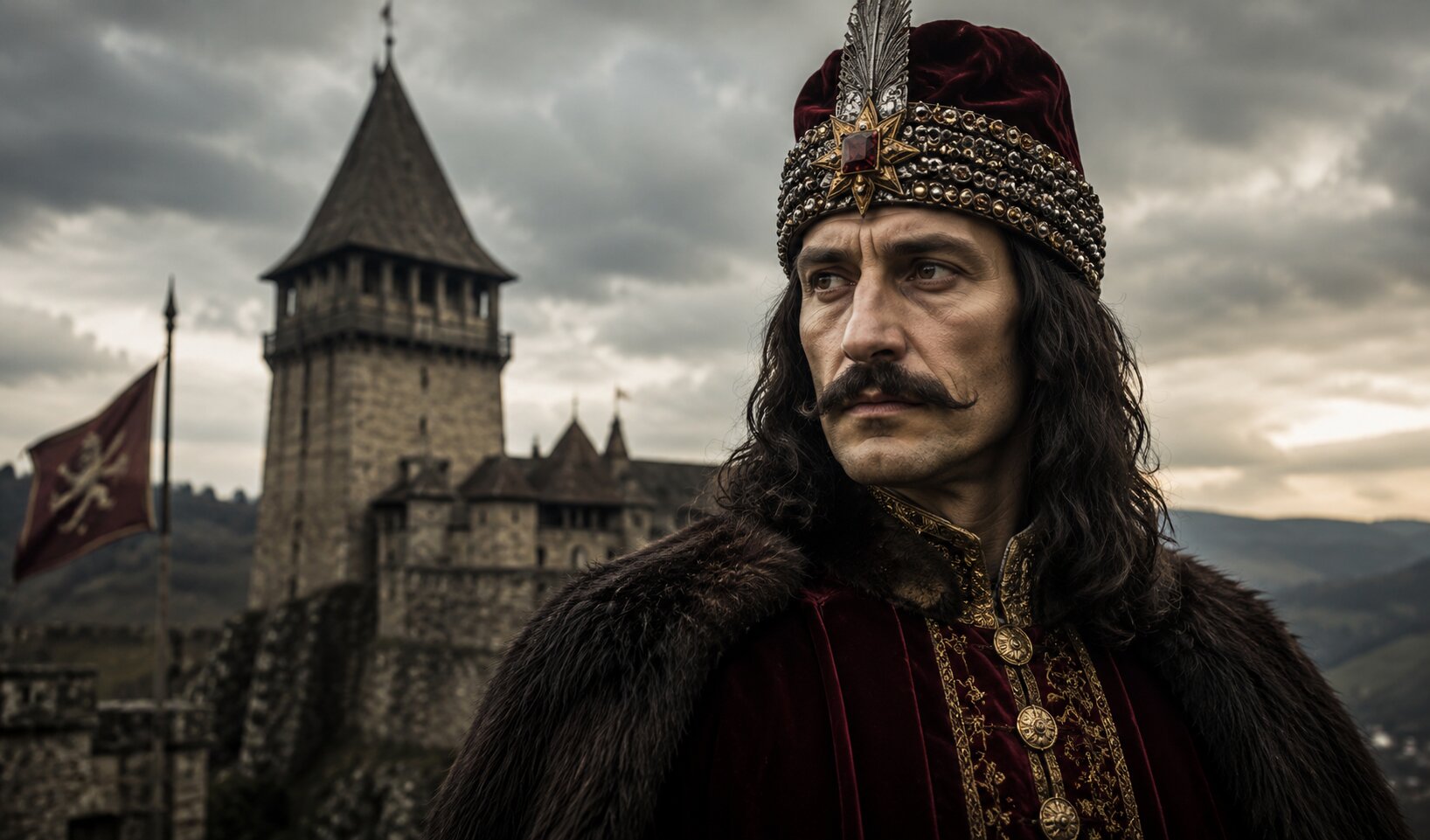
Few names in medieval history evoke as much fear, fascination, and misunderstanding as Vlad the Impaler. To many, he is remembered as the brutal ruler who inspired the Dracula legend. To others, especially in Romania, he remains a fierce national defender who stood against one of the most powerful empires of his time.
But who was Vlad III Dracula really?
Was he a monster, a patriot, a tyrant, or simply a product of a violent age?
The answer is complicated — and that is exactly what makes him so fascinating.
The Man Behind the Name
Vlad III was born in 1431 in Transylvania, a region historically associated with castles, mountains, and later, vampire legends. His father was Vlad II Dracul, a member of the Order of the Dragon, a Christian military order created to defend Europe against Ottoman expansion.
The name Dracula originally had nothing to do with vampires. It meant “son of Dracul.” Over time, however, the name became tied to darkness, cruelty, and supernatural horror — mostly because of Bram Stoker’s famous 1897 novel Dracula.
Vlad was also known as Vlad Țepeș, meaning Vlad the Impaler. That nickname came from his most feared method of punishment: impalement.
Why Was He Called “The Impaler”?
Vlad’s reputation for cruelty was not accidental. He used terror as a political tool.
His preferred method of execution — impalement — was deliberately slow, public, and horrifying. It was meant to send a clear message: disobedience, betrayal, theft, corruption, or invasion would be punished without mercy.
According to contemporary accounts, Vlad impaled thousands of people, including criminals, rebels, rival nobles, and captured enemy soldiers. Some numbers were likely exaggerated by his enemies, but there is little doubt that his punishments were exceptionally brutal even by medieval standards.
To modern readers, this cruelty is shocking. But in Vlad’s world, power was fragile, betrayal was common, and survival often depended on fear.
The Prince of Wallachia
Vlad ruled Wallachia, a historical region located in modern-day Romania. He held the title of Voivode, or prince, and ruled Wallachia three separate times.
His repeated rise and fall from power reflects the instability of the region. Wallachia stood between powerful forces: the expanding Ottoman Empire, the Kingdom of Hungary, rival noble families, and internal political enemies.
In such a world, ruling was not simply about administration. It was about survival.
Vlad had to fight foreign armies, suppress rebellious nobles, control local corruption, and maintain authority in a land constantly threatened by invasion.
A Brutal but Disciplined Ruler
Vlad was not a gentle ruler. He was authoritarian, severe, and merciless. But he was also intelligent, disciplined, and politically shrewd.
He enforced strict laws and punished crime harshly. Thieves, corrupt officials, tax evaders, and disloyal nobles could face torture or execution. Romanian folklore often presents him as a ruler who brought order to a chaotic land — someone so feared that people did not dare steal, cheat, or betray.
This is where Vlad’s legacy becomes complicated.
To his enemies, he was a monster.
To many of his people, he was a harsh but effective ruler who protected the country during a dangerous time.
This tension — between cruelty and justice, terror and order — is central to understanding Vlad the Impaler.
The Ottoman Threat
Vlad’s greatest enemy was the Ottoman Empire, one of the most powerful military forces in the world during the 15th century.
The Ottomans had already conquered Constantinople in 1453 under Sultan Mehmed II, a victory that transformed the balance of power in Europe and the Middle East. Wallachia, being strategically located, became a contested frontier zone.
Vlad refused to submit quietly. He resisted Ottoman pressure, refused tribute, and used guerrilla tactics against larger invading forces.
His methods included ambushes, scorched-earth strategies, surprise night attacks, and psychological warfare. He understood that he could not always defeat the Ottomans in open battle, so he fought with fear, speed, and brutality.
One of the most famous stories about Vlad says that when Mehmed II entered Wallachia, he encountered a horrifying sight: thousands of impaled bodies displayed along the road. The scene was meant to break the morale of the invading army.
Whether every detail of the story is accurate or embellished, it captures Vlad’s strategy perfectly. He wanted his enemies to believe that entering his land meant entering hell.
Was Vlad Really Dracula?
The answer is yes — but only partially.
Bram Stoker borrowed the name Dracula and drew inspiration from Eastern European history and folklore. Vlad’s reputation for cruelty likely contributed to the atmosphere surrounding the fictional Count Dracula.
But historically, Vlad was not a vampire. There is no evidence that people in his own time believed he drank blood, lived forever, transformed into a bat, or had supernatural powers.
The vampire myth came much later.
The real Vlad Dracula was not a creature of the night. He was a medieval ruler, a military strategist, and a man shaped by war, betrayal, and political violence.
In many ways, the real story is darker than fiction.
How Many People Did He Rule — and Kill?
Wallachia in Vlad’s time likely had a population of several hundred thousand people, possibly around 300,000 to 500,000. Compared to the great empires of the age, it was a small territory. But because of its strategic position, it carried enormous importance.
The number of people Vlad killed remains uncertain. Some contemporary accounts claim tens of thousands of victims. However, these reports often came from hostile sources, including German pamphlets and political enemies who had reasons to exaggerate his cruelty.
Still, even if the numbers were inflated, Vlad’s violence was real. His rule was built on fear, punishment, and absolute authority.
Loved by Some, Hated by Others
Vlad’s reputation depends heavily on who is telling the story.
To the Ottomans, he was a dangerous rebel.
To the Saxons and rival nobles, he was a terrifying tyrant.
To German pamphleteers, he became almost a monster — a ruler of unspeakable cruelty.
But in Romanian memory, Vlad is often seen differently. He is remembered as a defender of Wallachia, a ruler who resisted Ottoman domination, punished corruption, and protected his homeland when many others submitted.
This does not erase his brutality. But it explains why his legacy is not as simple as “evil ruler” or “national hero.”
He was both feared and admired.
The Mystery of His Death
Vlad died around 1476, most likely in battle against the Ottomans or their allies. The exact details remain unclear.
According to tradition, his head was sent to Istanbul as proof of his death. His burial place is also disputed, though Snagov Monastery is often associated with his tomb.
Like much of his life, Vlad’s death is surrounded by uncertainty, legend, and political storytelling.
The Legacy of Vlad the Impaler
Today, Vlad the Impaler remains one of the most debated figures in medieval European history.
He was undeniably cruel. His punishments were horrifying, and his name became associated with terror for good reason.
But he was also a ruler fighting for survival in a brutal world. He defended a small kingdom against a vast empire, used psychological warfare with chilling effectiveness, and became a symbol of resistance in Romanian history.
His transformation into Dracula added another layer to his legacy. The fictional vampire overshadowed the historical prince, turning a real medieval ruler into a global symbol of horror.
Yet the real Vlad Dracula is more interesting than the myth.
He was not a vampire.
He was something more human — and perhaps more disturbing: a ruler who believed that fear was the strongest foundation of power.
Final Thought
Vlad the Impaler forces us to ask an uncomfortable question: how should history judge a leader who protected his land through cruelty?
Was he a patriot? A tyrant? A monster? A necessary evil?
Perhaps he was all of these.
That is why Vlad III Dracula continues to fascinate us centuries after his death. His life sits at the intersection of history and legend, heroism and horror, justice and brutality.
The vampire was fiction.
But the darkness behind the legend was real.