When people think of Roman emperors, they often remember the dramatic ones first: Julius Caesar, Augustus, Nero, Caligula, or Marcus Aurelius.
But one of Rome’s most important emperors was not a glamorous philosopher, a mad tyrant, or a conquering celebrity.
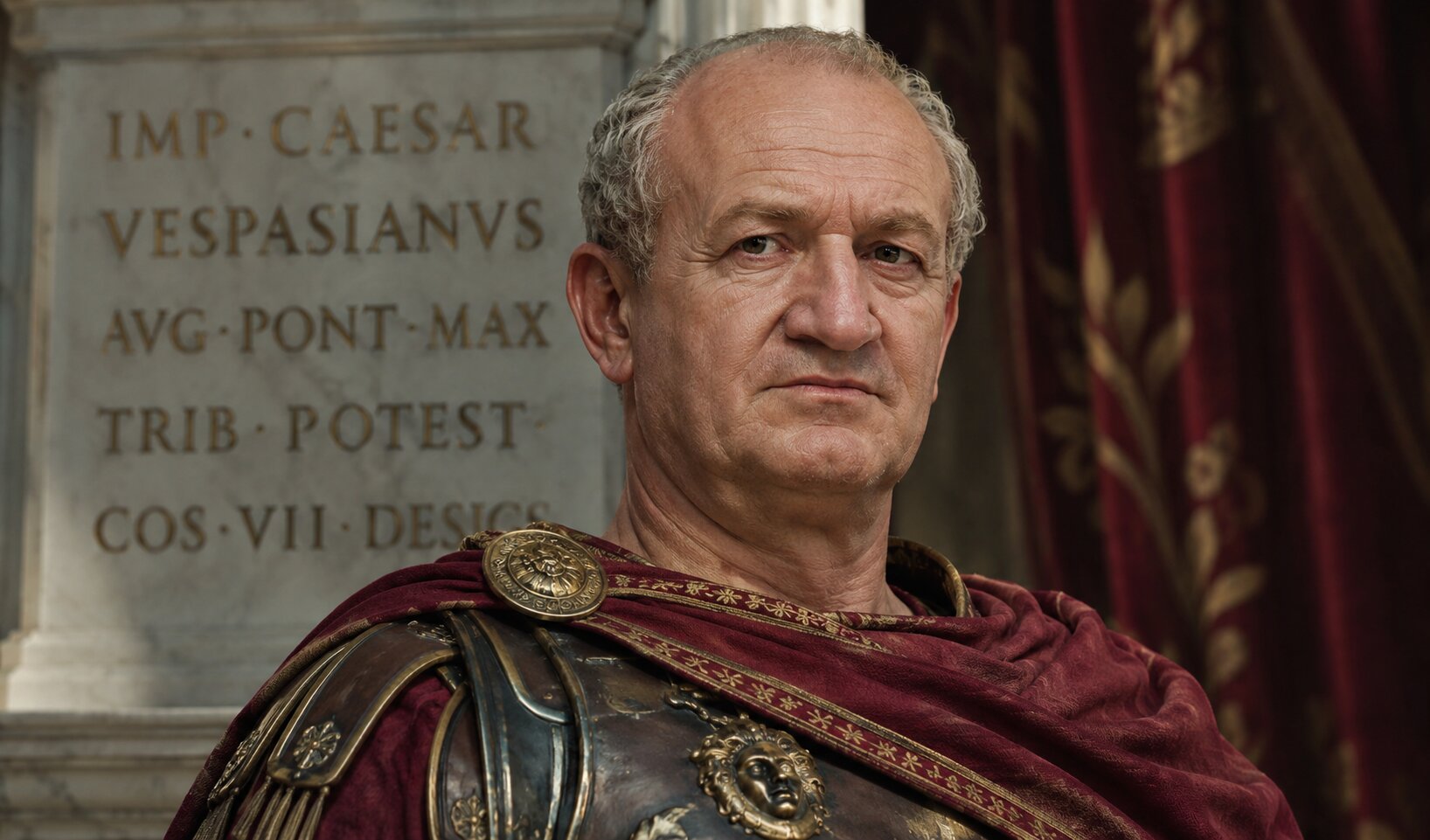
He was Vespasian.
Vespasian was practical, disciplined, plain-spoken, and deeply experienced.
He came to power after one of the most dangerous moments in Roman history, when the empire had nearly torn itself apart through civil war.
Instead of ruling like a theatrical monarch, he ruled like a soldier, administrator, and accountant.
That may sound less exciting than palace scandals and battlefield legends, but it was exactly what Rome needed.
Vespasian did not inherit stability.
He created it.
Rome Before Vespasian: A City in Crisis
To understand Vespasian’s importance, we must first understand the chaos that came before him.
In A.D. 68, Emperor Nero died after years of extravagance, political paranoia, and public resentment.
Nero’s death ended the Julio-Claudian dynasty, the family line that had ruled Rome since Augustus.
But his death did not bring peace.
Instead, it opened the door to civil war.
The year A.D. 69 became known as the “Year of the Four Emperors.”
In quick succession, Galba, Otho, Vitellius, and Vespasian all claimed imperial power.
Rome was no longer simply choosing a ruler.
It was discovering that armies, not just the Senate, could make emperors.
The empire needed someone strong enough to restore order, but not so reckless that he would destroy what remained.
Vespasian became that man.
A Humble Beginning for a Roman Emperor
Vespasian was born Titus Flavius Vespasianus in A.D. 9 in a modest family from the Sabine region of Italy.
Unlike many earlier emperors, he did not come from Rome’s oldest and most aristocratic families.
He was not born into the center of imperial privilege.
This mattered.
Vespasian’s background shaped his personality.
He was known for being direct, hardworking, careful with money, and less obsessed with aristocratic display than many Roman elites.
He rose through the Roman system through service, discipline, military competence, and political survival.
In many ways, Vespasian was not the emperor Rome expected.
He was the emperor Rome needed.
The Soldier Who Became Emperor
Before becoming emperor, Vespasian built a respected military career.
He served in Britain during Emperor Claudius’s invasion in A.D. 43 and gained a reputation as a capable commander.
Later, under Nero, he was sent to suppress the Jewish revolt in Judea.
This assignment placed him in command of a major military campaign at a critical moment.
When Nero died and Rome fell into civil war, Vespasian was still in the East, commanding powerful legions.
His troops proclaimed him emperor in A.D. 69.
He had military support, strategic position, and the backing of key eastern provinces.
While his forces moved west, Vitellius, the emperor in Rome, was defeated.
By the end of A.D. 69, Vespasian emerged as the winner.
But victory in a civil war was only the beginning.
Now he had to rebuild trust in the empire itself.
The Founder of the Flavian Dynasty
Vespasian founded the Flavian dynasty, which included himself and his two sons, Titus and Domitian.
This was a major turning point.
Rome had moved beyond the family of Augustus.
The imperial throne was no longer automatically tied to one sacred bloodline.
Vespasian’s rise showed that an emperor could come from outside the old inner circle if he had the support of the army, the provinces, and the political machinery of Rome.
This was both stabilizing and dangerous.
It stabilized Rome because capable men outside the old dynasty could now rule.
But it was dangerous because it confirmed that military power could determine imperial succession.
Vespasian understood this reality.
So he worked carefully to make his rule appear legitimate, orderly, and lasting.
Restoring Rome’s Finances
One of Vespasian’s greatest challenges was money.
Nero had spent lavishly.
Civil war had drained resources.
The empire needed repairs, soldiers needed pay, and public confidence had to be restored.
Vespasian responded with financial discipline.
He increased taxes, recovered public lands, reorganized revenue collection, and cut waste.
He was sometimes mocked for being too focused on money.
One famous story says he even taxed public urinals, because urine was used in industries such as tanning and laundering.
When his son Titus supposedly complained about the unpleasant nature of the tax, Vespasian held up a coin and said, “Money does not stink.”
Whether the story is perfectly accurate or partly legendary, it captures how Romans remembered him.
Vespasian was not sentimental about revenue.
He believed the state needed money to function.
And after years of disorder, Rome needed a ruler who understood that glory without finances was empty.
Rebuilding the City and the Empire
Vespasian also invested in rebuilding.
Rome had suffered from fire, neglect, political violence, and the excesses of Nero’s reign.
Nero had built the enormous Golden House, a luxurious palace complex that symbolized imperial self-indulgence.
Vespasian chose a different message.
He returned parts of Nero’s private pleasure grounds to public use.
Most famously, he began construction of the Flavian Amphitheatre, better known today as the Colosseum.
This was not merely an entertainment venue.
It was political symbolism in stone.
Where Nero had built for himself, Vespasian built for the people.
The Colosseum became one of the greatest monuments of ancient Rome and remains one of the most recognizable structures in the world.
Through architecture, Vespasian told Rome: the emperor is no longer just taking from the people; he is giving something back.
A Different Kind of Emperor
Vespasian’s personal style was very different from Nero’s.
Nero loved artistic performance, luxury, and spectacle.
Vespasian projected discipline, humor, and simplicity.
He did not try to appear divine in the same exaggerated way some rulers did.
He had a dry wit and a practical temperament.
Even on his deathbed, he reportedly joked, “I think I am becoming a god,” mocking the Roman custom of deifying emperors after death.
This humor made him seem more human.
Vespasian’s greatness was not in pretending to be above ordinary men.
It was in being grounded enough to govern them.
The Jewish Revolt and the Rise of Titus
One of the defining events of Vespasian’s era was the Jewish revolt.
Before becoming emperor, Vespasian led the Roman campaign in Judea.
After he became emperor, his son Titus continued the war.
In A.D. 70, Jerusalem fell to Roman forces, and the Second Temple was destroyed.
For Rome, this was a major military victory.
For Jewish history, it was a catastrophe of enormous religious and cultural significance.
The victory strengthened the Flavian dynasty and helped fund major building projects in Rome.
But it also left a deep historical wound that would echo for centuries.
Vespasian’s reign cannot be understood only as a story of Roman recovery.
It must also be remembered as part of a larger imperial world where Roman order often came through conquest, destruction, and domination.
Why Vespasian Succeeded
Vespasian succeeded because he understood the moment.
Rome did not need another performer.
It needed a manager.
It did not need more imperial fantasy.
It needed roads repaired, taxes collected, armies paid, cities rebuilt, and succession stabilized.
Vespasian brought military credibility, administrative discipline, and political realism.
He was not a dreamer like some rulers.
He was not a philosopher-king.
He was not a dramatic revolutionary.
He was a restorer.
That may be the key to his greatness.
Some leaders are remembered because they create new worlds.
Others are remembered because they prevent old worlds from collapsing.
Vespasian belonged to the second group.
His Legacy
Vespasian died in A.D. 79 after a decade in power.
Compared with many Roman emperors, his reign was relatively stable and successful.
He restored the treasury, strengthened the army, founded a new dynasty, began the Colosseum, and gave Rome a sense of recovery after civil war.
His son Titus succeeded him smoothly, which itself was a major accomplishment in Roman politics.
Vespasian proved that Rome could survive the end of its first imperial dynasty.
He also proved that a ruler did not need glamour to be great.
Sometimes, the most valuable leader is the one who arrives after disaster, cleans up the mess, restores confidence, and leaves the system stronger than he found it.