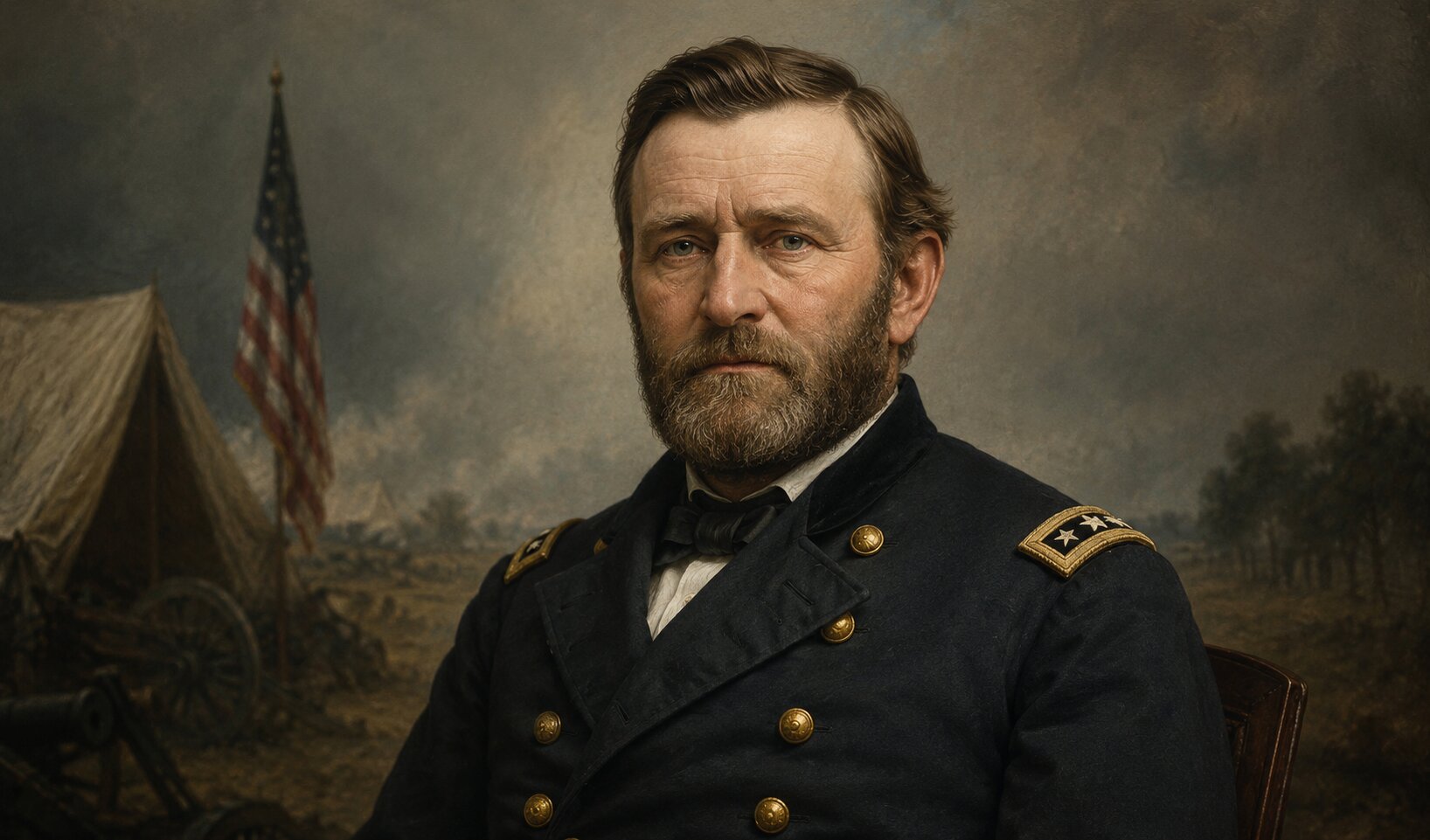
Ulysses S. Grant is often remembered as the Union general who defeated Robert E. Lee and later became the 18th president of the United States. But his life was far more complex than the simple image of a cigar-smoking Civil War hero. He was shy but stubborn, unlucky in business but brilliant in war, politically inexperienced but deeply important to Reconstruction, and a dying man who wrote one of the greatest memoirs in American history. (Encyclopedia Britannica)
1. His real name was not Ulysses S. Grant.
Grant was born Hiram Ulysses Grant on April 27, 1822, in Point Pleasant, Ohio. (National Park Service)
2. The “S” in his name did not officially stand for anything.
When he was nominated to West Point, his name was mistakenly recorded as Ulysses S. Grant, and he eventually kept it. The “S” is often associated with his mother’s maiden name, Simpson, but Grant himself said it did not stand for anything. (Wikipedia)
3. His initials accidentally became patriotic.
At West Point, “U. S. Grant” looked like “United States Grant,” which helped create a memorable public identity before he ever became famous.
4. He was not an enthusiastic student at West Point.
Grant was not considered a brilliant academic student, but he was an excellent horseman.
5. He was one of the finest riders in his West Point class.
His skill with horses was remarkable, and it became useful throughout his military life.
6. He disliked violence despite becoming a great general.
Grant was uncomfortable with bloodshed and reportedly disliked hunting, yet he became one of the most decisive military commanders in American history.
7. He fought in the Mexican-American War.
Before the Civil War, Grant served in the Mexican-American War from 1846 to 1848, gaining battlefield experience that later helped him as a Union commander. (HISTORY)
8. He learned from future enemies.
Many officers Grant knew during the Mexican-American War later became Confederate commanders in the Civil War.
9. He married Julia Dent in 1848.
Grant married Julia Dent on August 22, 1848, at her family home in St. Louis. (Wikipedia)
10. His father disapproved of Julia’s slaveholding family.
Grant’s father, Jesse Grant, opposed slavery and did not attend the wedding because Julia’s family owned enslaved people. (Wikipedia)
11. Grant lived for a time at White Haven.
From 1854 to 1859, Grant lived at White Haven, the Dent family property in Missouri, where enslaved African Americans also lived and worked. (National Park Service)
12. He struggled badly before the Civil War.
Before becoming famous, Grant failed at several civilian jobs and experienced poverty.
13. He once sold firewood on the street.
During one difficult period, Grant sold firewood in St. Louis to support his family.
14. He worked in his father’s leather goods store.
When his civilian life was going poorly, Grant returned to Galena, Illinois, and worked in the family leather business.
15. The Civil War rescued his career.
Grant was not famous in 1861, but the war gave him a chance to return to military service and reveal his talent.
16. His first major fame came at Fort Donelson.
In 1862, Grant demanded “unconditional and immediate surrender” from Confederate forces at Fort Donelson, giving him the nickname “Unconditional Surrender Grant.” (Wikipedia)
17. He gave the Union one of its first major victories.
Fort Donelson was a major morale boost for the North early in the Civil War. (Wikipedia)
18. He was calm under pressure.
Grant’s battlefield style was not flashy. He was steady, direct, and difficult to panic.
19. He understood total strategy better than many generals.
Grant did not just try to win battles; he focused on destroying the Confederacy’s ability to continue the war.
20. Vicksburg was one of his greatest victories.
In 1863, Grant’s Vicksburg campaign gave the Union control of the Mississippi River and split the Confederacy. (Wikipedia)
21. Vicksburg surrendered on July 4, 1863.
The surrender came one day after the Union victory at Gettysburg, making that week one of the turning points of the Civil War.
22. Lincoln trusted him because he fought.
President Abraham Lincoln valued Grant because, unlike some earlier Union generals, Grant was willing to take action.
23. Lincoln promoted him to lieutenant general.
After Grant’s success, Lincoln promoted him and gave him command of all Union armies. (whitehouse.gov)
24. He accepted Robert E. Lee’s surrender at Appomattox.
Grant’s meeting with Lee at Appomattox Court House in April 1865 effectively ended the Civil War.
25. He treated Lee with dignity.
Grant’s surrender terms were generous, allowing Confederate soldiers to return home instead of being imprisoned.
26. He did not celebrate Lee’s surrender harshly.
Grant believed the defeated Confederates were Americans again and discouraged triumphal humiliation.
27. He was supposed to attend Ford’s Theatre with Lincoln.
Grant and Julia were invited to join Abraham Lincoln on the night Lincoln was assassinated, but they declined and left Washington.
28. He became the 18th president.
Grant served as president from 1869 to 1877. (Encyclopedia Britannica)
29. He was only 46 when elected president.
At the time, Grant was one of the youngest men ever elected president.
30. His presidency focused heavily on Reconstruction.
Grant worked to implement Congressional Reconstruction and protect the rights of formerly enslaved people. (whitehouse.gov)
31. He supported the Fifteenth Amendment.
Grant urged ratification of the Fifteenth Amendment, which protected voting rights regardless of race, color, or previous condition of servitude. (Wikipedia)
32. African Americans attended his inauguration in large numbers.
Grant’s first inauguration symbolized the political changes that followed the Civil War. (Wikipedia)
33. He fought the Ku Klux Klan.
Grant used federal power to suppress the Ku Klux Klan and protect Black citizens from political violence in the South. (WHHA (en-US))
34. He signed the Ku Klux Klan Act of 1871.
The law helped enforce the Fourteenth Amendment and gave the federal government stronger authority to protect constitutional rights. (History, Art & Archives)
35. He helped strengthen the Department of Justice.
Grant created the Department of Justice with congressional support and used it to pursue civil rights enforcement. (WHHA (en-US))
36. His attorney general, Amos T. Akerman, aggressively prosecuted the Klan.
Akerman’s campaign against the Klan was one of the strongest federal civil rights enforcement efforts of the Reconstruction era. (WHHA (en-US))
37. His presidency was damaged by scandals.
Grant himself was generally viewed as personally honest, but several people around him were involved in corruption scandals. (Wikipedia)
38. He was loyal—sometimes too loyal.
One of Grant’s weaknesses as president was that he often trusted friends and associates even when they did not deserve it.
39. He supported civil service reform.
Grant backed early civil service reform and created the first Civil Service Commission, though the effort did not fully survive during his presidency. (Wikipedia)
40. He pursued a hard-money financial policy.
Grant supported paying Civil War debts in gold or its equivalent and favored restoring financial stability after wartime inflation. (Wikipedia)
41. He faced the Panic of 1873.
Grant’s second term was shaken by the Panic of 1873, a major financial crisis followed by a long economic downturn. (Wikipedia)
42. He improved relations with Britain.
Grant’s administration helped settle disputes with Britain and improved Anglo-American relations after the Civil War. (Miller Center)
43. His secretary of state, Hamilton Fish, was one of his strongest cabinet members.
Fish helped give Grant’s administration a more successful foreign policy than many people remember.
44. Grant had an unusual post-presidential world tour.
After leaving office, Grant traveled around the world for about two and a half years, meeting major leaders such as Queen Victoria, Otto von Bismarck, Pope Leo XIII, and Emperor Meiji. (Wikipedia)
45. He became an unofficial symbol of America abroad.
During his world tour, Grant was treated like a representative of the rising power of the United States. (Wikipedia)
46. He lost money near the end of his life.
Grant was financially ruined after a bad investment and business scandal involving a brokerage firm connected to his family.
47. He wrote his memoirs while dying of throat cancer.
Grant raced against death to complete his memoirs so his family would have financial security. (National Park Service)
48. Mark Twain helped publish his memoirs.
Twain’s publishing firm released Grant’s memoirs, and the book became a major success. (National Park Service)
49. His memoirs earned Julia Grant a huge royalty check.
In early 1886, the publisher wrote Julia Dent Grant a $200,000 royalty check, described by the National Park Service as the biggest royalty check written up to that time. (National Park Service)
50. His reputation has improved over time.
For many years, Grant was dismissed as a failed president, but modern historians have increasingly recognized his importance in civil rights enforcement, Reconstruction, and foreign policy. (Miller Center)
Final Thought
Ulysses S. Grant was not a polished speaker, a glamorous politician, or a man who always chose the right friends. But he was brave, persistent, humane in victory, and far more committed to civil rights than many presidents of his era. His life reminds us that history is rarely simple: the same man who failed in business became a military genius, the same quiet soldier became president, and the same dying father produced one of the finest memoirs ever written by an American leader.