The Great Hunger: A Harvest of Shadows
The year 1845 began with the promise of a bountiful harvest. Across the emerald patchwork of the Irish countryside, the potato plants were lush and vibrant.
For the millions of tenant farmers living on the edge of subsistence, the potato wasn’t just a side dish; it was the heartbeat of their existence.
High in nutrients and easy to grow in rocky soil, a single acre of the “Lumper” potato could feed a large family for a year.
But as the autumn mist rolled across the fields, a strange, sickly sweet smell began to drift on the wind.
Within days, the vibrant green leaves turned black and curled like scorched paper.
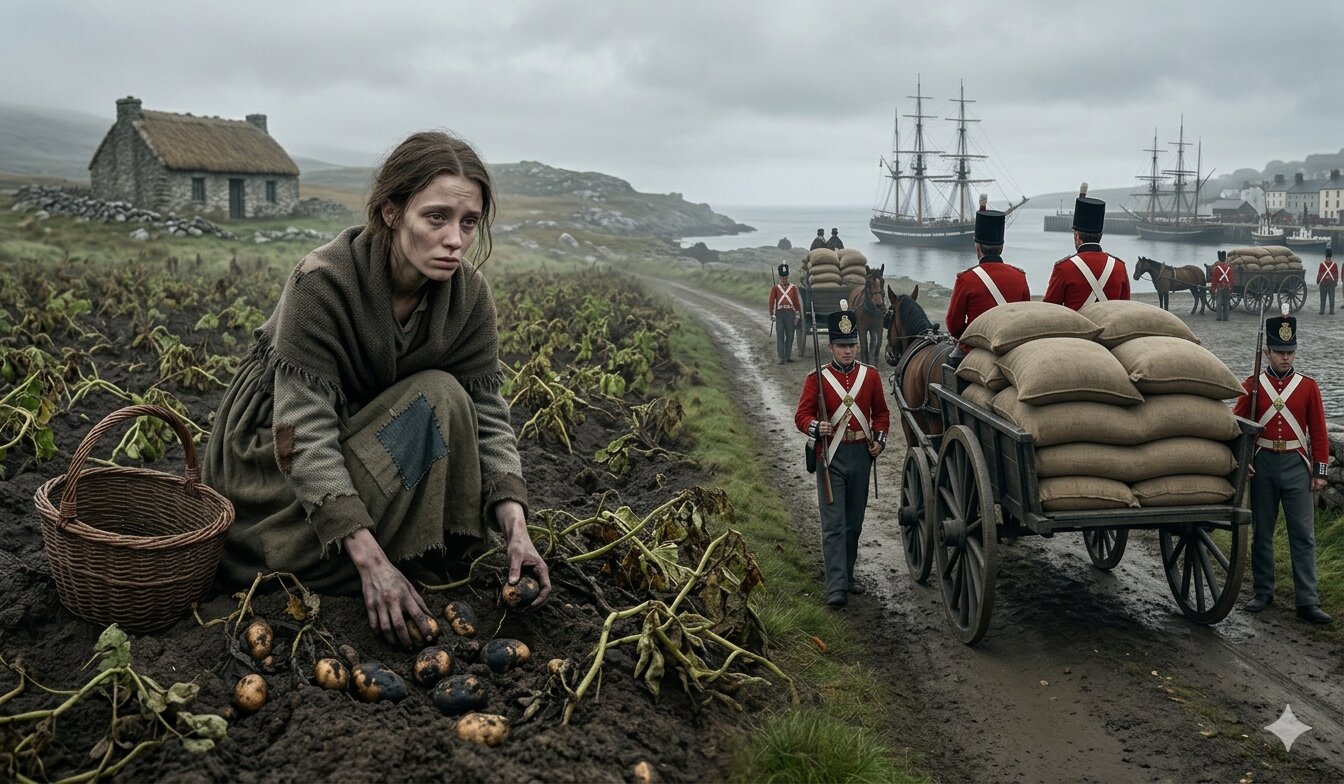
When farmers frantically dug into the earth, they didn’t find the firm, life-giving tubers they expected. Instead, they unearthed a rotting, blackened mush.
Phytophthora infestans—the potato blight—had arrived.
A Perfect Storm of Tragedy
The Irish Potato Famine, or An Gorta Mór (The Great Hunger), was never just about a fungus. It was a catastrophic collision of natural disaster and human failure.
To understand why a single crop failure turned into a genocide of neglect, one must look at the structure of 19th-century Ireland:
-
The Tenant System: Most of the land was owned by “absentee” British landlords. Irish families were often relegated to tiny plots of land, forced to pay high rents for the very soil they tilled.
-
The Monoculture Trap: Because the Lumper potato was so productive, it was the only thing grown. When the blight hit, there was no “Plan B.”
-
Laissez-faire Economics: The British government, led by figures like Sir Charles Trevelyan, was slow to provide aid. They believed that interfering with the “free market” would be a greater sin than the starvation of the populace.
Why Didn’t The Farmers Eat Other Grains?
The question of why Irish farmers didn’t simply eat the livestock and grain they were raising is one of the most tragic and debated chapters of the 19th century.
To understand the answer, one has to look past the biology of the blight and into the brutal mechanics of the colonial economy.
1. The “Rent or Starve” Dilemma
In the 1840s, the vast majority of Irish farmers were tenant farmers. They did not own the land; they rented small patches from landlords, many of whom lived in England.
These tenants used a “dual-crop” strategy:
-
The Potato: Grown on the smallest, poorest patch of land to feed the family.
-
The Grain (Wheat, Oats, Barley) and Livestock: Grown on the rest of the land specifically to pay the rent.
If a farmer ate the grain or slaughtered the cow to save his starving children, he would be unable to pay his rent.
This resulted in immediate eviction. Once evicted, the family lost their shelter and their ability to grow any food the following year.
For many, the choice was between starving inside their home or starving on the side of the road in the winter rain.
2. Armed Exports
One of the most harrowing sights of the Famine was the departure of ships from Irish ports.
While millions were starving, ships laden with oats, peas, beans, onions, rabbits, and beef were sailing for England.
Historians have noted that throughout the “Great Hunger,” Ireland remained a net exporter of food.
These exports were often protected by the British military to prevent “food riots” by the starving locals.
To the government in London, these exports were a matter of private property rights and sanctity of contract.
They believed that interfering with the export of food would ruin the economy.
3. The Lack of Processing Infrastructure
Even if a farmer managed to keep some grain, it wasn’t always edible in its raw state.
Most tenant cabins were set up only for boiling potatoes—the simplest form of cooking.
They often lacked:
-
The money to pay for the commercial milling of grain into flour.
-
Ovens for baking bread (most relied on a single peat fire and a pot).
-
Knowledge: Because the potato had been the sole staple for generations, many of the poorest families literally did not know how to cook or process grain-based meals.
4. The Ideology of “Moral Peril”
The British officials in charge of relief, such as Sir Charles Trevelyan, held a firm belief in Laissez-faire (let it be) economics.
They argued that giving food away for free—or stopping exports—would make the Irish “lazy” and dependent on the state.
They viewed the Famine as an “effective mechanism” for reducing Ireland’s population and modernizing its farming system.
In their eyes, the grain belonged to the landlords and the merchants, and the “market” must be allowed to function, even if the customers were dying.
The Bitter Reality: In 1848 alone, while the death toll was peaking, over 1.8 million bushels of grain were shipped out of Ireland. This was more than enough to bridge the gap left by the failed potato crop, but it was legally and physically out of reach for those who grew it.
The Years of Black ’47
By 1847, the situation had shifted from a crisis to a nightmare. The “soup kitchens” set up by the government and the Quakers were overwhelmed. Skeletal figures wandered the roads, their mouths stained green from attempting to eat grass.
While the potato crops failed, Ireland was actually producing plenty of other food.
Ships laden with grain, cattle, and dairy products were exported from Irish ports to England under armed guard, while the people who harvested them died of hunger in the shadows of the granaries.
This remains the most bitter sting of the famine’s legacy: the hunger existed in a land of plenty.
The Great Dispersion: A Legacy in Motion
As death knocked on every cottage door, the Irish were faced with a choice: stay and perish, or risk everything on the “Coffin Ships.”
These were overcrowded, disease-ridden vessels bound for North America.
Many did not survive the Atlantic crossing, their bodies committed to the deep.
However, those who did survive changed the world forever. The Famine triggered one of the greatest migrations in human history:
- The Diaspora: Over 1.5 million people fled, seeding vibrant Irish communities in New York, Boston, Liverpool, and beyond.
- Political Awakening: The trauma of the famine fueled a fierce desire for Irish independence, eventually leading to the revolution of the early 20th century.
- Cultural Scarring: The population of Ireland dropped by nearly 25% through death and emigration—a demographic wound that, in many rural areas, has never fully healed.
Remembering the Lessons
Today, the Irish Potato Famine serves as a haunting reminder of the dangers of extreme poverty, the fragility of a food system reliant on a single crop, and the devastating cost of political indifference.
It is a story of profound sorrow, but also one of incredible resilience.
From the ashes of the blackened potato fields rose a global Irish culture that remains as sturdy and enduring as the stone walls that still crisscross the hills of Connemara.
We remember An Gorta Mór not just as a history lesson, but as a testament to the human spirit’s will to survive against the darkest of harvests.