A tyrant almost never says, “This is my fault.”
He does something far more clever by letting anger rise and then throwing someone beneath him into the fire.
That is one of the oldest tricks in politics.
Machiavelli understood it better than most.
In The Prince, he advises rulers to let others handle “affairs of reproach,” while keeping honorable acts for themselves.
In plain English, that means this: let someone else carry the blame.
Let a minister do the dirty work.
Let a police chief terrify the people.
Let an adviser become the face of failure.
Then, when the hatred grows too hot, remove him.
The ruler remains.
The scapegoat falls.
This pattern appears again and again in history.
The names change.
The costumes change.
The method does not.
Cesare Borgia and Ramiro d’Orco
This is the example Machiavelli himself admired.
Cesare Borgia took control of a troubled region called Romagna.
It was disorderly, violent, and difficult to govern.
So he sent in a harsh lieutenant, Ramiro d’Orco, to impose order.
Ramiro did exactly what he was sent to do.
He ruled with severity, crushed disorder, and made himself feared.
Soon the province was quiet again.
But there was a problem.
The people now hated Ramiro, and that hatred could easily rise toward Borgia.
So Borgia acted.
He had Ramiro killed and his body displayed in public.
The message was brilliant and brutal.
The cruelty, the people were meant to believe, had belonged to the minister, not the prince.
Borgia kept the peace.
Ramiro absorbed the blame.
Machiavelli saw in this a masterclass in power.
He describes how Borgia used the minister’s “natural sternness” as a shield, then destroyed him when that shield had done its work.
It is a horrifying lesson.
A tyrant does not merely use force.
He stages force.
Commodus and Cleander
In ancient Rome, hunger could turn a crowd into a storm.
During the reign of Emperor Commodus, Rome suffered a grain shortage.
People grew angry, and angry people always want a face to blame.
That face became Cleander, a powerful imperial subordinate.
Cleander had influence, wealth, and enemies.
He was exactly the kind of man a desperate emperor could sacrifice.
As public fury mounted, Commodus gave the crowd what it wanted.
Cleander was executed.
The emperor survived by feeding the people a human offering.
Whether Cleander was corrupt or not is almost beside the point.
What matters is that he became the final container for anger that might otherwise have reached the throne.
That is how scapegoating works.
The subordinate does not have to be innocent.
He only has to be disposable.
Tiberius and Sejanus
Sejanus rose high under Emperor Tiberius.
He was not just another court official.
He became one of the most powerful men in Rome, commanding the Praetorian Guard and shaping the politics around the emperor.
Men like that are useful.
They do the things rulers want done.
They absorb fear.
They become the hard face of government.
But men like that are also dangerous.
If they become too powerful, or too hated, they stop being shields and start becoming threats.
That is what happened to Sejanus.
Tiberius turned on him.
Sejanus was arrested, condemned, and executed.
The people rejoiced at his fall.
It must have felt like justice.
One wicked man had fallen, and Rome could pretend its sickness had been cured.
But it was an illusion.
The terror did not vanish with Sejanus.
His death merely gave the empire a villain simple enough to hate.
That is another gift of the scapegoat.
He makes a complicated evil look simple.
Henry VIII and Thomas Cromwell
Henry VIII liked strong servants right up to the moment he no longer needed them.
Thomas Cromwell was one of the most capable men in Henry’s court.
He helped carry out some of the king’s most dramatic and ruthless policies.
He strengthened royal power.
He helped engineer the break with Rome.
He did the hard, ugly work of remaking England.
For years, Cromwell was indispensable.
Then came the marriage to Anne of Cleves.
The match turned into a disaster in Henry’s eyes.
Court enemies circled.
The king wanted distance from the failure.
Cromwell was the perfect man to sacrifice.
He was arrested and executed.
Once again, a ruler shifted blame downward.
The king’s policy became the minister’s mistake.
The king’s bad judgment became the servant’s fatal crime.
That is the comfort a scapegoat gives to power.
He allows the ruler to appear untouched by his own decisions.
Stalin and Nikolai Yezhov
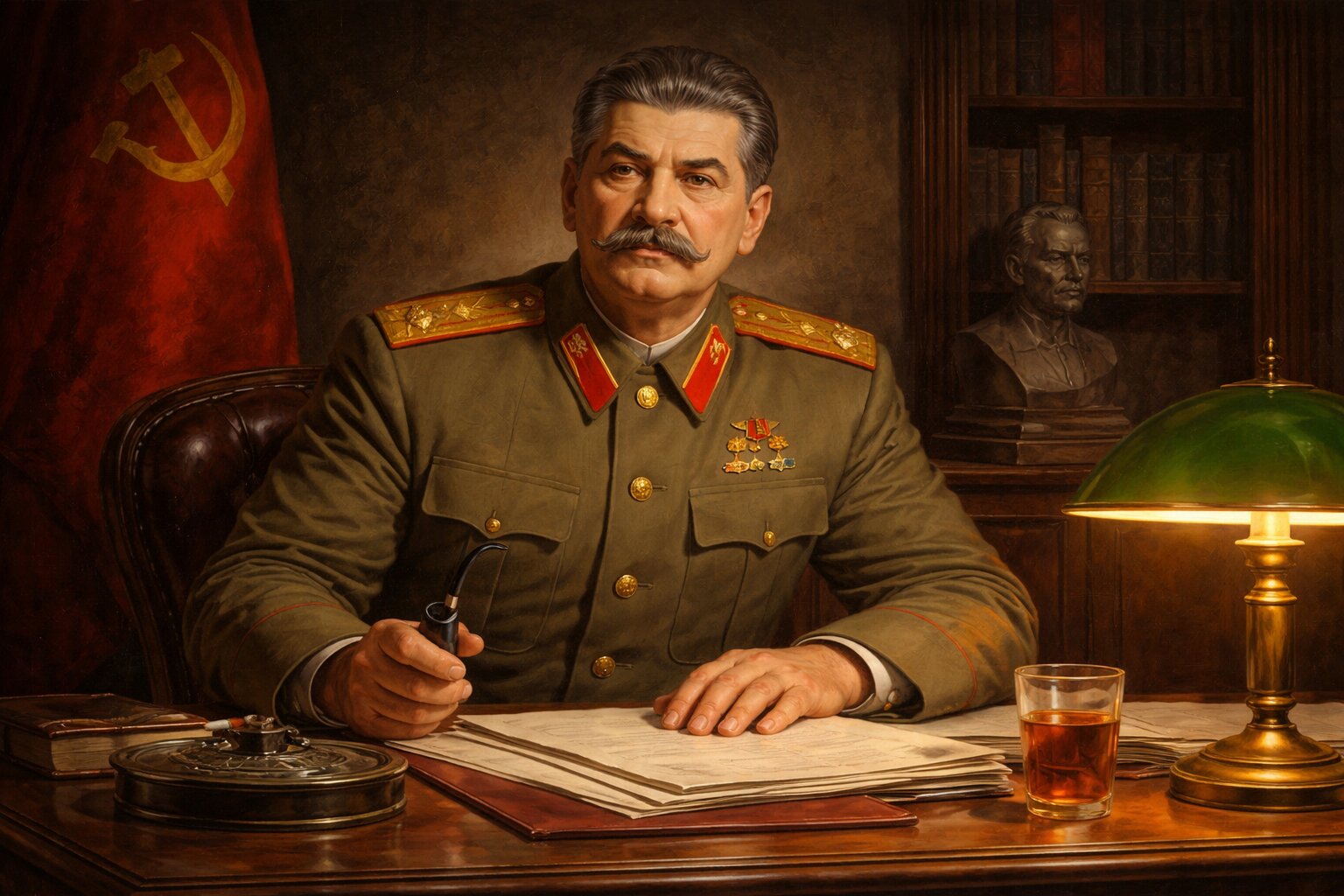
If there is a modern master of political scapegoating, it is Stalin.
During the Great Purge, Nikolai Yezhov oversaw the machinery of terror as head of the NKVD.
Arrests multiplied.
Executions spread.
Fear entered every home and office.
Yezhov became the face of mass repression.
But the terror had not appeared by accident.
It served Stalin’s system and Stalin’s will.
Then, when the bloodshed had gone too far even for Stalin’s convenience, the same system turned on Yezhov.
He was removed, arrested, and eventually executed.
The butcher became one more victim.
This is what makes the story so dark.
Yezhov was not merely a bystander who got blamed unfairly.
He was deeply involved.
But Stalin still used him as a scapegoat for the very terror Stalin had unleashed.
That is the genius of tyranny at its worst.
It makes guilt flow downward, never upward.
Mao and Liu Shaoqi
After the catastrophe of the Great Leap Forward, China was devastated.
Policies imposed from above had helped produce famine, suffering, and chaos.
But tyrannies do not like admitting that failure comes from the top.
They prefer to pin disaster on human betrayal.
Liu Shaoqi became one of the great targets of that blame.
He had once been one of the most important men in China.
But during the Cultural Revolution, he was denounced, humiliated, and destroyed politically.
The state turned him into a symbol of corruption and ideological betrayal.
This is a familiar pattern.
When policy fails, the tyrant does not confess error.
He invents treachery.
The failure of the system is turned into the guilt of a person.
That way the ruler can still appear pure, while the fallen man carries the burden of history.
Why tyrants love scapegoats
A scapegoat is useful because he simplifies anger.
People may not understand systems, institutions, or long chains of responsibility.
But they understand a face.
They understand a name.
They understand the spectacle of punishment.
That is why scapegoats are so powerful in politics.
They turn a complicated failure into a simple story.
They also protect the ruler’s image.
A throne depends not only on force, but on illusion.
The ruler must appear above the mess, even when he created it.
Machiavelli saw this clearly.
He also wrote that a prince should let others carry out harsh actions, while reserving acts of kindness and favor for himself.
That advice is cold, but it is honest.
It exposes how power often works behind its noble language.
The dark theater of rule
Tyrants are not just cruel.
They are theatrical.
They understand that politics is performance as much as force.
A public execution, a denunciation, a sudden fall from favor, all these things tell a story to the people.
The story is always the same.
The ruler is just.
The subordinate was the problem.
The system is sound.
Only one bad man needed to be removed.
That story is often a lie.
But it is a useful lie.
And tyrants have always known that useful lies can be stronger than truth.
Final thought
The most dangerous scapegoat is not always an innocent man.
Sometimes he is guilty.
Sometimes he is brutal.
Sometimes he truly did terrible things.
But he is still a scapegoat when a greater guilt above him is washed clean through his destruction.
That is the point Machiavelli understood.
Power survives not only by force, but by managing blame.
And when a tyrant suddenly discovers a villain at the edge of his own court, it is wise to ask one question.
Why was that man so useful yesterday?