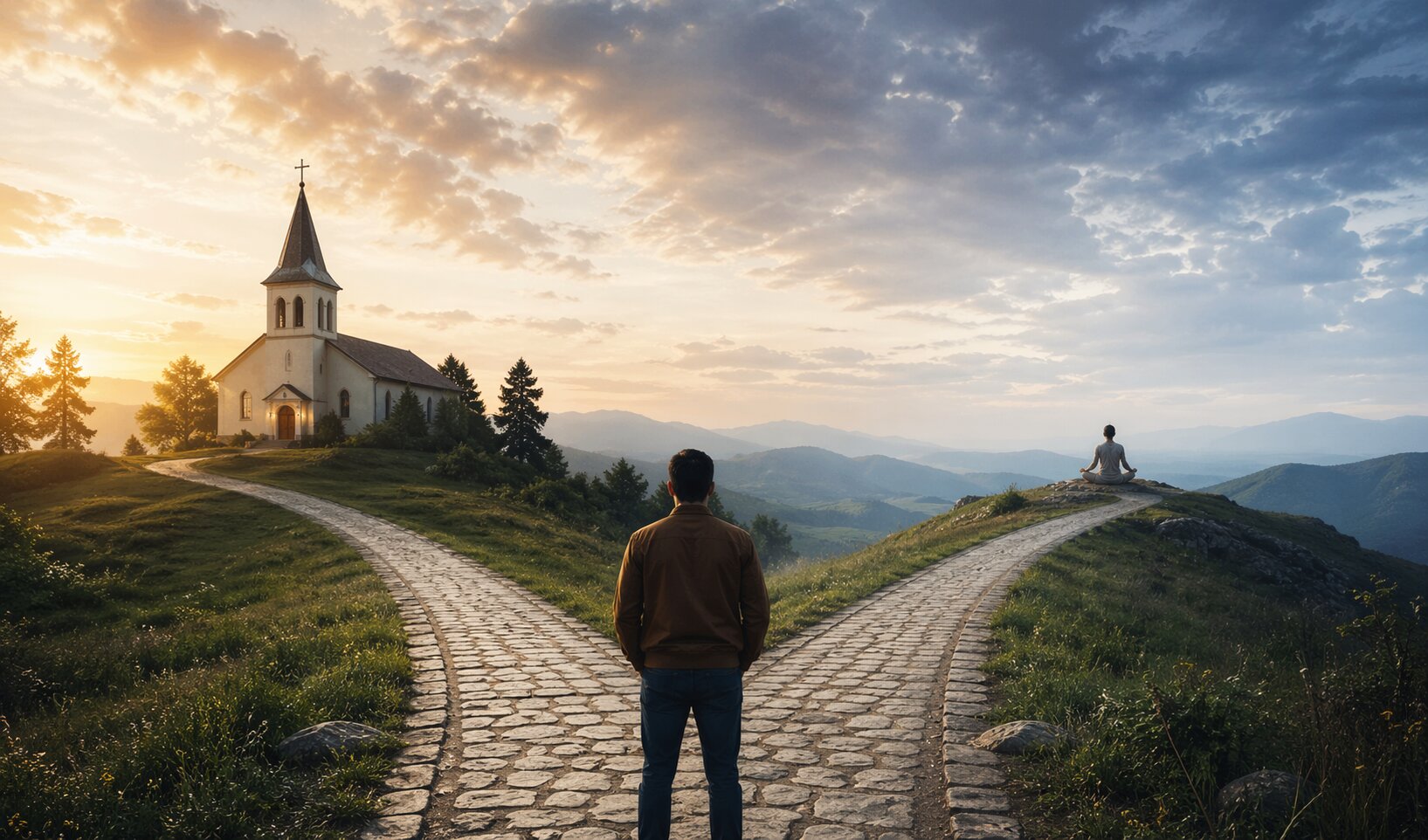
People often use the words spiritual and religious as if they mean the same thing.
They are related, but they are not identical.
A person can be religious and spiritual at the same time.
A person can also be spiritual without being religious.
Understanding the difference matters because these two ideas shape how people search for meaning, truth, morality, peace, and connection.
The Simple Difference
In general, religion is usually connected to an organized system of beliefs, practices, rituals, and worship.
Spirituality is more personal and inward.
Religion often involves a community, a tradition, sacred texts, and specific teachings about God, morality, and how to live.
Spirituality usually focuses on personal experience, inner transformation, self-awareness, and a sense of connection to something greater than oneself.
What It Means to Be Religious
A religious person usually follows a structured faith.
That structure may include attending a place of worship, following rituals, observing holy days, praying in a particular way, and accepting the teachings of a specific tradition.
Religion provides a shared framework.
It gives people a moral code, a sense of belonging, and answers to major life questions through established doctrine.
For many people, religion offers stability, identity, guidance, and community support.
It connects them to generations of believers who lived before them.
What It Means to Be Spiritual
A spiritual person usually focuses on the inner journey.
They may ask questions such as: Who am I, why am I here, what is the meaning of life, and how do I find peace?
Spirituality often emphasizes direct experience over formal structure.
It may involve meditation, reflection, mindfulness, silence, compassion, gratitude, or a feeling of connection with nature, humanity, or the universe.
A spiritual person may or may not believe in God in the traditional religious sense.
Their path is often more personal than institutional.
Organized Path vs. Personal Path
One of the clearest differences is that religion is usually organized, while spirituality is usually individual.
Religion says, “Here is a path that has been followed, tested, and preserved.”
Spirituality says, “Let me discover truth through my own inner experience.”
Religion often values obedience, tradition, and shared belief.
Spirituality often values freedom, exploration, and personal insight.
Neither approach is automatically better.
They simply answer the human search for meaning in different ways.
External Practice vs. Internal Experience
Religion often emphasizes external expressions of faith.
These may include prayer, fasting, ceremonies, scripture reading, and communal worship.
Spirituality emphasizes internal experience.
It asks whether a person feels peace, awareness, compassion, transcendence, or connection deep within.
A religious person may faithfully practice rituals.
A spiritual person may be more concerned with whether the heart is transformed.
This is why some people say religion is about the “house,” while spirituality is about the “fire” inside it.
Community vs. Solitude
Religion usually brings people together.
It creates congregations, institutions, festivals, traditions, and collective identity.
That communal aspect can be deeply powerful.
It offers support during grief, joy during celebration, and a shared sense of purpose.
Spirituality, by contrast, is often more solitary.
It may unfold in quiet reflection, meditation, long walks, journaling, or deep contemplation.
That does not mean spiritual people avoid others.
It simply means their search often begins within, rather than through a formal group.
Rules vs. Exploration
Religion often comes with doctrines, commandments, and boundaries.
It tells followers what is right, what is wrong, what to believe, and how to live.
For many, this is helpful.
Clear structure can prevent confusion and provide moral direction.
Spirituality is usually less focused on fixed rules.
It tends to encourage questioning, seeking, and personal discovery.
Some people find this freeing.
Others find it too vague.
That is one reason religion can feel grounding, while spirituality can feel open-ended.
Belief vs. Experience
Religion usually begins with belief.
A person accepts certain truths taught by a faith tradition.
Spirituality often begins with experience.
A person feels something, senses something, or awakens to something inwardly meaningful, and then tries to understand it.
Religion may say, “Believe, and then you will understand.”
Spirituality may say, “Experience, and then discover what it means.”
Again, these are broad tendencies, not rigid rules.
Many religious people have deep spiritual experiences.
Many spiritual people develop firm beliefs over time.
Can You Be Both?
Absolutely.
In fact, many people are both religious and spiritual.
They follow a religion, participate in its rituals, and belong to its community, while also cultivating a deep personal inner life.
This can be a powerful combination.
Religion can provide roots.
Spirituality can provide depth.
Religion can offer structure.
Spirituality can keep that structure alive and meaningful.
When the two work together well, faith becomes both grounded and deeply felt.
Why Some People Reject Religion but Keep Spirituality
Many people say, “I am spiritual, but not religious.”
Usually, they mean they still care about meaning, inner peace, morality, and transcendence, but they feel disconnected from organized religion.
Some may have had painful experiences with religious institutions.
Others may feel that religion has become too rigid, political, judgmental, or focused on rules instead of transformation.
So they keep the search for the sacred, but leave behind the institution.
They want connection without dogma.
They want depth without formal membership.
A simple way to remember the difference is this:
Religion is about belonging to a sacred path.
Spirituality is about personally experiencing the sacred.
Religion often asks, “What has been revealed, taught, and practiced?”
Spirituality often asks, “What is happening inside my soul right now?”
Religion leans toward tradition.
Spirituality leans toward transformation.
Final Thoughts
At their best, both religion and spirituality try to answer the deepest human questions.
Why are we here?
What is truth?
How should we live?
What gives life meaning?
Religion offers a map.
Spirituality is the felt journey.
Religion builds the temple.
Spirituality lights the candle inside it.
The healthiest life is often not about choosing one and attacking the other.
It is about understanding what each offers, where each can go wrong, and how both can help human beings live with greater meaning, humility, depth, and peace.