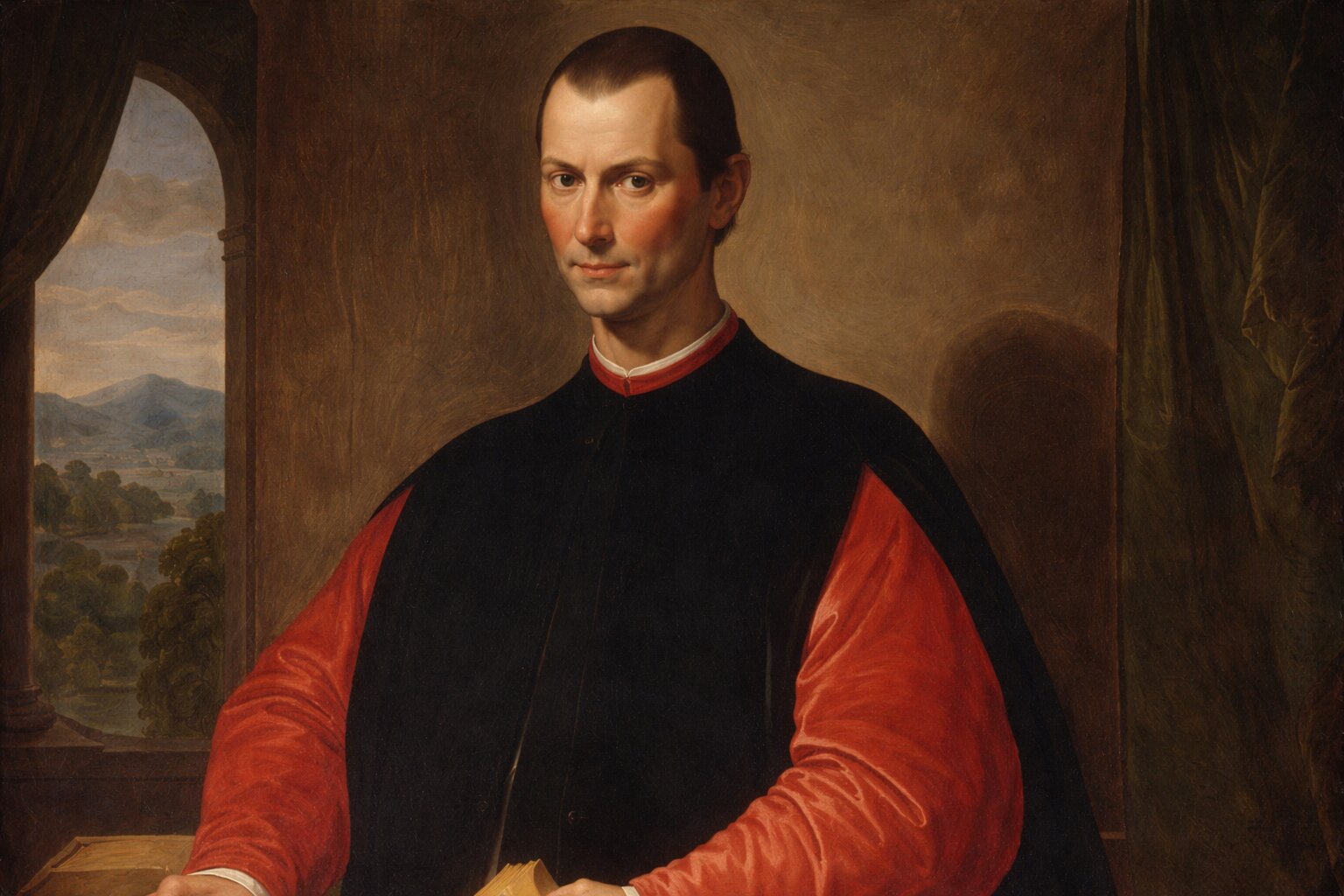
A Child of Florence and Conflict
Niccolò Machiavelli was born in Florence on May 3, 1469, into a world where politics was not a matter of theory, but a dangerous game played with daggers, alliances, betrayals, and ambition.
He grew up in Renaissance Italy, where city-states rose and fell quickly, and where the distance between high office and ruin could be as short as a single bad decision.
Educated in the classical traditions of Rome and Greece, Machiavelli absorbed the lessons of ancient history early, and those lessons would later shape the hard, unsentimental way he viewed power.
A Man Who Entered the Arena
He did not become famous by sitting quietly in a library, but by stepping directly into public life as a senior official in the Florentine Republic after the Medici family was driven from power.
In that role, he moved through the tense corridors of diplomacy, traveling to France, Germany, and Rome, where he observed rulers, courts, armies, and intrigue up close.
These were not abstract experiences, because Machiavelli was studying real men making real moves in the struggle to rule and survive.
The Lesson of Cesare Borgia
Among the figures who impressed him most was Cesare Borgia, a man whose cunning, speed, and ruthlessness seemed to embody the brutal logic of political success.
Where others saw cruelty and treachery, Machiavelli also saw method.
He admired Borgia not because he was morally pure, but because he understood how power is gathered, secured, and defended in an unstable world.
That habit of looking at politics as it truly operated, rather than as people wished it operated, would become Machiavelli’s signature.
When Fortune Turned
Then fortune turned against him.
In 1512, the Medici family returned to power, and Machiavelli, once a trusted servant of the republic, lost his position almost overnight.
Soon afterward, he was imprisoned, accused of conspiracy, and tortured under suspicion of opposing the restored regime.
The man who had once studied power from the inside now felt its weight on his own body.
Though he was eventually released, he was pushed out of political life and sent into a kind of exile at his family estate near Florence.
Exile Gave Birth to a Masterpiece
For many men, that would have been the end of the story.
For Machiavelli, it became the beginning of immortality.
Stripped of office but not of intellect, he began writing the works that would make his name echo through the centuries.
The most famous of those works was The Prince, written in 1513 and published after his death in 1532.
It was a short book, but it hit the world like a blade.
The Book That Refused Illusions
In The Prince, Machiavelli wrote with startling clarity about how rulers gain power, keep power, and lose power.
He did not waste much time comforting readers with idealistic fantasies.
Instead, he argued that politics often requires pragmatism, deception, force, and calculation.
This is why he became associated with the phrase, “the ends justify the means,” even though the exact wording is not his most direct line.
What mattered to Machiavelli was not how power should look in a perfect moral universe, but how it behaves in the real one.
Loved or Feared
He famously argued that it is better for a ruler to be feared than loved if he cannot be both.
That line has survived for centuries because it sounds cold, dangerous, and brutally honest.
Yet Machiavelli’s point was not that rulers should be needlessly cruel, but that affection is fragile while fear, if managed carefully, is more reliable.
He believed a ruler who depends only on love is building his house on soft ground.
Why He Distrusted Mercenaries
Machiavelli also distrusted mercenaries, believing that a state should rely on its own citizens for defense rather than hired soldiers who fight only for pay.
To him, a strong militia was not just a military necessity, but a sign of a healthy political community.
His concern with war and power also appeared in The Art of War, where he explored the deep connection between military strength and political stability.
More Than the Author of The Prince
But Machiavelli was not only the author of The Prince, despite the way history often traps him inside that one dark and glittering book.
In Discourses on Livy, he revealed another side of his mind, one that respected republican government, civic virtue, and shared political life.
This is what makes him more interesting than his caricature.
He was not simply cheering for tyrants, but wrestling with one of history’s oldest questions: how can order survive in a world filled with ambition, fear, weakness, and chaos?
Religion, Power, and Social Order
He criticized the Catholic Church for its political interference, yet he also understood that religion could serve as a powerful force for social unity.
That dual vision defined much of his writing.
He saw institutions not as sacred ornaments, but as tools that could strengthen or weaken a people depending on how they were used.
The Sharp Edge of His Pen
His prose was sharp, witty, and often edged with satire, which gave his political insights a force that dry theorists rarely achieve.
He wrote like a man who had seen too much to be naïve and too clearly to be sentimental.
That is why his name escaped the boundaries of biography and became an idea of its own.
When a Name Becomes an Adjective
The word “Machiavellian” entered the language to describe cunning, manipulative, and morally flexible behavior.
Few writers have been so thoroughly transformed into an adjective.
Some see that as proof of his darkness.
Others see it as proof that he understood human nature too well for comfort.
The Mind That Shaped Political Realism
Over time, his influence spread far beyond Florence.
Leaders, philosophers, generals, and political thinkers returned to him again and again, searching his pages for insight into ambition, leadership, fear, and statecraft.
He became one of the founding figures of modern political science because he treated politics as something to be observed honestly rather than disguised with pious language.
In many ways, he anticipated what later generations would call realpolitik.
He cared less about ideological purity than about outcomes, survival, and the actual mechanics of power.
A Genius Recognized Too Late
That does not make him easy to love.
But it does make him impossible to ignore.
When Machiavelli died in Florence on June 21, 1527, he was not widely celebrated as the genius history would later recognize.
He left the world with little of the glory that later clung to his name.
Yet his books survived, and in time they outlived princes, popes, generals, republics, and critics.
Why Machiavelli Still Matters
Today, centuries after his death, Machiavelli remains one of the most studied and debated minds in politics, philosophy, and literature.
He endures because he refused to lie about power.
He looked at the world as it was, not as people wished it to be.
And in doing so, he became the man who taught generations that behind every throne, every republic, every revolution, and every smiling public speech, there is always a harder and more dangerous story.