Before there were mortgages, credit scores, or suburban cul-de-sacs, attraction followed quieter rules.
Across cultures and centuries, one pattern keeps resurfacing: when choosing a long-term partner, many women place unusual weight on stability — on whether a man has built something solid beneath his feet.
Not charm.
Not poetry.
Not raw potential.
Structure.
A career that isn’t drifting.
A life that isn’t improvised.
A plan that stretches beyond next weekend.
You can dismiss it as modern materialism — but the pattern is older than civilization itself.
To understand it, we need to leave cities behind.
A Scene from the Savanna
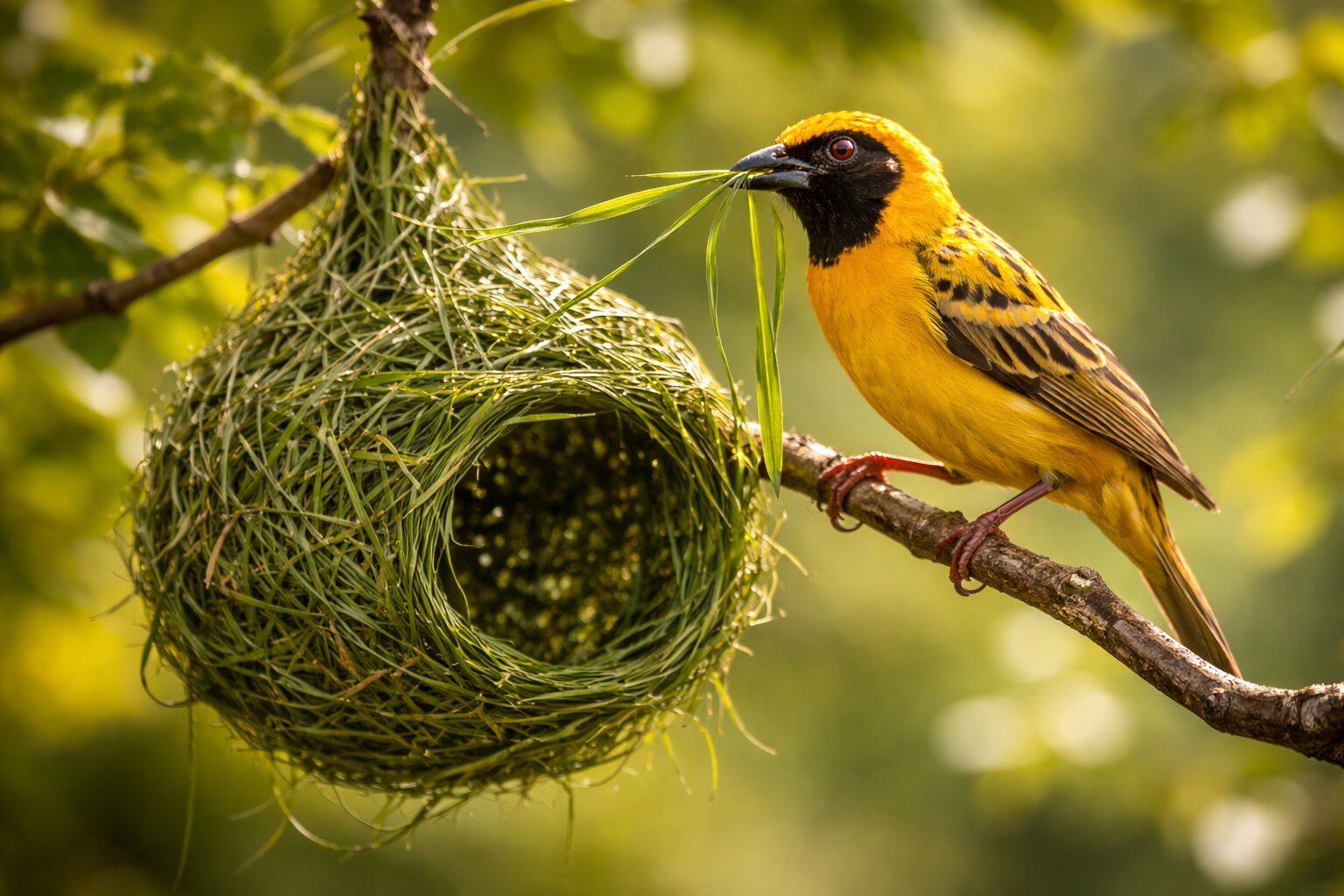
Imagine a quiet acacia tree in sub-Saharan Africa. Dozens of small woven structures hang from its branches like lanterns swaying in the wind.
They are not random tangles of grass.
They are deliberate constructions — tightly knotted, gravity-defying chambers with downward-facing entrances to keep predators out.
And somewhere nearby, a small yellow bird is still working.
This is the courtship ritual of the Village Weaver.
But notice something important: he doesn’t begin by singing.
He begins by building.
Proof Before Promise
The male weaver bird gathers strips of grass and meticulously knots them together using only his beak and instinct. The structure must be strong enough to survive windstorms, secure enough to deter snakes, and positioned strategically on the branch.
When it’s complete, he calls for attention.
A female arrives.
She does not applaud.
She does not assume good intentions.
She inspects.
She pulls at the fibers.
She evaluates the entrance.
She judges location and durability.
If it fails?
She flies away.
The male often tears it down and starts again.
No debate.
No explanation.
Just selection.
What the Nest Signals
The nest isn’t decorative. It’s data.
It communicates:
- Physical health (only strong males can weave efficiently)
- Technical skill
- Patience
- Access to good territory
- Persistence after rejection
It answers one evolutionary question:
Will my offspring survive here?
In human terms, this maps closely onto findings from evolutionary psychology research — including work by David Buss, author of The Evolution of Desire.
Across dozens of cultures, women consistently rank long-term resource stability, ambition, and reliability higher than men do when choosing a committed partner.
Why?
Because pregnancy and early child-rearing historically required protection and provisioning.
The preference for stability isn’t new.
It’s ancient.
The “House” in Modern Form
Today, the structure may not be woven grass hanging from a tree.
It may be:
- A house or apartment purchased with discipline
- A career built with steady progression
- Financial responsibility
- Emotional maturity
- Long-term planning
When someone says, “She wants a man who has his own place,” it’s rarely about square footage.
It’s about demonstrated competence.
The house symbolizes something deeper:
- Commitment
- Future orientation
- The ability to build rather than drift
The weaver bird doesn’t advertise potential. He demonstrates capability.
Rejection as Refinement
Another remarkable detail: male weavers often build multiple nests in a season — sometimes dozens.
Rejection doesn’t end the ritual.
It improves the next attempt.
There is no resentment in the system.
There is only feedback.
In human relationships, resilience plays a similar role. Stability is not built overnight. It is assembled piece by piece — through skill acquisition, savings, discipline, and consistency.
Architecture takes time.
The Quiet Logic of Attraction
It’s easy to reduce these dynamics to caricature — to call them superficial or transactional.
But beneath modern narratives lies something biological:
Where vulnerability increases, selectivity follows.
The weaver bird’s nest protects eggs from rain and predators.
A human “house” protects children from uncertainty.
Across species, attraction often orients around survival probability.
And survival probability often tracks competence.
Modern Misinterpretations
Today, the idea that women prefer stability is sometimes framed negatively — as “materialistic” or “gold-digging.”
But evolutionary signals are older than modern commentary.
In ancestral environments:
No resources = no protection
No shelter = no survival
No provider = no offspring
The house, whether grass-woven or brick-built, signals protection against uncertainty.
The Deeper Lesson
The weaver bird doesn’t complain about standards.
He doesn’t debate fairness.
He builds.
And the female chooses.
There is no resentment in nature — only strategy.
The male’s job is to demonstrate capacity.
The female’s job is to evaluate it.
When we strip away modern narratives, what remains is something elegant:
Women’s Attraction towards Men often aligns with competence.