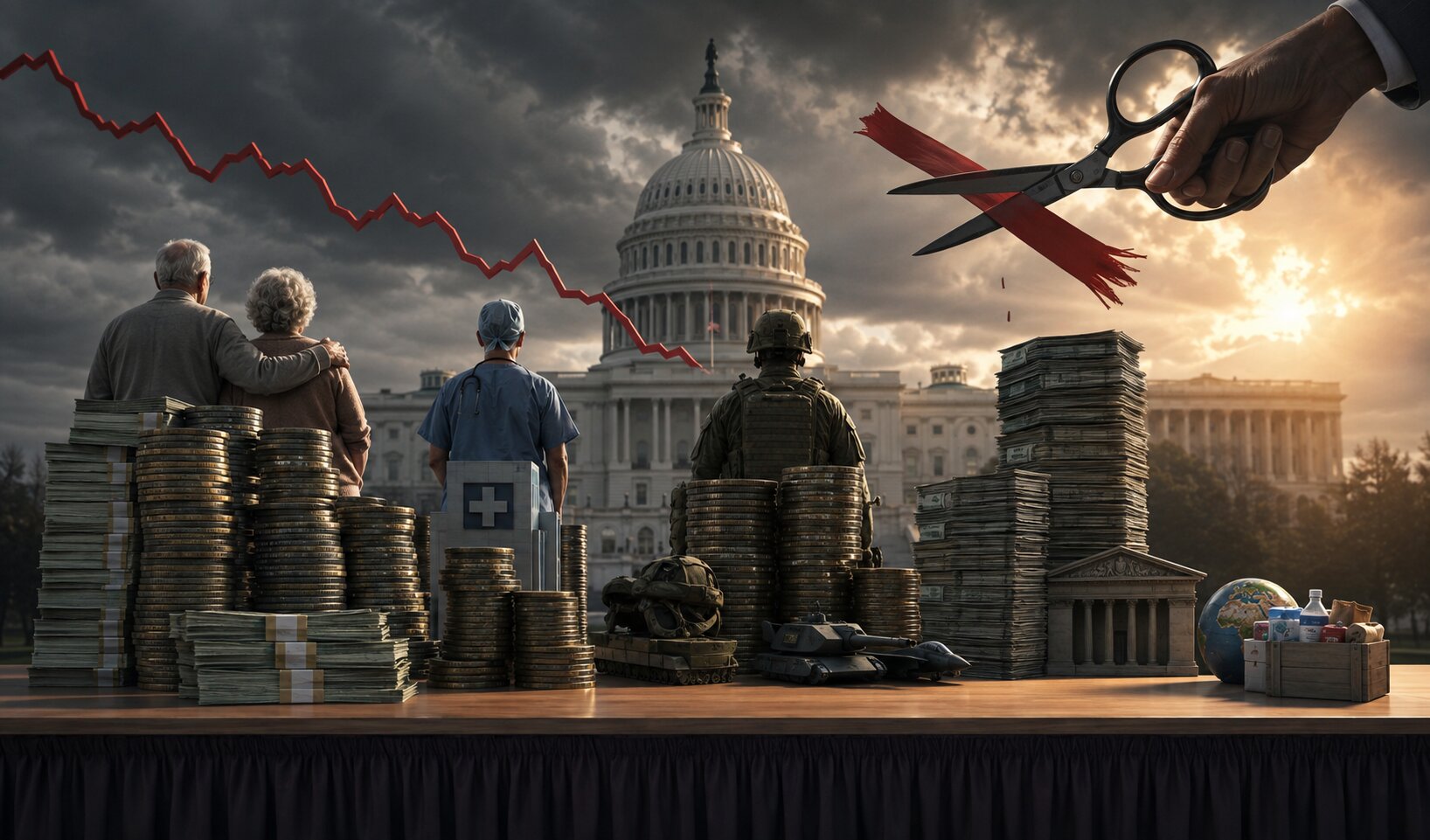
Be a Socialist in Your Heart, a Capitalist in Your Government
Modern politics often frames the world as a binary choice: socialism vs capitalism. But the real solution may lie in an unexpected combination.
A healthy society may actually require individuals to behave like socialists—generous, cooperative, compassionate—while governments operate with capitalist discipline—efficient, accountable, and fiscally responsible.
When these roles are reversed, nations often drift toward unsustainable debt and political dysfunction.
This idea may sound counterintuitive at first, but history, economics, and human psychology all suggest that misaligned incentives in government spending can gradually bankrupt even wealthy nations.
Let’s explore why.
The Human Side: Individuals Should Be Socially Generous
At the personal level, societies thrive when people act with empathy.
Families, communities, and friendships function because individuals willingly share resources and help others. Parents support children, neighbors assist one another during hardship, and communities donate to charity.
These behaviors resemble small-scale socialism, but they work because they occur in close social networks with accountability and emotional bonds.
Examples are everywhere:
- Parents sacrifice their own comfort to educate their children.
- Friends help one another during unemployment or illness.
- Communities rally to support victims of disasters.
These actions strengthen social fabric.
But importantly, individual generosity is voluntary and personal, not mandated by bureaucracies. People give because they care, not because of political incentives.
The Political Problem: Governments Are Incentivized to Spend
Governments operate under a completely different incentive structure.
Politicians face one primary goal:
Win the next election.
To achieve that goal, there is a powerful temptation to promise benefits, subsidies, and spending programs to voters.
The problem is that politicians gain immediate political rewards for spending money but suffer very little political cost for creating long-term debt.
This dynamic creates what economists call a “fiscal illusion.”
Voters enjoy immediate benefits today while the costs appear distant, abstract, or deferred to future generations.
Over time, the result is predictable:
- Expanding entitlement programs
- Increasing government payrolls
- Growing subsidies and tax credits
- Rising public debt
Each policy may seem reasonable individually. But collectively, they produce structural deficits.
The Election Incentive Trap
Imagine two politicians competing in an election.
Candidate A proposes:
- Free college
- New subsidies
- Expanded benefits
Candidate B proposes:
- Balanced budgets
- Spending discipline
- Long-term fiscal restraint
Which candidate is more likely to win?
In many cases, the candidate promising more immediate benefits wins.
This creates a dangerous feedback loop:
- Politicians promise more spending to win votes.
- Debt increases.
- The next election cycle begins with even more promises.
Over decades, this process can push countries toward unsustainable fiscal paths.
Warren Buffett’s 5-Minute Solution
Even legendary investor Warren Buffett once highlighted the absurdity of this dynamic with a simple proposal.
He famously said:
“I could end the deficit in five minutes. You just pass a law that says that anytime there is a deficit of more than 3% of GDP, all sitting members of Congress are ineligible for reelection.”
Buffett’s statement was partly humorous, but it revealed a profound truth:
Political incentives drive fiscal outcomes.
If lawmakers faced direct consequences for deficits, budget discipline would likely improve almost immediately.
In other words, the problem is not necessarily economic knowledge—it is the incentive structure.
What Happens When Governments Ignore Fiscal Discipline
History provides numerous examples of governments that prioritized political spending over long-term fiscal responsibility.
Argentina
Argentina was once among the richest countries in the world in the early 20th century.
Repeated cycles of populist spending, subsidies, and fiscal deficits gradually eroded the economy. The country has experienced:
- chronic inflation
- repeated sovereign defaults
- severe currency crises
Political incentives repeatedly favored short-term benefits over structural reforms.
Greece
Before the European debt crisis, Greece expanded government employment, pensions, and public spending.
When debt levels became unsustainable, the country faced severe austerity measures and economic contraction.
The political cost of decades of excessive spending eventually arrived—but it arrived suddenly and painfully.
The United States
The United States has not faced a crisis of that magnitude, but the trajectory of federal debt is increasingly concerning.
Over decades, both political parties have supported policies that increase deficits:
- tax cuts without spending reductions
- new entitlement programs
- emergency stimulus spending
Each policy has political justification. But collectively, they push debt levels higher.
Why Government Should Behave Like a Capitalist
In contrast to individuals, governments must operate with capitalist-style discipline.
Capitalism imposes constraints through:
- budgets
- profit and loss
- accountability
- efficiency
Businesses that overspend without revenue eventually fail.
Governments, however, can often borrow, print money, or raise taxes, delaying the consequences of fiscal imbalance.
Because governments lack the natural constraints of markets, they must create institutional discipline through policy.
Examples include:
- balanced budget rules
- debt limits
- independent fiscal oversight
Without these guardrails, the political system tends toward excess spending.
The Ideal Balance
A healthy society may require a subtle balance:
Individuals:
Generous, compassionate, community-oriented.
Governments:
Disciplined, efficient, financially responsible.
In other words:
- Let people behave like socialists toward one another in their communities.
- Let governments behave like capitalists with budgets and resources.
This alignment ensures that compassion remains strong while fiscal stability remains intact.
The Long-Term View
Debt accumulation rarely destroys a nation overnight.
Instead, it slowly erodes economic flexibility.
As debt grows:
- interest payments consume larger portions of budgets
- investment in infrastructure and innovation declines
- governments lose policy flexibility during crises
Eventually, difficult tradeoffs become unavoidable.
Fiscal discipline, therefore, is not about austerity for its own sake—it is about preserving long-term economic resilience.
The Paradox of Compassion and Discipline
The paradox is simple:
A society that wants to remain compassionate over the long run must maintain fiscal discipline today.
Without discipline, the resources needed for future generosity may disappear.
As Warren Buffett’s remark suggests, sometimes the solution to persistent deficits is not more economic theory—it is better incentives for those who control public spending.
If political systems reward fiscal responsibility instead of fiscal expansion, governments may finally begin behaving the way sustainable economies require.
In the end, perhaps the most stable formula is this:
Socialism in the heart.
Capitalism in the budget.
When compassion guides individuals and discipline guides governments, societies have the best chance of remaining both prosperous and humane.