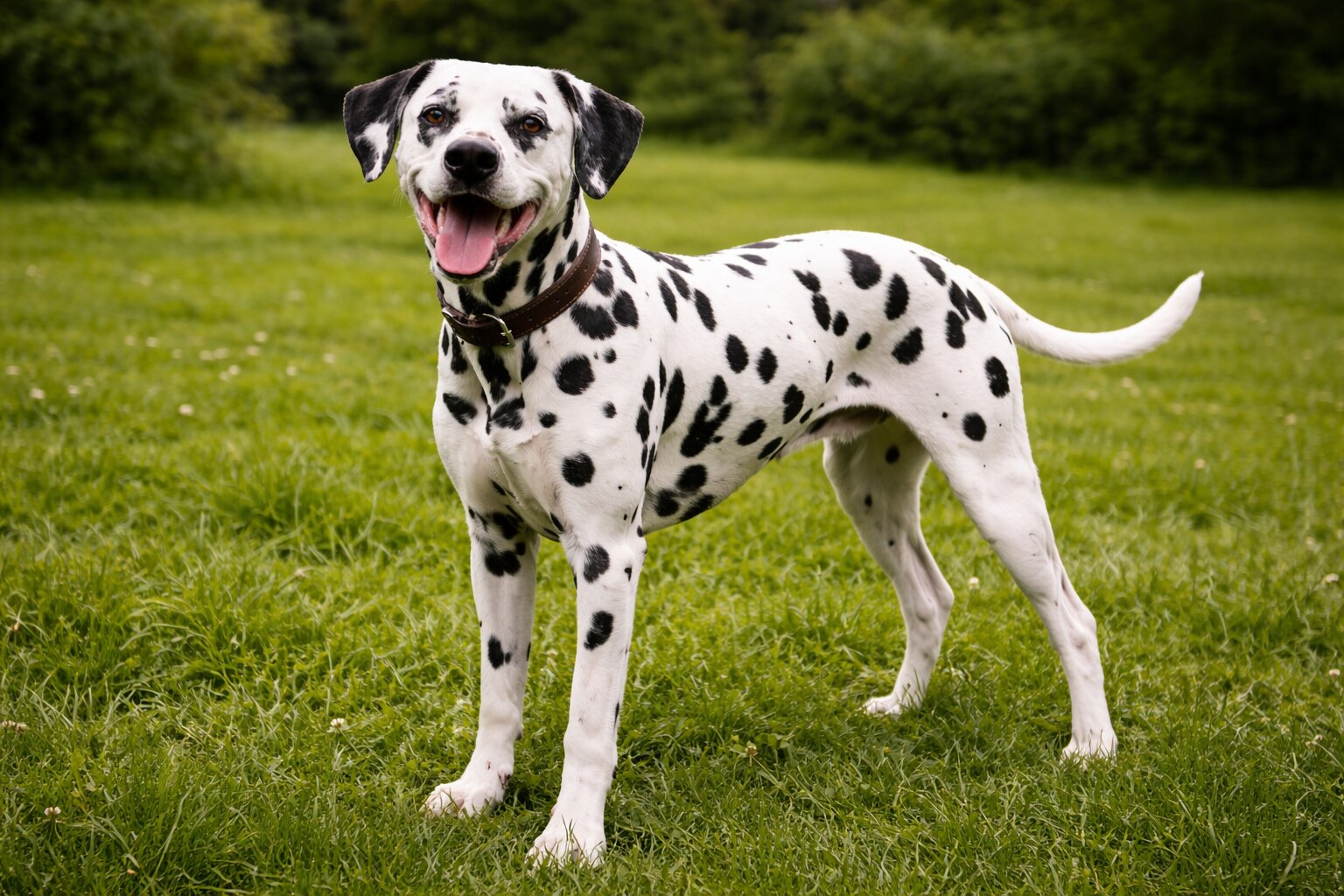
Few dogs are instantly recognizable from a distance. The Dalmatian is one of them.
White coat. Jet-black (or liver) spots. Athletic build. Almost theatrical elegance.
But behind that striking appearance is a centuries-old story of selective breeding, endurance running, aristocratic carriages—and even fire engines.
Let’s dive into how this spotted athlete came to be.
Where Did Dalmatians Come From?
The breed’s name points to Dalmatia, a historical region along the Adriatic coast (modern-day Croatia). While spotted dogs appear in ancient artwork dating back thousands of years, the modern Dalmatian was standardized in 18th-century England.
Interestingly, England—not Croatia—is where the breed was refined into what we know today.
By the 1700s, British breeders developed Dalmatians into what were called “carriage dogs.” These dogs would:
- Run alongside horse-drawn carriages for miles
- Guard passengers and cargo
- Clear the road ahead
- Protect horses at night
This required:
- Exceptional stamina
- Fearlessness
- A natural affinity for horses
- Strong guarding instincts
Breeding focused less on beauty and more on endurance and temperament. The spots were simply a bonus that made them unforgettable.
The breed was officially recognized by the American Kennel Club in 1888.
Why Were They Firehouse Dogs?
Before motorized fire trucks, fire engines were pulled by horses.
Dalmatians were already perfect carriage runners. Fire departments began using them to:
- Run ahead of horse-drawn fire wagons
- Clear crowds
- Guard equipment
- Calm the horses at chaotic fire scenes
Even today, the Dalmatian remains a symbolic mascot for many fire departments.
Their Most Unique Trait: The Spots
Dalmatians are born pure white.
The spots appear gradually over the first few weeks of life.
These spots are caused by a genetic pigmentation pattern. No two Dalmatians have identical markings—each is as unique as a fingerprint.
There are two primary coat varieties:
- Black-spotted
- Liver-spotted (brown)
Their coat is short, dense, and surprisingly heavy-shedding year-round.
Yes—those elegant white dogs shed constantly.
Built Like Marathon Runners
Dalmatians were bred for endurance, not bulk.
Average Size:
- Height: 19–24 inches
- Weight: 45–70 pounds
They are muscular but lean, with deep chests and powerful hindquarters. Their body structure is optimized for sustained trotting—not short bursts like a Greyhound.
If under-exercised, that energy doesn’t disappear.
It explodes.
They are not couch dogs.
Life Span and Health
Average Life Span: 11–13 years
Some live longer with good care.
However, Dalmatians have some unique genetic considerations:
1. Deafness
Up to 10–12% of Dalmatians are born completely deaf, and many more have partial hearing loss. This is linked to the same gene responsible for their white coat.
2. Urinary Stones
Dalmatians have a rare metabolic trait: they process uric acid differently than most dog breeds. This makes them prone to urinary stones.
Modern breeders have introduced a “low uric acid” line through careful outcrossing to reduce this issue.
3. High Energy Demands
Without mental and physical stimulation, they can develop behavioral problems.
This is not a beginner’s breed.
Temperament: Noble but Sensitive
Dalmatians are:
- Loyal
- Protective
- Intelligent
- Highly energetic
- Sensitive to harsh training
They bond strongly with their families but may be reserved with strangers.
Because they were bred to guard and run long distances, they need:
- Daily vigorous exercise
- Structured training
- Clear leadership
They thrive in active households.
The Disney Effect
After the release of 101 Dalmatians and later its live-action adaptation starring Glenn Close, Dalmatian popularity exploded.
Unfortunately, this led to overbreeding and inexperienced owners adopting high-energy dogs they weren’t prepared to handle.
Many ended up in shelters.
The lesson? Beauty alone is not enough reason to choose a breed.
A Breed of Endurance and Elegance
The Dalmatian is not just a spotted fashion statement.
It is:
- A marathon runner
- A carriage guardian
- A firehouse icon
- A genetically fascinating breed
- A dog built for movement and purpose
They were engineered for work.
And when they don’t have it, they create their own.
If you want a calm lapdog, look elsewhere.
If you want a living piece of history that can run beside you for miles—physically and loyally—the Dalmatian is unmatched.
Final Thought
The Dalmatian is a reminder of something deeper about selective breeding.
When humans shape animals for function, elegance often follows.
But when we choose them only for appearance, we forget the engine beneath the coat.
And the Dalmatian has one of the strongest engines in the dog world.