From Blitzkrieg to Berlin
When Germany invaded Poland on September 1, 1939, few could have imagined the scale of the war that would follow. Within less than two years, Nazi Germany controlled or dominated most of continental Europe. Poland had been crushed, France had fallen, and German armies stood deep inside the Soviet Union.
Yet less than six years after the invasion of Poland, Adolf Hitler was dead, Berlin was in ruins, and Germany had surrendered unconditionally.
The story of Germany in World War II is therefore one of the most dramatic military reversals in history: extraordinary operational victories followed by strategic overreach and catastrophic defeat.
1. Invasion of Poland — September 1939
Result: Decisive German victory
World War II in Europe began when Germany invaded Poland on September 1, 1939.
German forces combined tanks, motorized infantry, artillery and aircraft in fast-moving operations commonly associated with Blitzkrieg — “lightning war.” Rather than fighting a slow war of attrition, German formations attempted to penetrate enemy lines, surround opposing armies and destroy them before they could reorganize.
Britain and France declared war on Germany on September 3.
Poland was also invaded from the east by the Soviet Union on September 17, following the secret arrangements associated with the Molotov–Ribbentrop Pact.
Warsaw surrendered on September 28, and organized Polish resistance soon collapsed.
Outcome: Poland was divided between Germany and the Soviet Union. Germany had won its first major campaign, but Britain and France were now at war with it.
2. Denmark and Norway — April–June 1940
Result: German victory
Germany next invaded Denmark and Norway.
Denmark surrendered extremely quickly. Norway resisted longer with British and French assistance, but German forces ultimately prevailed.
Norway was strategically valuable because it helped protect Germany’s access to Swedish iron ore and gave the German navy and air force bases closer to the North Atlantic.
Outcome: Germany occupied Denmark and Norway, strengthening its position in northern Europe.
3. Battle of France — May–June 1940
Result: Spectacular German victory
This was perhaps Germany’s most astonishing victory of the war.
France possessed one of Europe’s largest armies and was protected along much of its eastern frontier by the formidable Maginot Line.
Germany largely avoided attacking the strongest portions of those defenses. German armored forces instead advanced through the Ardennes, crossed the Meuse and raced toward the English Channel.
The maneuver split Allied forces.
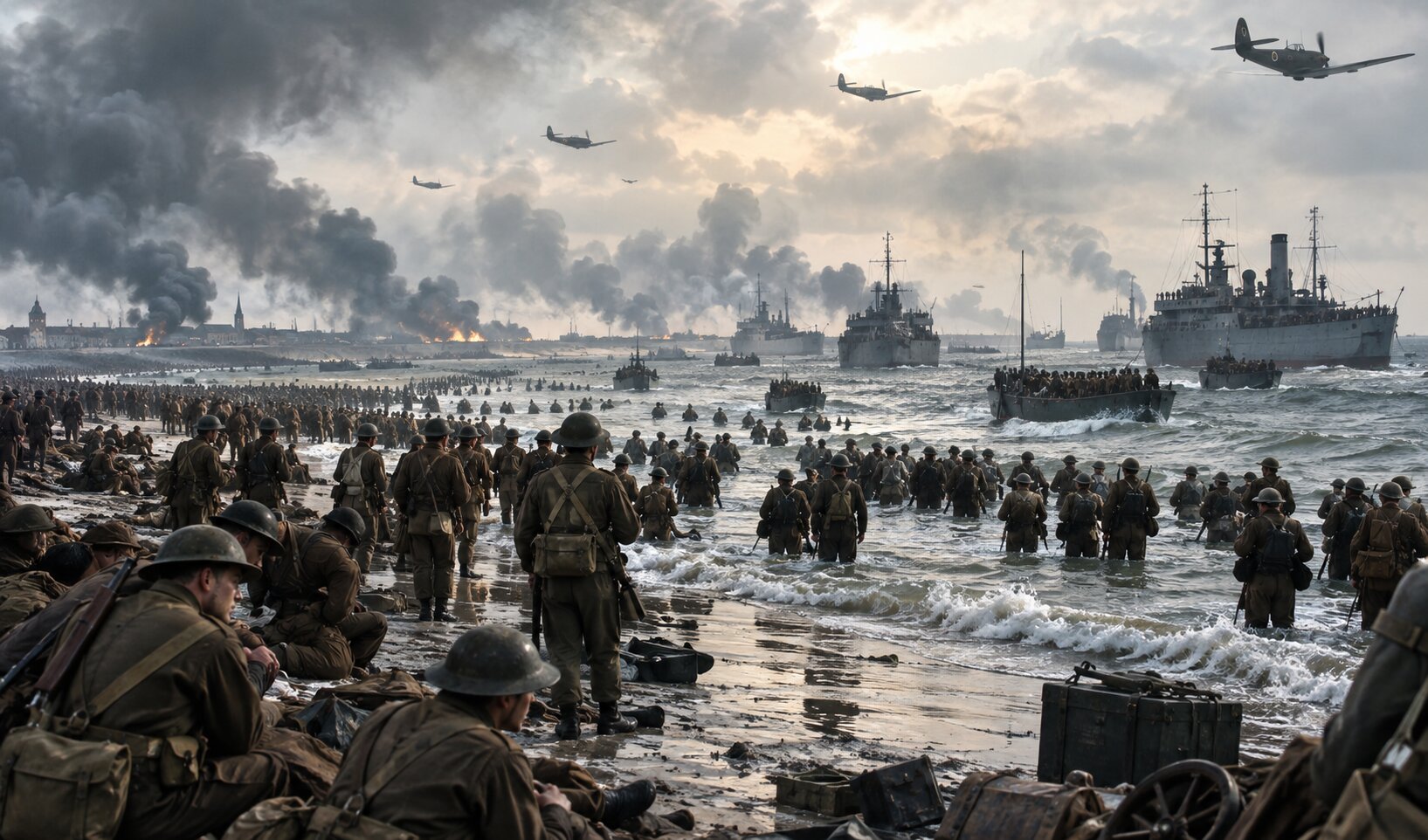
British and Allied troops were pushed toward Dunkirk, where hundreds of thousands were evacuated across the Channel.
Paris fell on June 14.
France signed an armistice on June 22, only about six weeks after the German offensive began.
Outcome: France was defeated with remarkable speed. Germany now dominated Western Europe.
At this moment, Hitler appeared almost unstoppable.
4. Battle of Britain — July–October 1940
Result: German strategic defeat
Britain remained the major obstacle in Western Europe.
For Germany to invade Britain successfully, it first needed to neutralize the Royal Air Force and establish air superiority.
The Luftwaffe attacked British airfields, radar infrastructure and eventually cities.
But Britain’s integrated air-defense system—radar, ground observers, fighter control and aircraft such as the Hurricane and Spitfire—proved remarkably resilient.
Germany failed to destroy the Royal Air Force.
Hitler indefinitely postponed Operation Sea Lion, the proposed invasion of Britain.
Outcome: Germany suffered its first major strategic setback.
Britain survived and eventually became a gigantic base from which the Western Allies would return to continental Europe.
5. North Africa — 1941–1943
Result: Initial German successes, eventual Axis defeat
Germany entered the North African campaign primarily to support its struggling Italian ally.
General Erwin Rommel and the Afrika Korps achieved impressive victories against British and Commonwealth forces, earning Rommel his famous nickname, the “Desert Fox.”
German and Italian forces advanced toward Egypt, threatening the Suez Canal.
But logistics were extremely difficult. Every tank, shell and gallon of fuel had to travel across the Mediterranean and then over long distances through the desert.
The decisive reversal came at the Second Battle of El Alamein in October–November 1942.
British forces under General Bernard Montgomery defeated Rommel’s army.
Meanwhile, American and British forces landed in Morocco and Algeria during Operation Torch.
Axis forces were eventually trapped in Tunisia.
Outcome: In May 1943, roughly a quarter-million Axis troops surrendered in Tunisia. Germany and Italy lost North Africa.
6. The Balkans and Greece — April 1941
Result: German victory
Germany invaded Yugoslavia and Greece after difficulties experienced by its Italian ally and political developments in Yugoslavia threatened German plans in southeastern Europe.
The campaigns were rapid.
Yugoslavia was defeated, and German forces pushed British and Greek forces out of mainland Greece.
German airborne troops subsequently captured Crete, although German paratroopers suffered heavy casualties.
Outcome: Germany controlled much of southeastern Europe, but occupying the Balkans created additional military commitments and continuing resistance.
The Turning Point: Hitler Invades the Soviet Union
7. Operation Barbarossa — June 1941
Result: Enormous initial German victories, eventual strategic catastrophe
On June 22, 1941, Germany invaded the Soviet Union.
It was the largest land invasion in history.
Approximately three million German troops participated alongside forces from Germany’s allies.
Initially, the results were devastating for the Soviet Union.
German armies surrounded enormous Soviet formations and captured hundreds of thousands of prisoners. German forces advanced hundreds of kilometers.
Three major army groups moved toward:
- Leningrad in the north
- Moscow in the center
- Ukraine and southern USSR in the south
But the Soviet Union did not collapse.
Its enormous territory, population and industrial resources allowed it to absorb losses that would have destroyed most countries.
German supply lines became increasingly stretched.
Then came winter.
8. Battle of Moscow — October 1941–January 1942
Result: Soviet victory
German troops advanced to the outskirts of Moscow.
But they were exhausted, undersupplied and increasingly exposed to severe winter conditions.
The Soviets brought additional forces into the battle and launched a major counteroffensive in December.
German troops were pushed back from Moscow.
Outcome: Germany had failed to defeat the Soviet Union in a single campaign.
This was enormously important.
Germany was now trapped in precisely the kind of prolonged war Hitler had hoped to avoid.
9. Siege of Leningrad — 1941–1944
Result: Soviet victory
German and Finnish forces isolated Leningrad for nearly 900 days.
The city’s population suffered horrifying deprivation. Hundreds of thousands of civilians died, particularly from starvation, cold and bombardment.
Yet Leningrad never surrendered.
The Red Army eventually broke the siege completely in January 1944.
Outcome: Germany failed to capture one of the Soviet Union’s most important cities despite years of siege.
Stalingrad: The Disaster That Changed the War
10. Battle of Stalingrad — August 1942–February 1943
Result: Catastrophic German defeat
In 1942 Hitler shifted the focus toward southern Russia, particularly the Caucasus oil fields.
Stalingrad became a major objective.
German forces entered the city, where fighting degenerated into brutal close-quarters combat.
Then the Soviets launched Operation Uranus in November 1942.
Rather than attacking the strongest German positions directly, Soviet armies struck weaker Romanian forces protecting the German flanks.
The Soviet pincers met behind Stalingrad.
Approximately 300,000 Axis personnel were trapped in the pocket, including the German Sixth Army.
Hitler refused to permit a timely withdrawal.
Field Marshal Friedrich Paulus surrendered in early February 1943.
Outcome: The Sixth Army was destroyed.
Stalingrad became one of the great psychological and military turning points of World War II.
Germany was no longer advancing relentlessly eastward.
It was beginning the long retreat toward Berlin.
11. Battle of Kursk — July–August 1943
Result: Soviet victory
Germany attempted to regain the initiative by attacking a large Soviet salient around Kursk.
The Soviets knew an offensive was coming and constructed immense defensive belts filled with trenches, mines, anti-tank positions and artillery.
The resulting battle involved enormous armored forces.
Germany failed to achieve the decisive breakthrough it needed.
The Soviets then launched counteroffensives.
Outcome: Germany effectively lost the strategic initiative on the Eastern Front.
From this point onward, the Red Army would conduct the majority of the major offensives and push steadily westward.
Germany Begins Losing Everywhere
12. Sicily and Italy — 1943–1945
Result: Allied victory
After defeating Axis forces in North Africa, the Western Allies invaded Sicily in July 1943.
The campaign contributed to the collapse of Benito Mussolini’s Fascist government.
Italy surrendered to the Allies in September.
Germany quickly occupied much of Italy and continued fighting.
The Italian campaign became a slow, bloody advance through difficult mountainous terrain, including major battles around Monte Cassino and Anzio.
Outcome: Germany was forced to commit valuable troops to another front while Soviet pressure in the east continued to grow.
D-Day: The Western Allies Return
13. Normandy — June–August 1944
Result: Allied victory
On June 6, 1944—D-Day—American, British, Canadian and other Allied forces landed in Normandy during Operation Overlord.
It was the largest amphibious invasion in history.
Germany now faced the nightmare its leadership had long feared:
A massive two-front land war.
The Soviet Union was attacking from the east while Britain, the United States and their allies attacked from the west.
After weeks of intense fighting in Normandy, Allied forces broke through German defenses.
Paris was liberated in August.
Outcome: Germany’s control of France began collapsing.
14. Operation Bagration — June–August 1944
Result: Catastrophic German defeat
While Western attention often focuses on D-Day, Germany simultaneously suffered an even larger disaster in the east.
The Soviet Union launched Operation Bagration against Germany’s Army Group Centre.
German defensive positions collapsed.
Entire formations were surrounded and destroyed as Soviet forces advanced hundreds of kilometers through Belarus and toward Poland.
Outcome: Army Group Centre was devastated.
Germany was being crushed simultaneously from east and west.
15. Battle of the Bulge — December 1944–January 1945
Result: Allied victory
Hitler attempted one final major offensive in the west.
German forces unexpectedly attacked through the Ardennes, creating a large “bulge” in the Allied front.
Hitler hoped to capture Antwerp, split British and American forces and perhaps force the Western Allies to negotiate.
German troops initially achieved surprise.
But they lacked sufficient fuel, reserves and air superiority.
Once the weather improved, Allied aircraft returned in force.
The offensive failed.
Outcome: Germany exhausted tanks, aircraft, fuel and experienced troops it could no longer replace.
The road into Germany was increasingly open.
The Final Battle
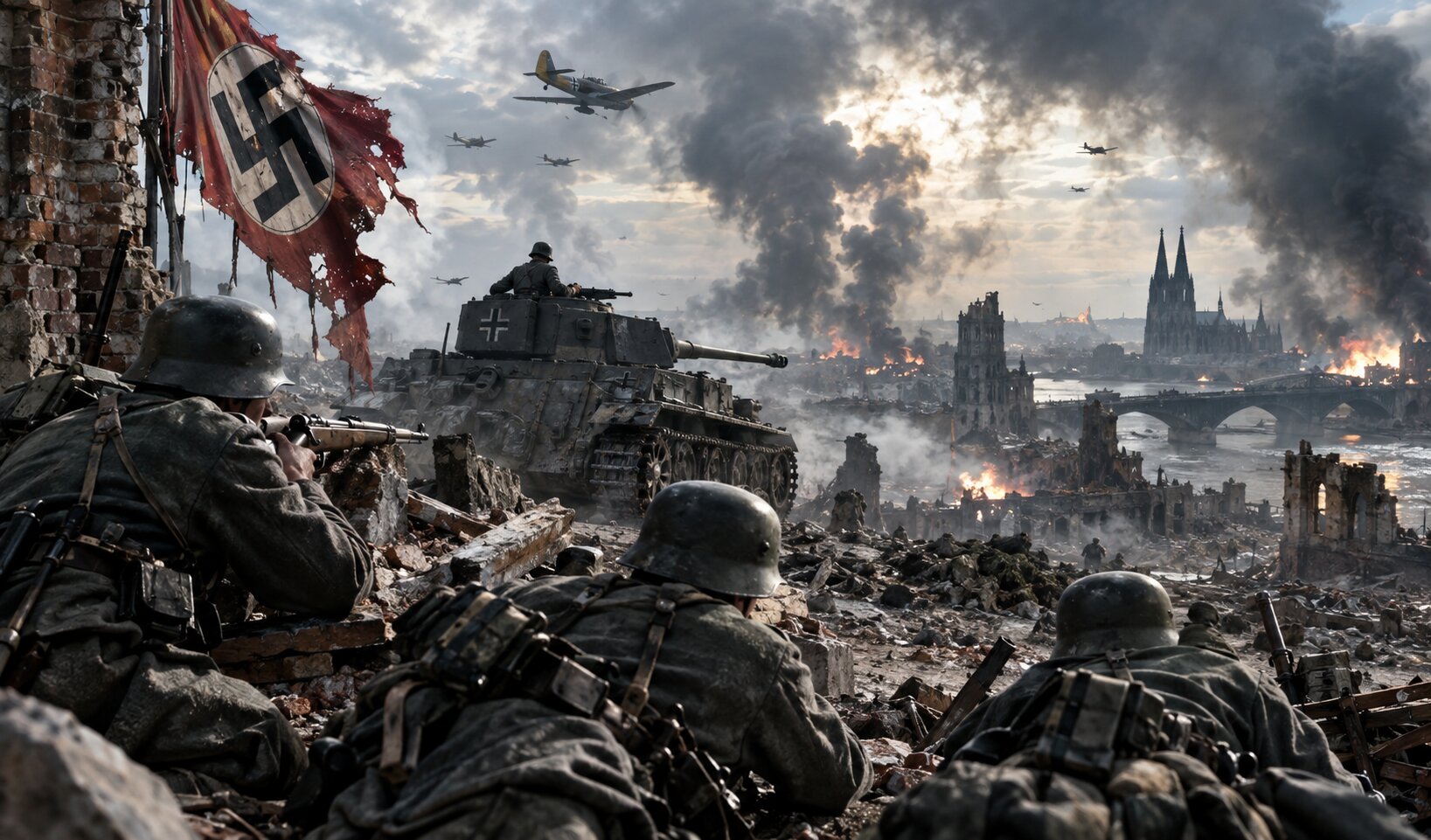
16. Battle of Berlin — April–May 1945
Result: Total German defeat
By April 1945, Soviet armies had reached Berlin.
Germany was collapsing.
The Western Allies had crossed the Rhine, while millions of Soviet troops approached from the east.
Hitler remained in his underground Führerbunker as Soviet forces fought their way through Berlin street by street.
On April 30, 1945, Hitler committed suicide.
Berlin surrendered on May 2.
Germany signed its unconditional surrender shortly afterward.
Victory in Europe Day—V-E Day—came on May 8, 1945.
The European war was over.
Germany’s Major Campaigns at a Glance
| Campaign/Battle | Period | Result for Germany |
|---|---|---|
| Poland | 1939 | 🟢 Victory |
| Denmark & Norway | 1940 | 🟢 Victory |
| France | 1940 | 🟢 Decisive victory |
| Battle of Britain | 1940 | 🔴 Strategic defeat |
| Balkans & Greece | 1941 | 🟢 Victory |
| Operation Barbarossa | 1941 | 🟡 Initial victories → strategic failure |
| Moscow | 1941–42 | 🔴 Defeat |
| North Africa | 1941–43 | 🔴 Defeat |
| Stalingrad | 1942–43 | 🔴 Catastrophic defeat |
| Kursk | 1943 | 🔴 Defeat |
| Italy | 1943–45 | 🔴 Retreat/defeat |
| Normandy | 1944 | 🔴 Defeat |
| Operation Bagration | 1944 | 🔴 Catastrophic defeat |
| Battle of the Bulge | 1944–45 | 🔴 Defeat |
| Berlin | 1945 | 🔴 Total defeat |
How Did Germany Go From Dominating Europe to Total Defeat?
Germany’s defeat becomes easier to understand when the war is divided into two periods.
1939–1941: Germany’s great advantage was speed
Germany repeatedly defeated enemies individually before they could fully coordinate their military power.
Poland fell quickly.
Denmark and Norway fell.
France fell.
The Balkans fell.
German commanders repeatedly demonstrated exceptional operational skill, particularly in combining armor, aircraft, artillery and mobile infantry.
But tactical and operational brilliance could not compensate indefinitely for strategic mistakes.
1941–1945: Germany’s enemies became overwhelmingly powerful
The invasion of the Soviet Union fundamentally changed the equation.
Then Hitler made another enormously consequential decision: Germany declared war on the United States on December 11, 1941, after Japan attacked Pearl Harbor.
Germany was eventually fighting an extraordinary coalition that included three industrial and military giants:
The Soviet Union + the United States + the British Empire and Commonwealth.
Germany simply lacked the resources to win a prolonged global war against that combination.
The Soviet Union supplied enormous manpower and increasingly formidable military production.
The United States possessed extraordinary industrial capacity and supplied not only its own forces but also vast quantities of equipment and supplies to its allies.
Britain provided a secure base immediately across the English Channel, maintained powerful naval forces, conducted strategic bombing and remained in the war from 1939 until Germany’s defeat.
Germany, meanwhile, suffered growing shortages of fuel, experienced soldiers, aircraft, vehicles and industrial capacity.
Allied bombing increasingly damaged Germany’s transportation system and oil production.
By 1944, Germany was fighting major armies in France, Italy and Eastern Europe simultaneously, while its cities and industrial infrastructure were being bombed from the air.
The strategic mathematics had become impossible.
The Crucial Mistake: Turning a European War Into a War Against the World
Hitler’s greatest failures were ultimately strategic rather than purely tactical.
Germany failed to force Britain out of the war.
It then invaded the Soviet Union while Britain remained undefeated.
Months later, Germany declared war on the United States.
That sequence transformed Germany’s situation.
In 1940, Germany had fought France and Britain from a position of extraordinary operational strength.
By 1942, it faced Britain, the Soviet Union and the United States simultaneously.
No brilliant tank commander or battlefield maneuver could permanently compensate for that disparity.
And Germany’s genocidal occupation policies—particularly in Eastern Europe and the Soviet Union—made the conflict extraordinarily brutal while destroying opportunities to exploit anti-Soviet sentiment among some populations.
From the English Channel to the Führerbunker
The geographical reversal tells the story.
1940: German troops stood on the English Channel.
1941: German troops approached Moscow.
1942: German troops reached Stalingrad and pushed toward the Caucasus.
Then the direction reversed.
1943: Germany lost Stalingrad, North Africa and the initiative at Kursk.
1944: The Western Allies landed in France while Soviet armies destroyed major German forces in the east.
1945: American, British and other Western Allied forces entered Germany from the west while the Red Army entered from the east.
Finally, Soviet soldiers fought their way into the center of Berlin.
In less than six years, Nazi Germany had gone from conquering much of Europe to disappearing entirely as a functioning state.
That is perhaps the central military lesson of Germany’s experience in World War II:
Germany repeatedly demonstrated that it could win campaigns. It never demonstrated that it could win the global war those campaigns created.
Blitzkrieg could deliver spectacular victories.
It could not manufacture oil, replace millions of casualties, neutralize American industrial power, defeat the British Empire and simultaneously conquer the Soviet Union.
Germany won many of the early battles.
But by creating more enemies than it had the resources to defeat, it ultimately made victory in the war impossible.