Most people think fat and cholesterol are the same thing. They aren’t.
In fact, one of the biggest misconceptions about heart health is believing that eating fat simply “turns into” cholesterol. The real story is far more fascinating—and understanding it can completely change the way you think about weight gain, cholesterol, and heart disease.
Let’s follow the journey.
Fat and Cholesterol: Two Very Different Things
Although both belong to a family of molecules called lipids, they serve entirely different purposes.
Fat is your body’s energy reserve. When you eat more calories than your body needs, the excess is stored as triglycerides inside fat cells. Think of it as money deposited into a savings account for future use.
Cholesterol, on the other hand, isn’t an energy source at all. Your body uses it to build cell membranes, produce hormones like testosterone and estrogen, manufacture vitamin D, and create bile acids that help digest food.
One stores energy.
The other builds and maintains life.
Not All Fats Are Created Equal
Before we talk about body fat, it’s worth clearing up another common misconception.
People often hear the term “unsaturated fat” and assume it refers to one specific type of fat. It doesn’t.
Unsaturated fats come in two varieties:
Monounsaturated Fats (The Heart-Friendly Choice)
These contain one double bond in their chemical structure and are found in foods such as:
- Olive oil
- Avocados
- Almonds
- Cashews
- Peanuts
These fats tend to lower LDL (“bad”) cholesterol and are excellent choices for everyday cooking.
Polyunsaturated Fats (The Essential Fats)
These contain multiple double bonds and include the famous omega-3 and omega-6 fatty acids.
You’ll find them in:
- Salmon
- Sardines
- Walnuts
- Flaxseeds
- Chia seeds
These fats support heart health, brain function, and help reduce inflammation.
Meanwhile, saturated fats—and especially trans fats—can raise LDL cholesterol and increase cardiovascular risk when consumed in excess.
So What Happens When You Gain Too Much Body Fat?
Here’s where things get interesting.
Most people imagine that extra body fat somehow transforms directly into cholesterol.
It doesn’t.
Instead, it sets off a chain reaction inside your body.
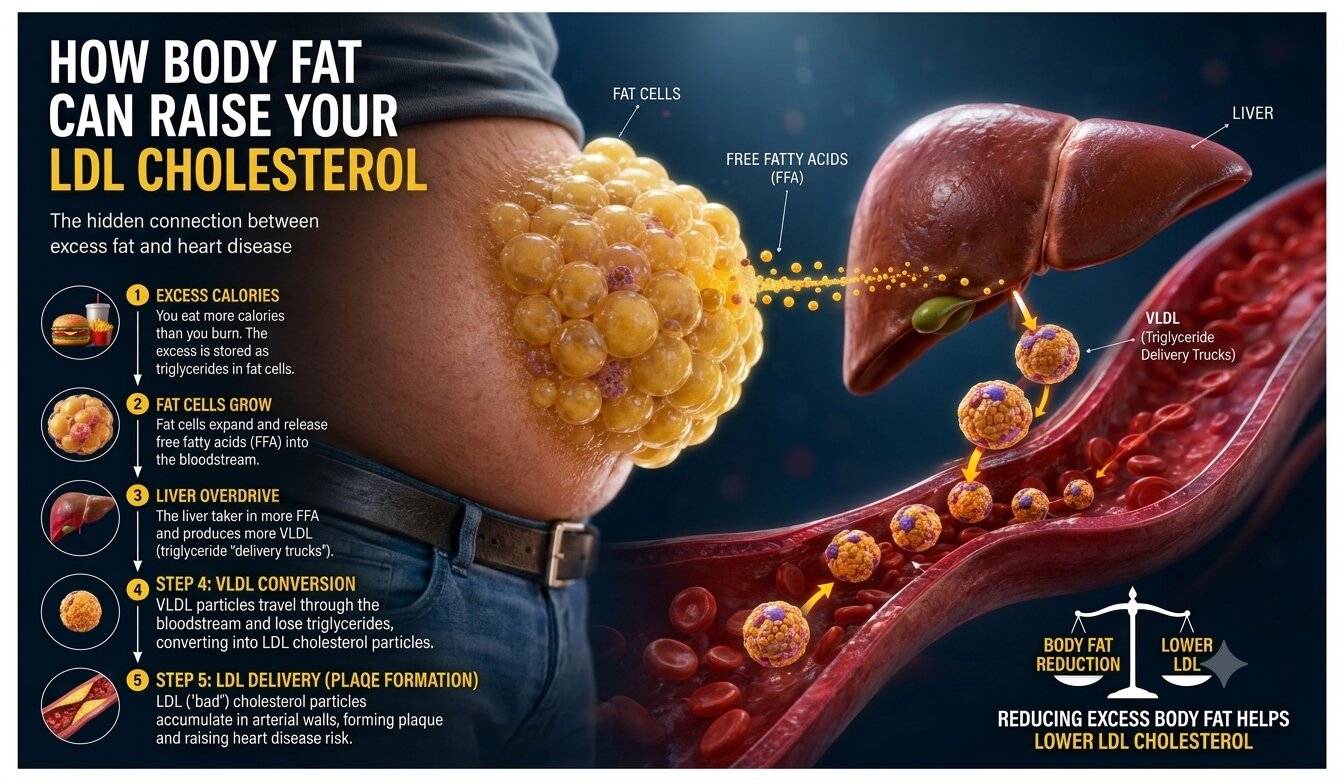
Step 1: You Eat More Calories Than You Burn
Whether the calories come from carbohydrates, fats, or proteins, any excess energy gets converted into triglycerides and stored inside fat cells.
At this stage, your body is simply storing fuel.
Step 2: Fat Cells Grow Larger
As fat accumulates—particularly around your abdomen—fat cells become enlarged.
But they don’t just sit there quietly.
Large fat cells begin releasing increasing amounts of free fatty acids into the bloodstream.
They also produce inflammatory chemicals that reduce your body’s sensitivity to insulin.
This is where metabolism begins to change.
Step 3: Your Liver Goes Into Overdrive
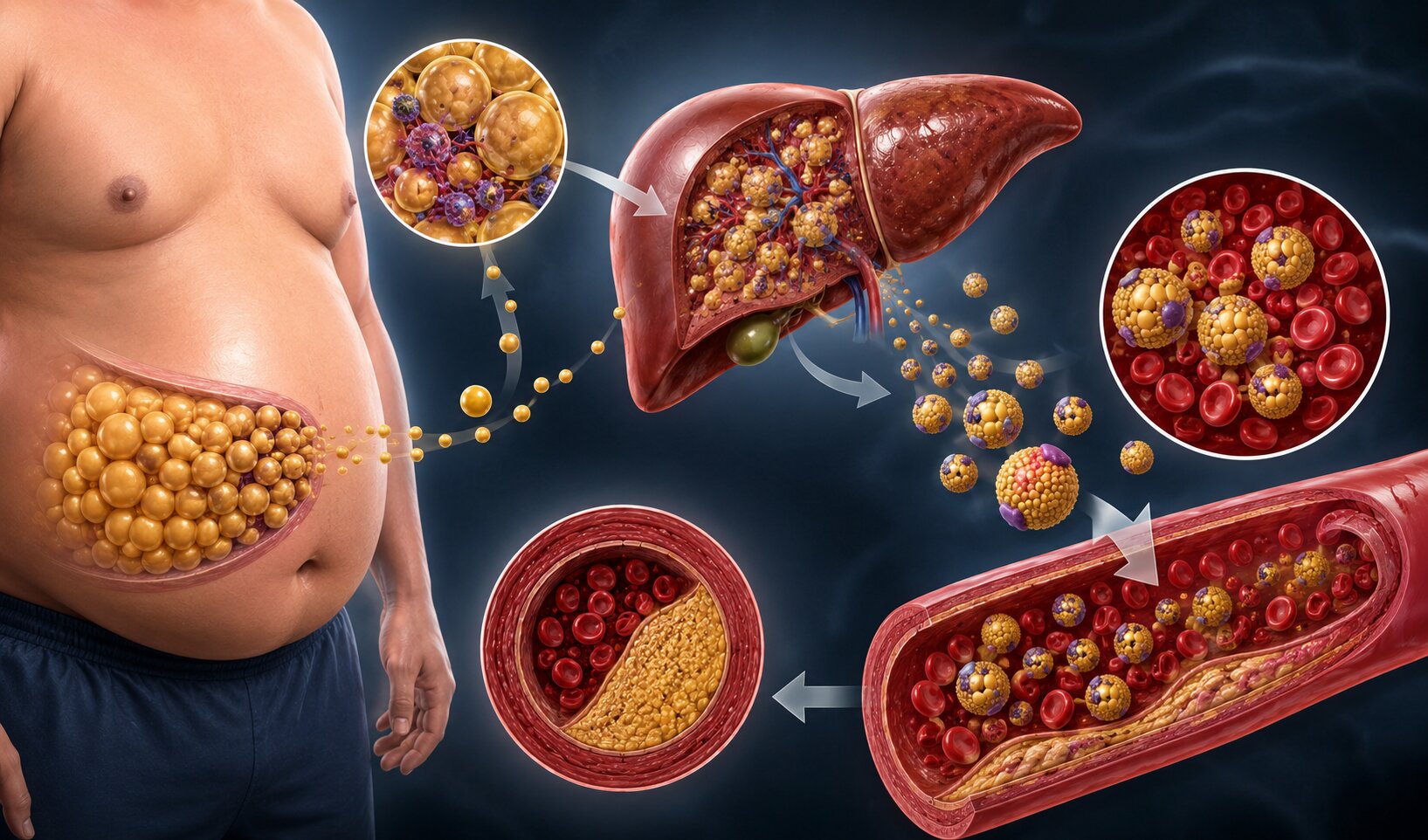
Your liver collects these free fatty acids and starts packaging them into particles called Very Low-Density Lipoproteins (VLDL).
Think of VLDL as delivery trucks loaded with triglycerides.
Their job is to transport fat through your bloodstream to tissues that need energy.
The more free fatty acids arriving at the liver, the more VLDL trucks it produces.
Step 4: VLDL Eventually Becomes LDL
As VLDL particles travel through your bloodstream, enzymes gradually remove much of their triglyceride cargo.
What’s left behind becomes Low-Density Lipoprotein (LDL)—the cholesterol particle often referred to as “bad cholesterol.”
So the real sequence looks like this:
Extra calories → More body fat → More free fatty acids → More VLDL production → More LDL cholesterol
Notice something important?
Body fat doesn’t magically become cholesterol.
Instead, excess body fat forces the liver to manufacture more cholesterol-carrying particles.
Why Belly Fat Is More Dangerous Than It Looks
Not all body fat behaves the same way.
Fat stored under the skin (subcutaneous fat) is relatively quiet.
Fat stored deep inside the abdomen around organs—called visceral fat—is much more active.
Visceral fat releases:
- More free fatty acids
- More inflammatory substances
- More hormones that promote insulin resistance
This places constant stress on the liver and often leads to:
- Higher triglycerides
- Lower HDL (“good”) cholesterol
- Higher levels of LDL particles, especially the smaller, denser forms associated with greater cardiovascular risk
That’s why waist circumference is often a better predictor of heart disease than body weight alone.
Can Losing Weight Improve Cholesterol?
For many people, yes.
Losing even 5–10% of your body weight can:
- Reduce the amount of fat reaching the liver
- Lower VLDL production
- Reduce triglycerides
- Improve insulin sensitivity
- Lower LDL cholesterol in many individuals
- Raise HDL cholesterol
The exact improvement varies depending on genetics, diet, exercise, and overall health, but even modest weight loss can have meaningful benefits.
Final Takeaway
Your body fat is more than just stored energy.
It acts like a living organ, constantly communicating with the rest of your body.
When body fat—especially belly fat—grows beyond healthy levels, it sends your metabolism down a path that can increase LDL cholesterol and raise the risk of heart disease.
The encouraging news is that the process works in reverse, too.
Healthier eating, regular physical activity, and gradual weight loss don’t just reduce the number on the scale—they help restore healthier communication between your fat tissue, liver, and heart.
And that may be one of the most powerful reasons to take care of your body.