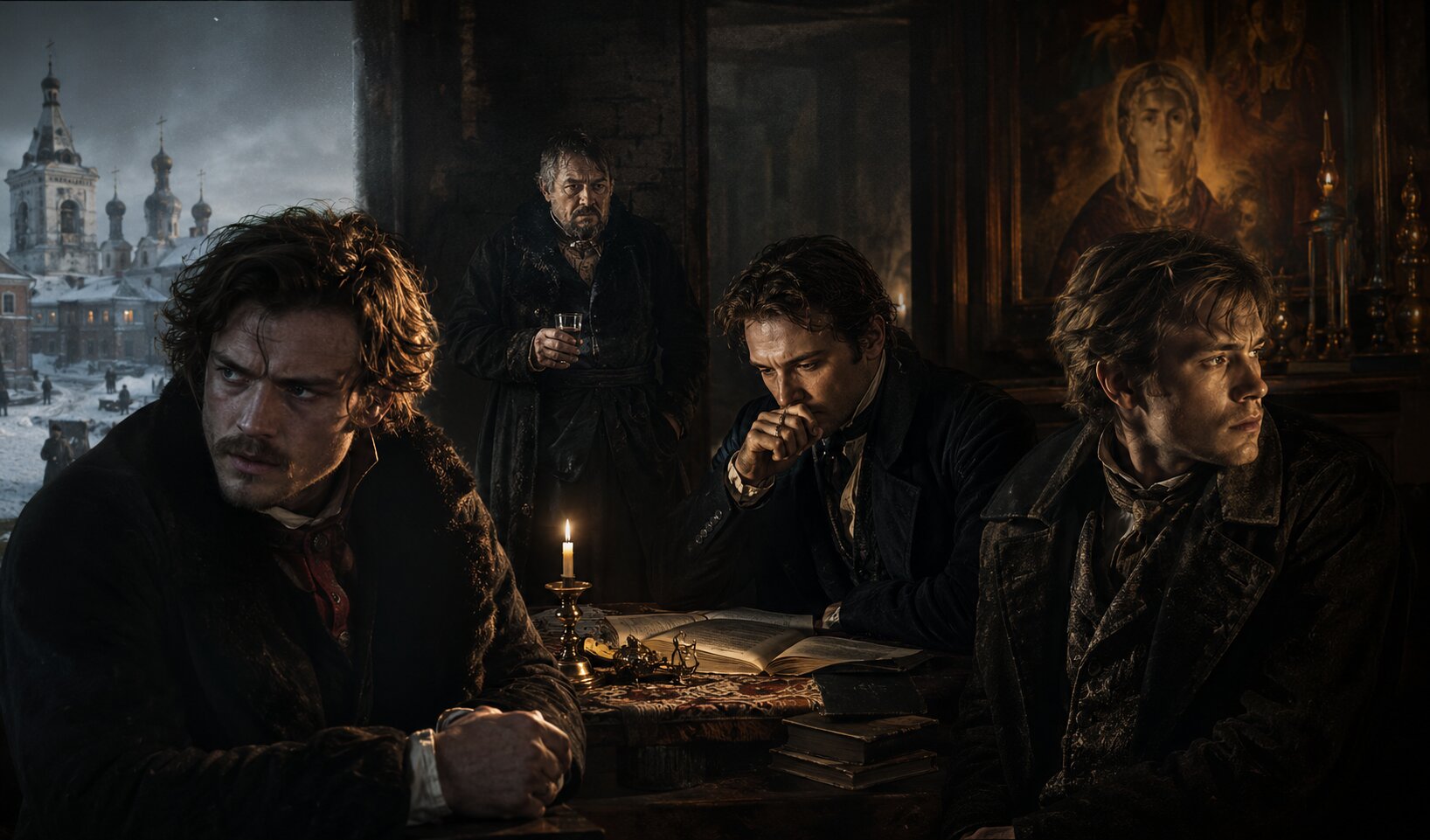
Fyodor Dostoevsky’s The Brothers Karamazov is not just a novel about a family conflict.
It is a massive spiritual, psychological, and philosophical drama about the human soul.
Published in 1880, it was Dostoevsky’s final novel, and many readers consider it his greatest work.
At the center of the story is one deeply troubled family: the Karamazovs.
Through them, Dostoevsky explores some of life’s biggest questions: Does God exist? Can morality survive without faith? Why do innocent people suffer? Are we responsible only for our own actions, or also for the evil we inspire in others?
The Karamazov Family: A House Built on Disorder
The father, Fyodor Pavlovich Karamazov, is selfish, vulgar, greedy, and morally empty.
He is not a noble patriarch.
He is a clownish but dangerous man who ruins the lives of those around him through neglect, lust, and cruelty.
He has three legitimate sons, each representing a different side of human nature.
Dmitri, the eldest, is passionate, impulsive, sensual, and emotionally explosive.
Ivan, the intellectual middle son, is brilliant, skeptical, and tormented by questions of God, justice, and suffering.
Alyosha, the youngest, is gentle, spiritual, compassionate, and deeply influenced by the saintly Elder Zosima.
There is also Smerdyakov, widely believed to be Fyodor’s illegitimate son.
He is resentful, emotionally cold, and far more important to the story than he first appears.
Together, these characters form one of literature’s most unforgettable families.
They are not merely people in a plot.
They are living arguments about what it means to be human.
The Central Conflict: Money, Desire, and Hatred
The surface story revolves around the bitter conflict between Fyodor and Dmitri.
Dmitri believes his father has cheated him out of his inheritance.
At the same time, father and son are both attracted to the same woman, Grushenka.
This creates a storm of jealousy, rage, humiliation, and suspicion.
Dmitri is already engaged to Katerina Ivanovna, a proud and emotionally intense woman who once helped him financially.
But Dmitri’s passion for Grushenka pulls him into chaos.
His life becomes a battlefield between honor and desire, guilt and self-justification, love and destruction.
As tensions rise, Dmitri repeatedly threatens his father.
Everyone can see that hatred is building toward violence.
Then Fyodor Pavlovich is murdered.
Because Dmitri had motive, rage, and a public history of threats, he becomes the obvious suspect.
But Dostoevsky’s genius lies in showing that guilt is not always simple.
The person who commits the act may not be the only person morally responsible for it.
Ivan Karamazov: The Tragedy of a Brilliant Mind
Ivan is one of Dostoevsky’s most famous characters because he gives voice to some of the strongest arguments against religious faith.
He does not reject God casually.
He rejects a world in which innocent children suffer.
For Ivan, the problem is not simply whether God exists.
The problem is whether any future harmony, heaven, or divine plan can justify the pain of the innocent.
His famous “rebellion” is not shallow atheism.
It is moral outrage.
Ivan cannot accept a universe where suffering is explained away as part of a grand design.
His intellectual crisis reaches its most powerful form in “The Grand Inquisitor,” a story he tells Alyosha.
In that parable, Christ returns to earth during the Spanish Inquisition, only to be arrested by the Church.
The Grand Inquisitor tells Christ that human beings do not truly want freedom.
They want bread, security, miracle, authority, and comfort.
This section is one of the most famous passages in world literature because it attacks not only religion, but also politics, power, and human weakness.
Ivan’s ideas later have devastating consequences.
His belief that “everything is permitted” if God does not exist influences Smerdyakov, who uses Ivan’s philosophy as a moral excuse for murder.
Ivan did not kill his father with his hands.
But he is forced to ask whether he helped kill him with his ideas.
Alyosha Karamazov: Compassion in a Broken World
Alyosha is the moral heart of the novel.
He is not naïve, and he is not untouched by suffering.
He sees corruption, cruelty, lust, pride, and despair all around him.
Yet he refuses to answer darkness with bitterness.
Under the guidance of Elder Zosima, Alyosha learns that love is not an abstract idea.
It is a practical responsibility.
To love humanity is not enough.
One must love real people, difficult people, wounded people, and even guilty people.
Alyosha’s spirituality is humble and active.
He does not win arguments by logic alone.
He wins trust through kindness.
In a novel filled with rage and philosophical conflict, Alyosha represents the possibility of grace.
He shows that goodness is not weakness.
It is a form of courage.
Dmitri Karamazov: A Soul at War With Itself
Dmitri is often crude, reckless, and self-destructive.
But he is not evil.
He is one of Dostoevsky’s most emotionally alive characters because he knows he is divided.
He is capable of shame, repentance, generosity, and deep feeling.
He wants pleasure, but he also wants purity.
He wants Grushenka, but he also wants honor.
He sins wildly, but he longs for redemption.
Dmitri’s tragedy is that he looks guilty even when the deepest truth is more complicated.
He becomes the symbol of a person judged by his worst appearances.
His trial is not only a legal event.
It is a public drama about passion, class, reputation, and the human hunger to simplify guilt.
Smerdyakov: The Quiet Face of Resentment
Smerdyakov is one of the darkest characters in the novel.
He is quiet, observant, bitter, and spiritually empty.
He absorbs Ivan’s ideas but twists them into justification.
If there is no God, no final judgment, and no moral order, then why not act?
Smerdyakov becomes the terrifying example of thought without conscience.
He does not have Ivan’s moral anguish.
He has only cold resentment.
Through him, Dostoevsky asks a disturbing question: What happens when intellectual rebellion is separated from love, humility, and responsibility?
The answer is not freedom.
It is spiritual collapse.
The Trial: Justice, Performance, and Human Blindness
The courtroom section of The Brothers Karamazov is one of the great dramatic climaxes in literature.
Dmitri is tried for the murder of his father.
The evidence against him is powerful, but the truth is far more complex.
The lawyers turn the case into a spectacle.
The public wants drama.
Each side creates a story that sounds convincing.
Dostoevsky shows how legal truth, emotional truth, and moral truth can separate from one another.
A court can reach a verdict.
But that does not mean it fully understands the soul.
The trial exposes the limits of human judgment.
It also shows how easily society mistakes passion for guilt, appearance for reality, and eloquence for truth.
The Big Themes of the Novel
The Brothers Karamazov is famous because it works on many levels at once.
It is a murder mystery.
It is a family tragedy.
It is a philosophical debate.
It is a religious novel.
It is a psychological study of guilt, pride, desire, and redemption.
One of its most important themes is responsibility.
Dostoevsky suggests that human beings are connected in ways they often refuse to admit.
We are not responsible only for what we do directly.
We may also bear responsibility for the anger we encourage, the cruelty we excuse, the ideas we spread, and the love we fail to give.
Another major theme is freedom.
Freedom is beautiful, but it is also terrifying.
People say they want freedom, but they often run from it because freedom requires moral responsibility.
The novel also explores faith and doubt with unusual honesty.
Dostoevsky does not make belief look easy.
Alyosha’s faith is tested.
Ivan’s doubt is powerful.
Dmitri’s repentance is painful.
The novel respects the seriousness of unbelief while still pointing toward the possibility of spiritual renewal.
Why The Brothers Karamazov Still Matters
The novel remains relevant because its questions have not disappeared.
We still argue about religion, morality, justice, freedom, family trauma, and personal responsibility.
We still see people who are intellectually brilliant but emotionally broken.
We still see people who are legally guilty but spiritually more complicated than society allows.
We still see families damaged by selfishness, pride, money, and unspoken resentment.
Dostoevsky understood that the human being is not simple.
A person can be ridiculous and tragic, guilty and innocent, cruel and lovable, lost and redeemable.
That is why the novel feels so alive.
It does not merely tell us what happened.
It asks us what kind of people we are.
Final Thoughts
The Brothers Karamazov is one of the greatest novels ever written because it combines the intensity of a crime story with the depth of a spiritual masterpiece.
Its murder plot gives the book suspense, but its real power comes from the inner lives of its characters.
Dmitri represents passion.
Ivan represents intellect.
Alyosha represents faith.
Smerdyakov represents resentment without conscience.
Fyodor Pavlovich represents moral decay.
Together, they form a portrait of humanity in all its confusion, beauty, violence, and longing.
In the end, Dostoevsky does not give us a simple answer to suffering, evil, or doubt.
Instead, he gives us something deeper.
He gives us a world where love is difficult, faith is tested, freedom is dangerous, and every human soul is a battlefield.
That is why The Brothers Karamazov is not just a book to read.
It is a book to wrestle with.