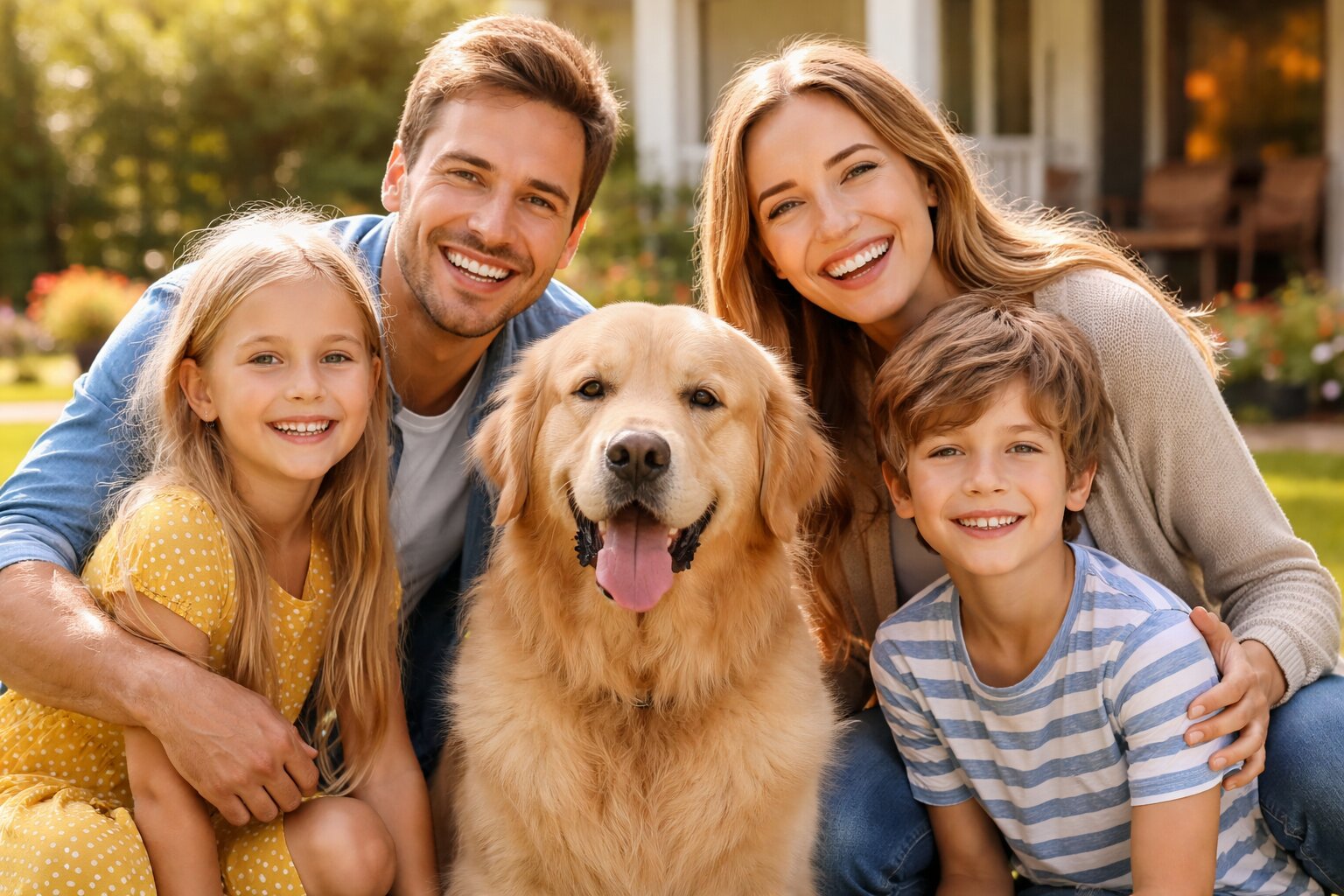
Imagine a social mammal that chose, thousands of years ago, to tie its emotional life to another species.
That is the dog.
A dog is not just a small wolf living in a house.
A dog is a creature shaped by evolution to read humans unusually well, live close to us, depend on us, and, in many cases, love us with a consistency that people find almost shocking.
If I were explaining a dog to an alien, I would say this: a dog is a four-legged emotional companion with a powerful nose, a flexible social brain, a strong attachment system, and a daily need for connection, play, routine, safety, and meaning.
Why dogs seem so loyal
Loyalty in dogs is not magic, but it can feel like magic.
Dogs are highly social animals, and social animals survive by bonding, tracking group members, and staying close to those who provide safety and predictability.
In a human home, the family becomes the dog’s pack-like social unit, so loyalty often looks like following you from room to room, waiting near doors, becoming alert when you are upset, and greeting you as though your return is the most important event of the day.
Separation-related behaviors are especially common in dogs that are strongly attached to their people.
What humans call loyalty is often a blend of attachment, habit, trust, emotional memory, and dependency.
A dog remembers who feeds it, protects it, comforts it, plays with it, and makes life understandable.
To the dog, that person becomes emotionally important.
Why dogs are loving and caring
Dogs express affection in ways that are different from human affection, but the emotional intent is often easy to recognize.
They lean against you.
They rest near your feet.
They bring you toys.
They lick your hands or face.
They watch your movements.
They get excited when you wake up, when you come home, and sometimes even when you simply look at them.
These are normal social behaviors in dogs and are tied to closeness, communication, and attention-seeking within a bonded relationship.
Some dogs also seem “caring” because they respond to human distress.
They may come near when you cry, place a paw on you, nuzzle you, or stay beside you.
Part of this may be sensitivity to your voice, posture, scent, and routine changes rather than human-style moral concern, but from the human point of view, it feels deeply caring because the dog is emotionally present.
Why dogs play so well with kids
Dogs and children often connect because both communicate heavily through energy, movement, repetition, and play.
A child runs, squeals, throws a ball, laughs, and repeats the game twenty times.
A dog thinks this is excellent social behavior.
Play gives dogs mental stimulation, exercise, and social bonding, and many dogs are naturally motivated by chase, fetch, gentle wrestling, and shared attention.
That said, safe dog-child interaction still depends on supervision, because dogs can become overstimulated or stressed, especially if a child grabs, corners, or startles them.
The AVMA [American Veterinary Medical Association] advises learning canine body language and removing dogs from situations that trigger stress signals.
To an alien, I would explain it this way: children and dogs often speak the same emotional dialect of movement.
But adults must translate when excitement becomes too much.
The psychology of a dog
A dog’s mind is not human, but it is not simple.
Dogs are constantly answering a few core questions.
Am I safe?
Who belongs to me?
What does this sound, smell, or movement mean?
What behavior gets me food, comfort, access, or praise?
Where is everyone?
What happens next?
A dog’s psychology is built around attachment, pattern recognition, sensory interpretation, and consequences.
Dogs learn from repetition.
They become calm when life is predictable.
They become anxious when signals are confusing.
They thrive when their needs are met clearly and consistently.
Veterinary behavior sources emphasize reducing uncertainty, giving dogs safe spaces, and setting up the environment so the dog can succeed.
In short, a dog is a feeling-and-routine machine with a genius-level nose.
Do dogs feel lonely if they are stuck in a house alone?
Yes, many dogs can feel lonely, distressed, bored, or anxious when left alone, though not all dogs react the same way.
Some dogs nap peacefully.
Some dogs experience true separation-related distress.
Some become restless because they are under-stimulated rather than emotionally panicked.
When dogs struggle with being alone, common signs include barking, whining, pacing, destruction, escape attempts, house soiling, and anxious behavior that begins as the owner prepares to leave or within the first 15 to 30 minutes after departure.
So yes, a dog shut inside a house all day may not just be “waiting.”
It may be enduring confusion, frustration, fear, or loneliness.
Dogs are social creatures, and for many of them, too much isolation is psychologically hard.
Do dogs have depression?
Dogs can absolutely show depression-like behavior, but it is safer to say they can show signs consistent with depression, withdrawal, or low mood rather than claim they experience human depression in exactly the same way.
A dog that seems depressed may sleep more, lose interest in play, move less, withdraw socially, eat less, or stop showing enthusiasm for normal routines.
But these same signs can also be caused by pain, illness, aging, fear, stress, or cognitive decline, so behavior change should not be brushed off as “just sadness.”
Veterinary sources note that behavioral problems must be evaluated carefully, and cognitive changes in older dogs can also alter mood and normal behavior.
To an alien, the answer would be this: dogs do seem capable of emotional downturns, but because they cannot describe their inner life, humans must infer it from changes in appetite, activity, attention, sleep, and social behavior.
Do dogs miss human beings?
Yes.
Dogs often miss specific humans.
They notice absence.
They notice routine disruption.
They notice when the emotional center of their day is gone.
A dog may wait by the door, sleep on your clothes, stay near your chair, become quieter, vocalize more, or become unusually clingy when you return.
Some dogs are especially attached and show clear distress when separated from their preferred person. Separation anxiety is, in essence, a disorder of distressed attachment.
Humans often think the dog is “just being dramatic.”
But from the dog’s point of view, the social unit has temporarily broken apart.
That matters.
How dogs express emotion
Dogs do not usually express emotion with words, but they are talking all the time.
They use tail position.
They use tail speed.
They use ear position.
They use eye shape.
They use body tension.
They use mouth tension.
They use licking, yawning, panting, freezing, turning away, jumping, leaning, play-bowing, and vocalizing.
Fear can show up as avoidance, lowered posture, lip licking, body shaking, yawning, and vocalizing.
Stress signals can include panting and nose licking.
Affiliative emotion can show up as relaxed posture, soft eyes, proximity-seeking, tail wagging, and playful invitations.
A tail wag alone does not always mean happiness.
It can also mean arousal, uncertainty, or agitation.
To understand a dog, you read the whole body, not one moving part.
Do dogs cry?
Dogs do cry physically in the sense that their eyes can water, but they do not usually cry emotional tears the way humans do to express sadness.
Their emotional distress is more likely to be expressed through whining, whimpering, howling, withdrawal, pacing, panting, destructive behavior, or unusual clinginess. Separation distress in dogs is typically expressed through behavior and vocalization, not human-style sobbing.
So when people say, “My dog cried because he missed me,” what they usually mean is that the dog vocalized, looked distressed, or showed tear production for some other reason while also being emotionally upset.
Why dogs sniff our crotches
Because dogs are running a scent-based intelligence system, and the human crotch is an information-rich location.
Dogs gather information through smell far more than humans do through vision.
Areas with apocrine sweat glands produce strong personal odor signals, and the crotch region is close to nose level for many dogs, making it a highly efficient place for a quick “identity scan.” AKC notes that dogs sniff crotches to gather information and that certain conditions such as menstruation, recent sex, or childbirth can make some people especially interesting because of stronger pheromonal cues.
To an alien, this is not rudeness.
It is data collection.
Your embarrassment is a human problem.
The dog is being a biologist.
Why dogs are so obsessed with smell
Humans live mostly in a visual world.
Dogs live in a scent world.
You see a person and recognize a face.
A dog smells a person and may gather identity, mood, recent environment, health-related changes, and whether that person has been near another animal.
That is why dogs investigate shoes, laundry, doorways, grass, visitors, and private areas.
Smell is their primary news feed.
What a dog needs emotionally
A dog needs more than food and shelter.
A healthy dog usually needs predictability, social connection, movement, play, rest, safety, and mental engagement.
Without these, behavior problems often appear.
With these, the dog becomes calmer, more confident, and easier to understand.
A dog left alone too long, under-exercised, under-stimulated, or punished unpredictably may become noisy, destructive, withdrawn, hypervigilant, or clingy.
That is not “badness.”
That is unmet need colliding with instinct.
Why do dogs tilt their heads when you talk?
Head-tilting is one of the most charming things dogs do, and it likely happens for a few reasons at once: they may be trying to localize sound better, focus on important words they recognize, or visually adjust around their muzzle to read your face more clearly.
In plain language, the tilt often means, “I am paying attention, and I am trying to decode you.”
Do they smell their own fart?
Almost certainly, yes. Dogs live in a scent-dominated world, and smells that humans find disgusting are often simply information to them.
A fart is not just bad air to a dog; it is a data signal from the digestive system, carrying clues about food, body state, and recent digestion, so a dog may notice it far more naturally than a human would.
Can they control their bladder and stools?
Yes, dogs can learn bladder and bowel control, but that control depends on age, training, health, schedule, and stress level.
A healthy adult dog usually can hold urine and stool for a reasonable period, but puppies, senior dogs, untrained dogs, and dogs with medical or anxiety problems may not manage that reliably, which is why house-training is really a combination of biology, timing, and habit-building rather than pure willpower.
Why do they grab shoes or socks?
Shoes and socks are treasure objects in the dog world because they smell intensely like humans, are easy to carry, and often trigger play or attention.
To a dog, stealing a sock can be part comfort, part scent-seeking, part boredom relief, and part game, especially if the humans immediately start chasing them, which accidentally turns theft into entertainment.
Do they get excited if good food is given?
Very much so. Dogs are highly responsive to rewarding food, and for many of them, tasty food produces instant arousal, attention, anticipation, and visible joy.
You can often see it in widened eyes, tail wagging, intense focus, quick movement, vocalizing, or suddenly perfect obedience, because in the canine brain, delicious food is not just nutrition but a powerful reward signal.
Do they understand our language, or just our tone?
The honest answer is both, but not in the way humans do. Dogs are very good at reading tone, rhythm, emotion, facial expression, and body language, yet research also suggests they can recognize some words, distinguish speech from nonsense, and even tell familiar language patterns from unfamiliar ones.
So when you speak to a dog, it is not hearing only emotion, and it is not understanding full human grammar either; it is picking up a blended stream of words, sounds, cues, habits, and context.
Do they want to be petted or belly-rubbed?
Often yes, but not always. Many dogs enjoy petting, scratches, and belly rubs, especially from trusted humans, but preferences vary by individual dog, body area, mood, and breed tendencies.
A dog that rolls over may be asking for affection, but it can also be showing appeasement or uncertainty, so the best guide is the whole body: relaxed muscles, soft eyes, loose tail movement, and leaning in usually mean “yes,” while stiffness, lip licking, turning away, or moving off usually mean “not right now.”
A final way to explain a dog to an alien
A dog is a social mammal that entered into an ancient alliance with humans and never really left.
It loves routine but welcomes adventure.
It cannot speak, but it communicates constantly.
It is capable of attachment deep enough to break its composure when you walk out the door.
It can play with children like a furry comedian, guard a home like a sentinel, and sit beside a grieving person without asking a single question.
It does not understand philosophy, politics, or rent.
But it understands tone, absence, tension, kindness, fairness, and whether it belongs.
And for many humans, that is more than enough.