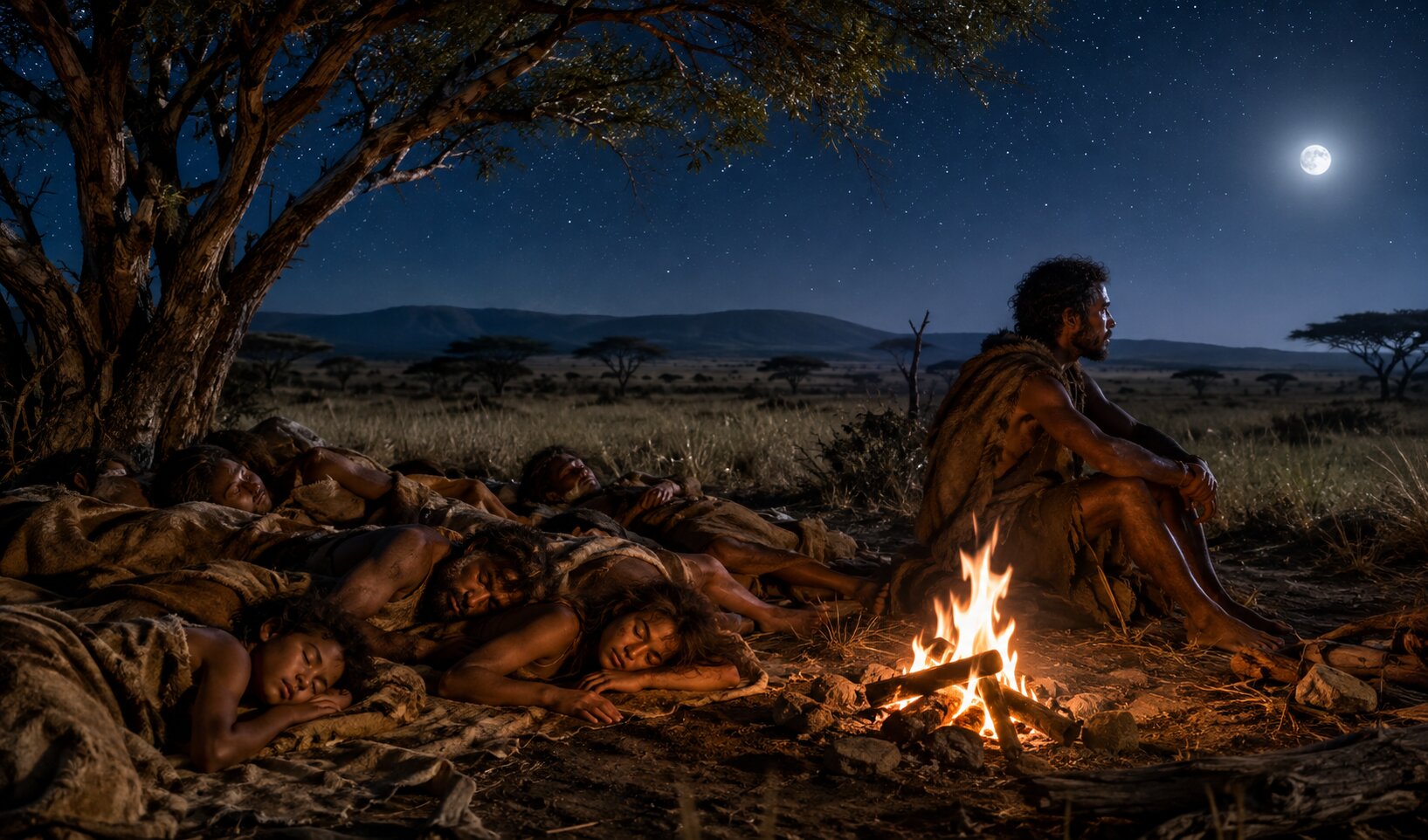
A chimpanzee may sleep about nine to ten hours; humans average closer to seven. Based on our body size, diet and evolutionary relationships, researchers estimate that we should sleep roughly nine and a half hours. Instead, humans are the shortest-sleeping primates studied—and devote an unusually large proportion of that sleep to REM.
The sleep-intensity hypothesis argues that our ancestors compressed sleep into fewer, more efficient hours. Once hominins began sleeping on the ground, fire and group sleeping may have reduced danger enough to permit deeper, consolidated rest. The hours saved could then be spent socializing, learning skills, making tools and guarding against predators.
Well supported: phylogenetic analyses find that human sleep is substantially shorter than predicted from other primates. Studies of the Hadza also found that differing sleep schedules kept at least one person awake during 99.8% of nighttime observations—an accidental “sentinel” system.
Plausible but debated: natural selection shortened sleep specifically to promote culture, protection or learning. These benefits are difficult to separate, and modern populations cannot perfectly reconstruct ancestral life.
This is not evidence that sleep deprivation is healthy. Evolution apparently made human sleep compact—not optional.