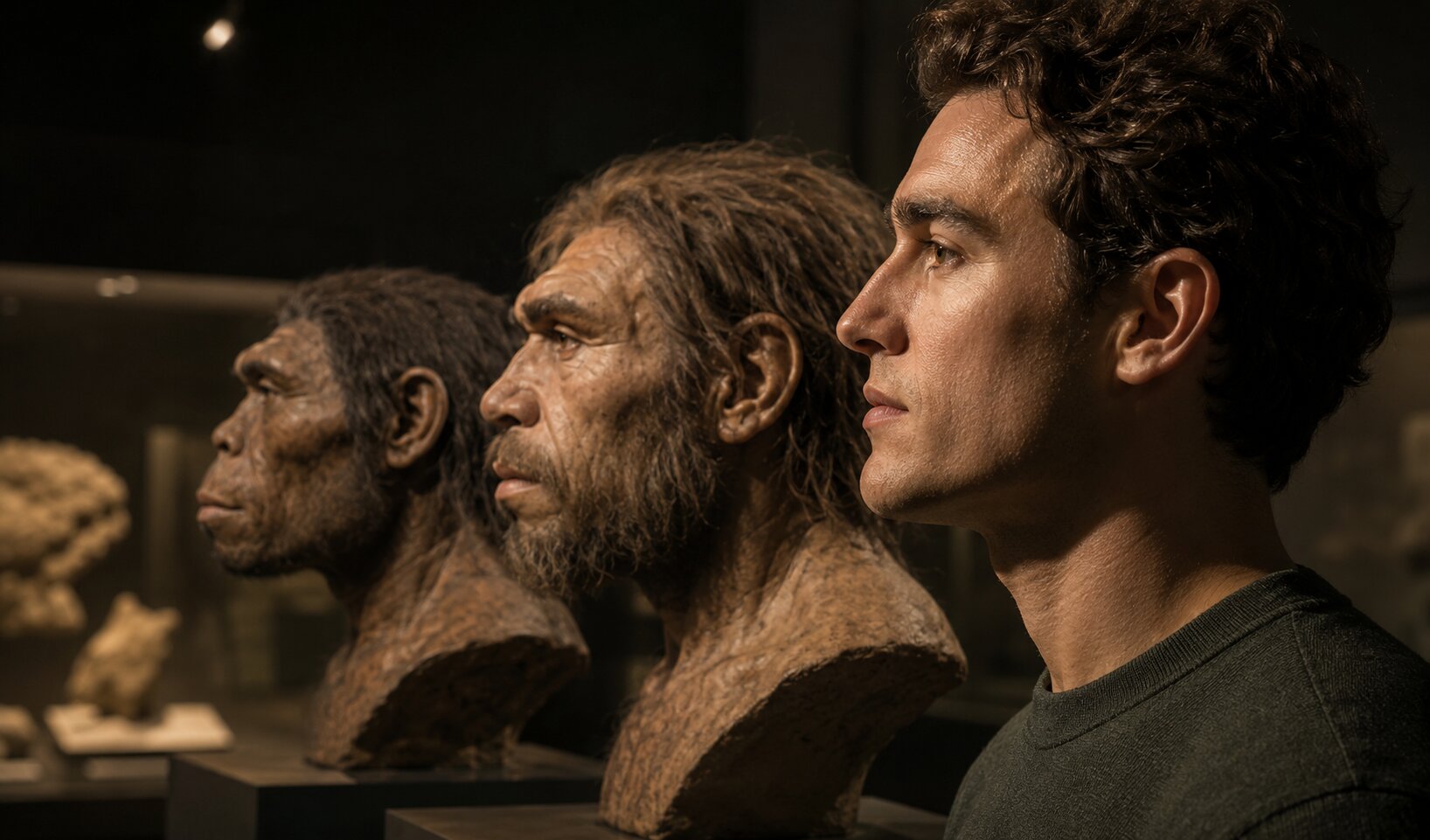
The Chin: Evolution’s Most Mysterious Bump
Look at a chimpanzee, Neanderthal or Homo erectus skull: none possesses a true projecting chin. Among known animals, this little shelf of bone appears uniquely characteristic of Homo sapiens.
Why did it evolve? Popular explanations claim that the chin strengthened our jaw, supported speech or became attractive through sexual selection. Yet none has convincing evidence.
The strongest test examined computerized 3-D models of human jaws. Researchers digitally removed the chin and simulated biting forces. The chinned and chinless jaws experienced remarkably similar strain, suggesting that the chin did not evolve as reinforcement for chewing. Study
Well supported: the chin evolved unusually rapidly along the modern-human lineage. A comparison of 123 primate groups estimated that chin-related features changed roughly 77 times faster in humans than the primate background rate. Evolutionary analysis
Plausible but debated: the chin may not be an adaptation at all. As human faces retracted and teeth and jaws became smaller, the lower jaw’s developmental growth patterns may simply have left a projection behind—a biological byproduct called a spandrel.
A spandrel is a feature that arose as a side effect of something else, rather than because natural selection directly favored that feature.
The term comes from architecture. When two arches are placed side by side, a triangular space automatically appears between them. Architects did not necessarily design that space—it is an unavoidable consequence of building the arches. They may later decorate it, but decoration was not why it originally existed.
In evolution, a spandrel works similarly:
- An adaptation evolved because it performed a beneficial function.
- A spandrel appeared because other body parts changed.
For example, the human chin may have emerged as our faces, teeth and jaws became smaller and repositioned. The remaining bone projected forward—not necessarily because a chin improved survival or reproduction.
A spandrel can later acquire a function. Even if the chin began as a byproduct, it might subsequently have influenced facial attractiveness, muscle attachment or communication.
In short: An adaptation is selected for; a spandrel comes along for the architectural ride.
The chin’s lesson is larger than the chin: evolution does not necessarily design every feature for a purpose.
Sometimes changing the whole structure creates an unexpected bump.