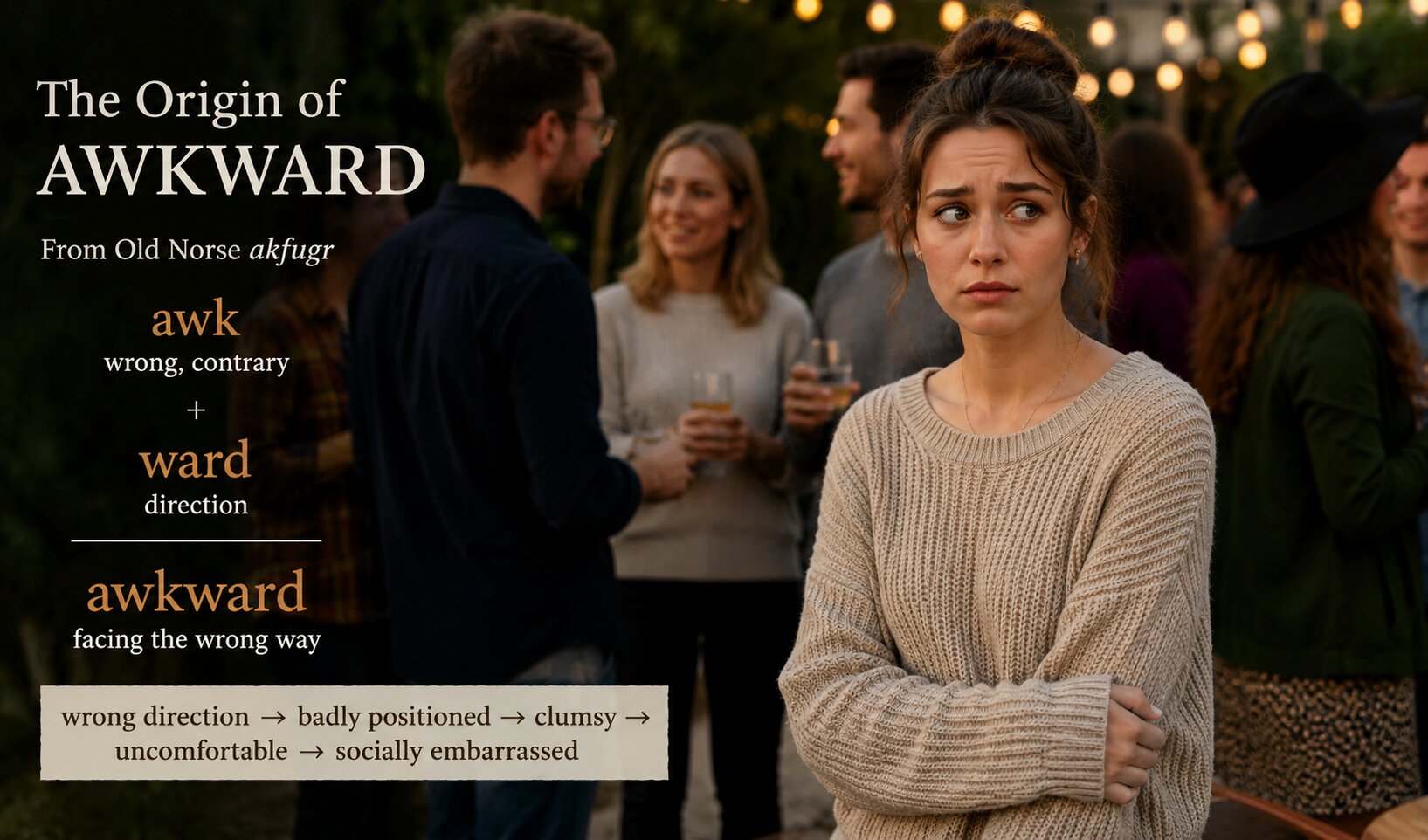
Why “Awkward” Originally Meant “Facing the Wrong Way”
Today, awkward describes an uncomfortable silence, a clumsy movement, or a socially embarrassing moment.
But originally, it was much more literal.
The word comes from Middle English awkward, built from awk, meaning “turned the wrong way,” plus -ward, meaning “in a particular direction.”
So awkward essentially meant “in the wrong direction.”
The older awk came from Old Norse ǫfugr, meaning backward, contrary, or turned the wrong way. That little word eventually disappeared from everyday English, but it survives inside awkward.
The meaning then followed an interesting path:
wrong direction → badly positioned → clumsy → uncomfortable → socially embarrassed.
By the 1500s, awkward could describe someone moving without grace. By the 1700s, it was also being used for people who felt uncomfortable or embarrassed.
So when there is an awkward silence at dinner, nobody is literally facing backward.
But linguistically, something still feels as though it has gone…
the wrong way.