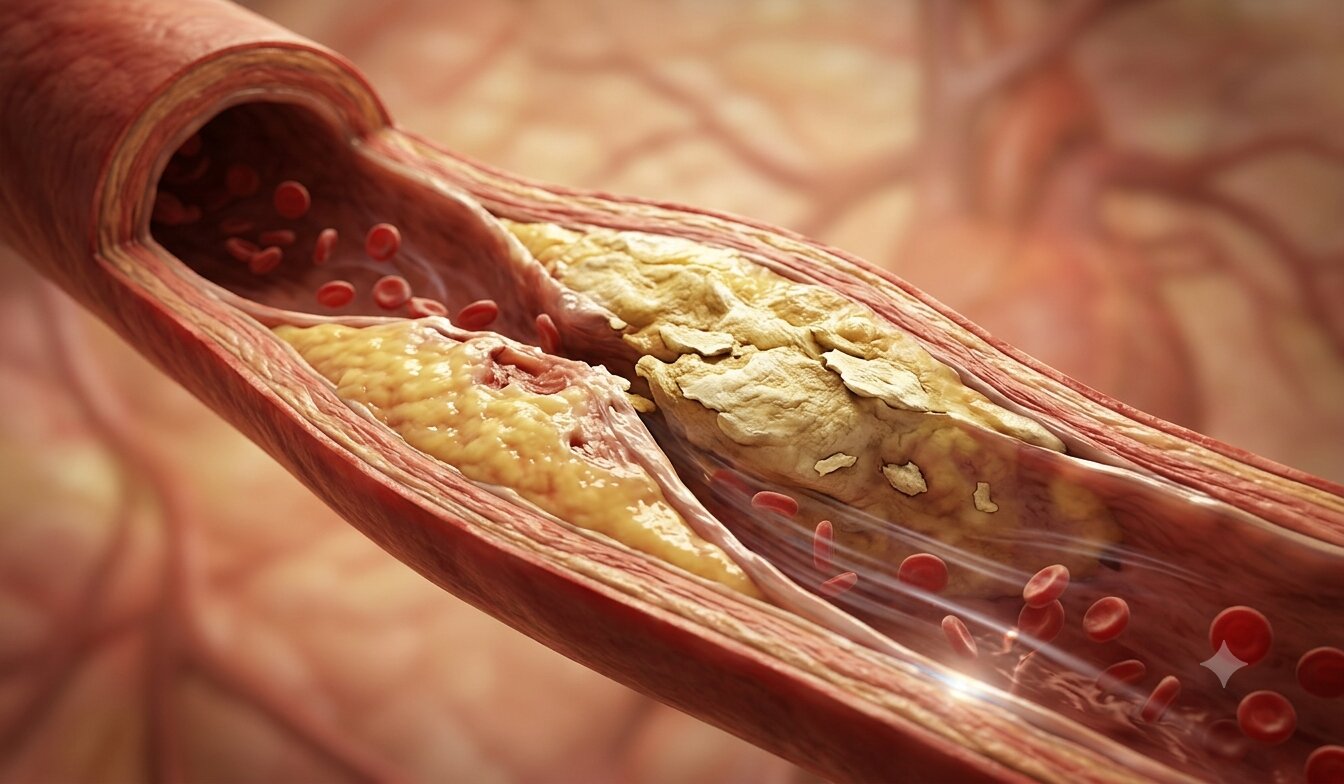
It is one of the most counterintuitive moments in cardiovascular medicine: you start taking a statin, your LDL cholesterol drops beautifully, but a follow-up Coronary Artery Calcium (CAC) scan shows your calcium score has actually increased.
Naturally, this feels alarming. If the medication is doing its job to lower “bad” cholesterol, why does the scan suggest the disease is progressing?
This phenomenon is known as the statin paradox. To understand why a rising CAC score can actually be a sign of success rather than failure, we have to look closer at what a CAC score actually measures—and how statins physically remodel the plaque inside your arteries.
1. The Anatomy of a Plaque: Soft vs. Hard
To understand why the score moves upward, it helps to look at the two primary types of arterial plaque:
-
Soft (Vulnerable) Plaque: This type of plaque is rich in fats (lipids) and inflammatory cells, covered by a thin, fragile fibrous cap. Soft plaque is highly unstable. If it ruptures, it exposes the interior contents to the bloodstream, triggering a sudden blood clot that can cause a heart attack or stroke. Crucially, soft plaque does not contain calcium, meaning it is invisible on a standard CAC scan.
-
Hard (Calcified) Plaque: This is plaque that has become calcified and mineralized over time. It has a thick, durable cap and is highly mechanically stable. Hard plaque is much less likely to rupture. However, because it is loaded with calcium, it lights up clearly on a CT scan and forms the basis of your CAC score.
2. How Statins Remodel Your Arteries
Statins do far more than just lower circulating LDL cholesterol; they actively change the composition of the plaque already inside your arterial walls.
When you take a statin and your LDL drops, the drug stabilizes the plaque through a process akin to “biological healing”:
-
Emptying the Lipid Core: The statin draws the dangerous, fatty liquid out of the soft plaques.
-
Quelling Inflammation: It calms the underlying cellular inflammation within the artery wall.
-
Calcification (The Healing Phase): As the soft, dangerous components are cleared away, the body deposits dense calcium to reinforce the area, forming a hard, protective shell over the remaining plaque core.
The Result: The statin effectively converts volatile, high-risk “soft” plaque into stable, low-risk “hard” plaque.
Because the scan only detects the calcified portions, this transition causes the calculated CAC score to rise. In essence, the score is going up because the danger is going down. The increase reflects the calcification of preexisting soft plaque, not the creation of brand-new arterial blockages.
3. The Technical Nuance: Plaque Density
Standard CAC tracking uses the Agatston scoring system, which calculates your score based on both the area of the calcium and its density.
Statins heavily increase the mineral density of your plaque. Because the Agatston system multiplies the plaque area by a density factor, a plaque that becomes more densely packed and safer will mathematically yield a higher score on the machine.
Why Doctors Rarely Re-Scan After Statin Therapy
Because statins inherently accelerate calcification as part of their therapeutic function, repeating a CAC scan after you are already established on a statin is generally considered clinically unnecessary. The rising number ceases to be an accurate metric for tracking active risk, as it mixes the “good” calcification of healed plaque with standard disease progression.
Instead, clinical focus shifts toward monitoring systemic markers:
-
Achieving target LDL-C and ApoB levels.
-
Managing overall metabolic health, blood pressure, and lifestyle factors.
If you see your CAC score rise after starting a statin, it shouldn’t be a reason to panic. More often than not, it is tangible proof that the medication is altering the biology of your blood vessels exactly the way it was designed to do.