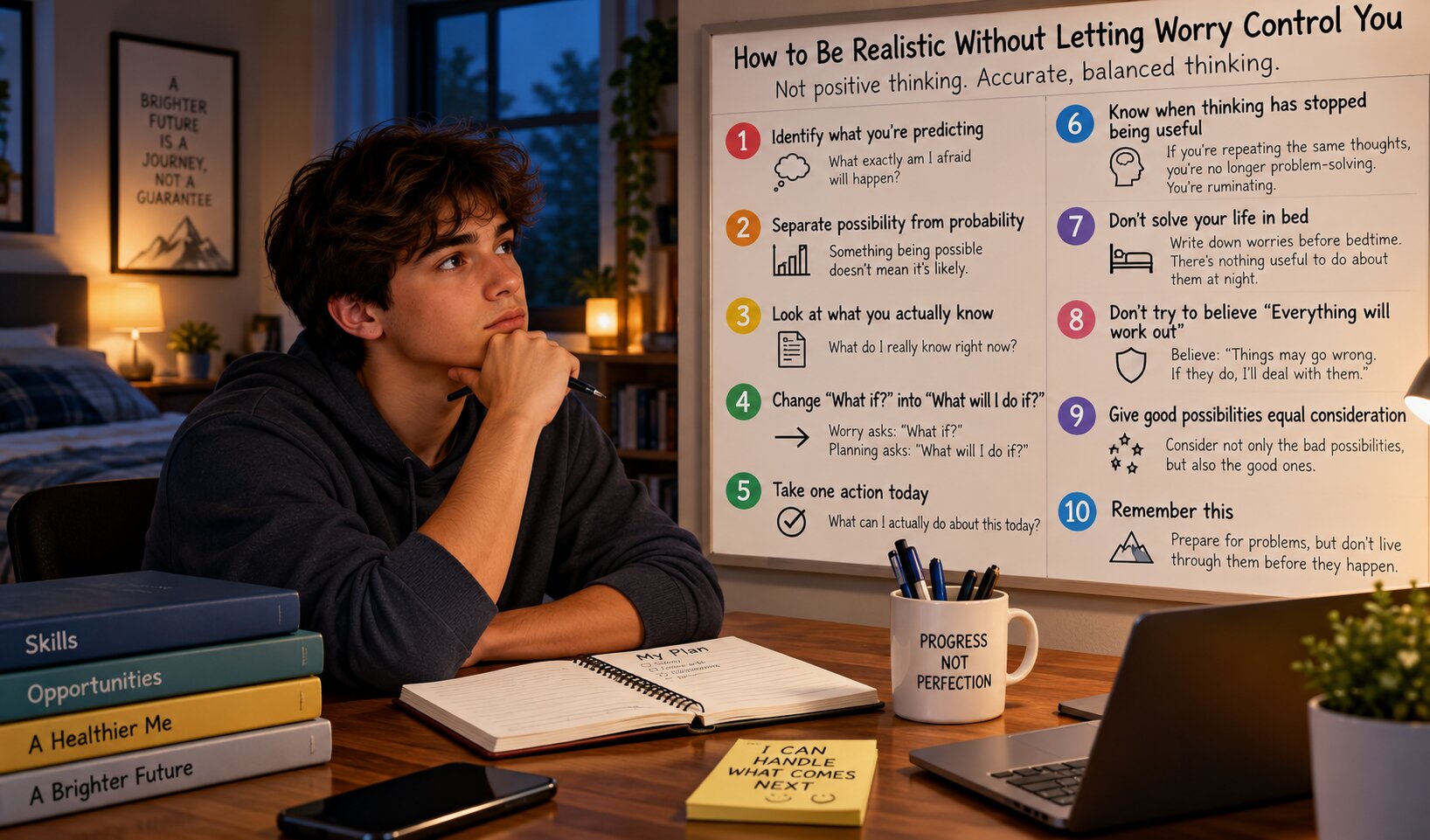
Most of us believe we worry because we are being responsible.
We think:
“What if something goes wrong?”
“What if I lose my job?”
“What if my health gets worse?”
“What if my children struggle?”
“What if I make the wrong decision?”
The mind tells us that worrying is a form of preparation.
But Dale Carnegie, in his classic book How to Stop Worrying and Start Living, makes a very different argument:
Worry rarely solves tomorrow’s problems. It usually steals today’s peace.
The goal is not to become careless or unrealistically optimistic.
The goal is to replace unproductive worry with productive action.
1. Live in “Day-Tight Compartments”
One of Carnegie’s most powerful ideas is remarkably simple:
Live one day at a time.
Imagine a ship with watertight compartments. If one section is damaged, the doors close so the entire ship does not flood.
Carnegie suggests doing something similar with time.
Close the door on yesterday.
Close the door on tomorrow.
Deal with today.
Yesterday cannot be changed.
Tomorrow cannot be fully controlled.
But today is where you can act.
Instead of asking:
“What if my life goes badly over the next five years?”
Ask:
“What can I do today that improves my situation?”
A frightening future often becomes manageable when reduced to a single day.
2. Ask Yourself: “What Is the Worst That Can Happen?”
Worry becomes powerful when the problem remains vague.
The imagination fills the uncertainty with disaster.
Carnegie recommends a three-step method.
First, ask:
What is the worst realistic outcome?
Second:
Could I survive or accept that outcome if I absolutely had to?
Third:
What can I do now to improve the situation?
Suppose you are afraid of losing your job.
Your mind may say:
“My career will be destroyed.”
But examine it carefully.
The realistic worst case might be:
You lose the job.
You reduce expenses.
You use savings temporarily.
You update your résumé.
You apply for new positions.
You may eventually find another job.
The situation is unpleasant.
But it is no longer an undefined catastrophe.
Once the mind realizes, “Even the worst case is survivable,” anxiety often loses some of its power.
3. Separate Problems From Worries
A problem and a worry are not the same thing.
A problem can usually be acted upon.
A worry is often repeated thinking after useful action has already ended.
For example:
Problem:
“I have an exam next month.”
Useful response:
Study two hours today.
Worry:
“What if I fail? What if everyone else does better? What if this ruins my career?”
That extra mental activity feels productive.
But it produces nothing.
A useful question is:
“Is there something I can do about this right now?”
If yes, do it.
If no, continuing to think about it is usually not problem-solving anymore.
It is mental repetition.
4. Get the Facts Before You Worry
Many worries are built on assumptions rather than facts.
We imagine:
“My manager probably thinks I’m incompetent.”
“The doctor will probably find something terrible.”
“My child will never find a good career.”
“This investment is going to collapse.”
But how much of that is actually known?
Carnegie emphasized gathering facts objectively before making decisions.
Try writing two columns:
| What I Know | What I Am Assuming |
|---|---|
| My manager requested changes | He wants to fire me |
| My doctor ordered another test | I have a serious disease |
| The market dropped 5% | A depression is coming |
| My child is uncertain about his career | He will never succeed |
Very often, anxiety lives mostly in the second column.
Facts may still reveal a genuine problem.
But facts usually make the problem smaller, clearer and more manageable.
5. Make a Decision — Then Stop Re-Deciding
One major source of anxiety is repeatedly reopening decisions.
Should I take the job?
Should I invest?
Should I move?
Should I study something else?
Should I call that person?
We collect information, make a reasonable decision…and then spend three more days questioning it.
Carnegie recommended a disciplined approach:
Gather the facts.
Consider your options.
Make the best decision you can with the information available.
Then act.
Once the decision has been made, stop mentally putting it back on trial every hour.
No decision made under uncertainty comes with a guarantee.
Good decision-making does not mean knowing the future.
It means making the best choice available without demanding certainty that does not exist.
6. Stay Busy With Meaningful Work
There is a reason worry becomes louder at 2:00 AM.
The mind has nothing else competing for its attention.
Carnegie observed that purposeful activity is one of the strongest antidotes to excessive worry.
This does not mean distracting yourself forever.
It means giving your mind something constructive to do.
Exercise.
Clean the house.
Study.
Work.
Cook.
Call a friend.
Read.
Build something.
Solve a problem.
Take a walk.
An occupied mind has less room for endless imaginary disasters.
You cannot always think your way out of worry.
Sometimes you have to act your way out of it.
7. Don’t Let Small Things Become Big Things
Human beings often survive enormous crises surprisingly well.
Yet we can lose an entire afternoon because someone sent an irritating email.
A driver cut us off.
Someone made a rude comment.
A website did not work.
A meeting was annoying.
Carnegie warns against allowing small irritations to consume disproportionate amounts of mental energy.
Ask yourself:
“Will this matter one year from now?”
If the answer is no, perhaps it does not deserve three hours of anger today.
Not every problem deserves equal emotional investment.
8. Use the Law of Averages
Anxiety frequently exaggerates probability.
A plane might crash.
A disease might occur.
A business might fail.
An investment might collapse.
A child might make a terrible decision.
All of these things are possible.
But possible does not mean probable.
Ask:
“How often does this actually happen?”
This simple question forces the mind to move from imagination to probability.
An anxious mind asks:
“Could it happen?”
A calmer mind asks:
“How likely is it?”
That difference matters enormously.
9. Accept What Cannot Be Changed
Some events genuinely cannot be repaired.
A relationship ends.
A loved one dies.
Money is lost.
An opportunity disappears.
A mistake has already happened.
At that point, the mind often starts bargaining with reality:
“If only I had…”
“I should have…”
“Why did this happen?”
Carnegie’s lesson is not to pretend the loss does not hurt.
It is to recognize that fighting an irreversible fact adds a second layer of suffering.
The first pain comes from what happened.
The second comes from repeatedly demanding that reality be different.
Acceptance does not mean approval.
It means saying:
“This happened. I cannot change the past. What can I do from here?”
10. Put a “Stop-Loss Order” on Your Worry
Investors sometimes use a stop-loss to limit how much they are willing to lose.
Carnegie applies a similar idea to emotional energy.
How much of your life is this problem worth?
Ten minutes?
One evening?
Three days?
Three months?
Some people give a minor insult five years of mental rent.
Others replay an embarrassing event from twenty years ago.
At some point, you have to decide:
“This problem has taken enough from me.”
That is an emotional stop-loss.
11. Stop Expecting Gratitude
Many people become bitter because they expect others to appreciate everything they do.
But gratitude is wonderful precisely because it is not guaranteed.
If you constantly expect recognition, appreciation or fairness, you give other people enormous control over your emotional state.
Do good because it reflects the kind of person you want to be.
Appreciation is a bonus.
Not a requirement.
12. Count Your Blessings — Without Pretending Problems Don’t Exist
Gratitude is sometimes misunderstood as forced positivity.
It is not.
You can have serious problems and still notice what is going well.
You can dislike your job and appreciate your family.
You can have financial stress and appreciate your health.
You can be worried about the future and still enjoy today’s dinner.
The human mind naturally notices threats.
Sometimes we have to deliberately notice what is not wrong.
A simple question helps:
“What is good in my life right now that I would deeply miss if it disappeared tomorrow?”
That question can change perspective very quickly.
A Simple Formula for Handling Worry
When something is bothering you, try this:
1. Define the problem clearly.
What exactly am I worried about?
2. Separate facts from assumptions.
What do I actually know?
3. Identify the worst realistic outcome.
Not the most dramatic outcome — the realistic one.
4. Decide whether you could survive it.
Most of the time, you probably could.
5. Determine what you can control.
What action is available today?
6. Take that action.
Even one small step reduces helplessness.
7. Let go of what remains outside your control.
This is often the hardest step — and the most important.
The Big Idea
The opposite of worrying is not positive thinking.
It is clear thinking.
You do not need to tell yourself:
“Everything will be fine.”
Sometimes everything will not be fine.
A more realistic thought is:
“Whatever happens, I will deal with it when it happens. Until then, I will focus on what I can do today.”
That is not denial.
That is resilience.
You cannot control every outcome.
You cannot eliminate uncertainty.
You cannot guarantee success.
But you can choose not to live every future disaster before it actually happens.
And that may be one of the most important lessons in How to Stop Worrying and Start Living:
Don’t spend today’s life fighting tomorrow’s imaginary battles.