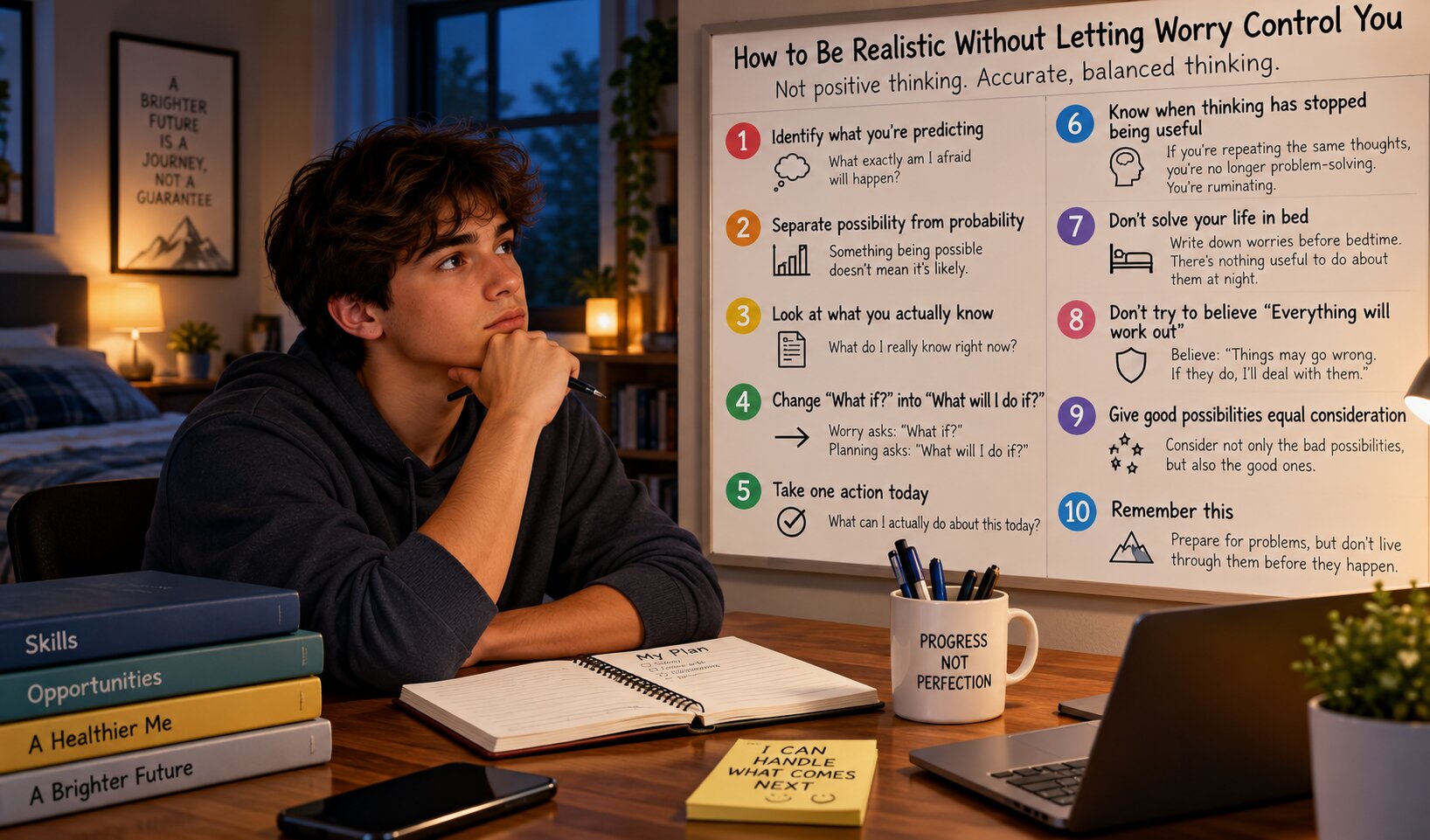
You don’t have to “think positively” or convince yourself that everything will be fine. If that feels fake, don’t do it.
The goal is not positive thinking. The goal is accurate, balanced thinking.
Step 1: Identify what you’re predicting
When anxiety appears, ask:
“What exactly am I afraid will happen?”
For example:
“I’m worried I won’t get a good job and my future won’t work out.”
Turn the vague anxiety into a specific prediction.
Step 2: Separate possibility from probability
Something being possible doesn’t mean it’s likely.
Ask:
“Am I thinking about the most likely outcome—or the worst possible outcome?”
Your brain is very good at imagining disasters. That doesn’t make those disasters predictions.
Step 3: Look at what you actually know
Instead of:
“My future is going to be bad.”
Try:
“The future is uncertain. There may be difficulties, but there are also many possible good outcomes that I can’t see yet.”
That’s not positive thinking.
That’s realism.
Step 4: Change “What if?” into “What will I do if?”
This is one of the most useful changes you can make.
Instead of:
“What if I don’t get the job I want?”
Ask:
“What will I do if I don’t get the job I want?”
Maybe you’ll improve your skills, apply elsewhere, change your strategy, ask someone for advice, or take a temporary alternative.
Worry asks: “What if?”
Planning asks: “What will I do if?”
Step 5: Take one action today
Ask:
“What can I actually do about this today?”
Study for an hour. Send an application. Exercise. Learn something. Make a phone call. Improve your résumé.
Then do it.
Action reduces uncertainty far better than another hour of worrying.
Step 6: Know when thinking has stopped being useful
Thinking about a problem once may help.
Thinking about it ten times usually doesn’t make you ten times more prepared.
When you’re repeating the same thoughts without discovering anything new, you’re no longer problem-solving.
You’re ruminating.
Tell yourself:
“I’ve already thought about this. More thinking isn’t helping me. I will schedule a time to worry. Let me schedule it tomorrow from 5PM to 6pm”
Step 7: Don’t solve your life in bed
Your bed should not become your conference room.
Before bedtime, spend 15–20 minutes writing down:
What am I worried about? → What can I control? → What will I do tomorrow?
Then close the notebook.
If the thought returns in bed:
“There’s nothing useful I can do about this tonight. I’ll deal with it tomorrow.”
Step 8: Don’t try to believe “Everything will work out”
You don’t know that.
Believe something much more defensible:
“Things may go wrong. If they do, I’ll deal with them.”
Your confidence doesn’t have to come from believing that nothing bad will happen.
It can come from knowing you can handle problems when they happen.
Step 9: Give good possibilities equal consideration
If you’re being truly realistic, you can’t consider only negative possibilities.
Maybe something goes badly.
But maybe something goes reasonably well.
Maybe an unexpected opportunity appears.
Maybe you become better at something you currently find difficult.
If you consider only bad possibilities and call that realism, you’re not being realistic. You’re giving pessimistic possibilities extra weight.
Step 10: Remember this
Prepare for problems, but don’t live through them before they happen.
You don’t need to become an optimist.
Become someone who can say:
“I don’t know exactly what my future holds. I’ll prepare for what I can, act on what I can control, and trust myself to deal with the rest when it actually happens.”