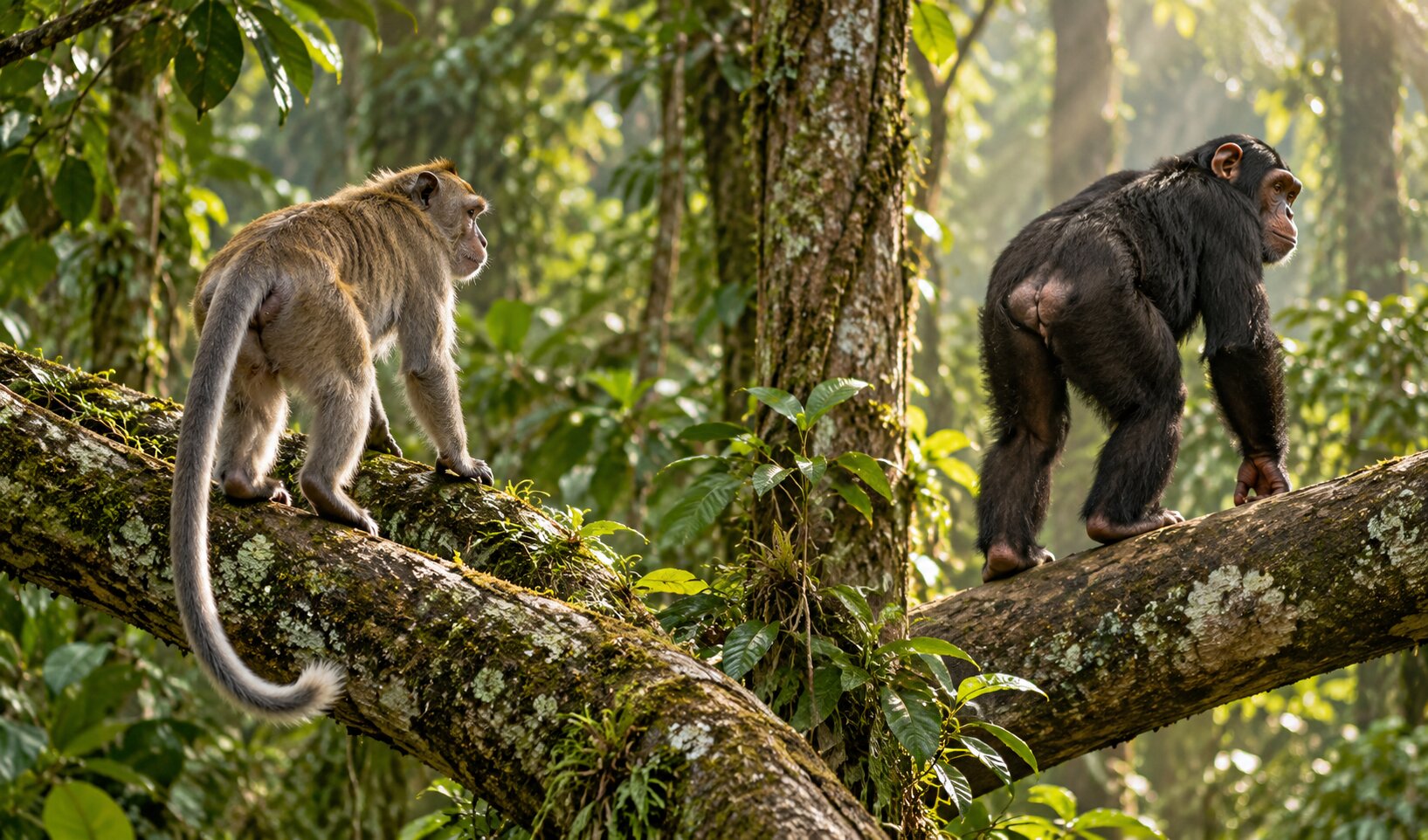
A monkey’s tail helps it balance. Humans and other apes manage without one. How did such a conspicuous body part disappear?
A 2024 genetic study identified a compelling clue: a small piece of mobile DNA inserted into TBXT, a gene involved in embryonic development. The insertion is shared by humans and other apes but absent from the tailed monkeys examined. It changes how the gene’s RNA is assembled, producing an additional version with one section omitted. Study Nature
The strongest evidence went beyond comparing genomes. Researchers engineered mice to produce corresponding versions of the gene’s message. Some developed shortened tails or no tails—demonstrating that this molecular change can alter tail development. PubMed
Well supported: the insertion provides a credible genetic contribution to ancestral ape tail loss. It does not establish that one mutation explains the entire transformation.
Plausible but debated: losing the tail benefited ancestors adopting more upright postures or different ways of moving. The experiments explain a developmental mechanism; they cannot show why the change spread. Selection and chance remain harder to disentangle.
Nor should we imagine evolution removing tails in anticipation of humans walking upright. Evolution has no foresight.
The discovery illustrates a striking principle: a modest change in how genetic instructions are processed can produce a major anatomical difference. Understanding how that happened is easier than establishing why it persisted.


