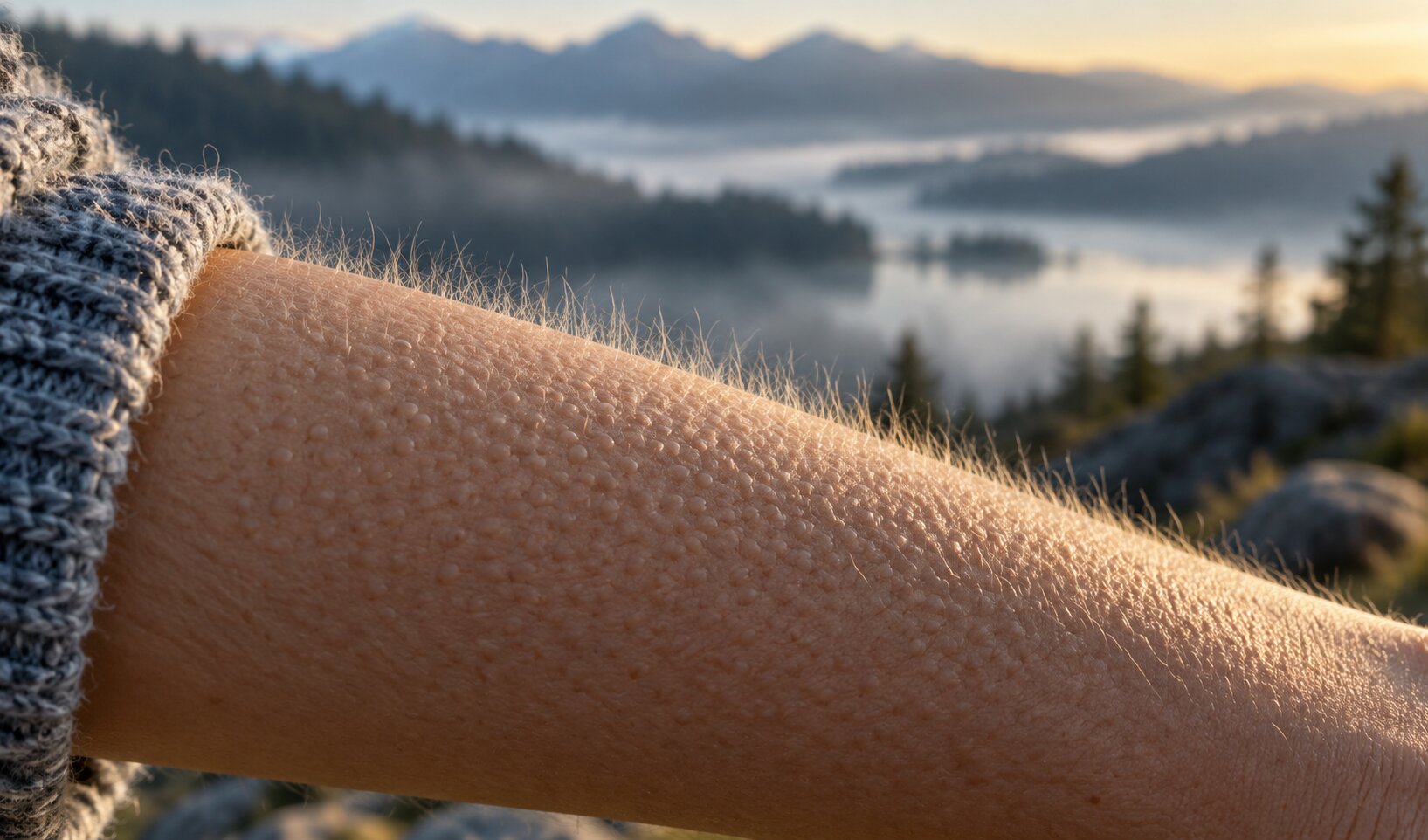
A cold breeze or a moving song can make your skin erupt into tiny bumps. Each bump forms when a miniature muscle attached to a hair follicle contracts, pulling the hair upright.
In furry mammals, raised hair can improve insulation or make an animal appear larger. Humans retain the machinery despite having much less body hair—one reason goosebumps are commonly described as an evolutionary leftover. But “leftover” need not mean functionless. PMC
The strongest experimental evidence for an additional role comes from a 2020 study in mice. Researchers found that the muscles responsible for goosebumps help maintain connections between sympathetic nerves and hair-follicle stem cells. Those nerves release norepinephrine, which activates the stem cells. Prolonged cold stimulated this system and promoted hair regeneration. Study PMC
The same biological apparatus therefore connects an immediate response—raising existing hairs—with a slower response: growing hair.
Well supported: goosebumps involve coordinated activity among nerves, muscles and follicles. In mice, that network also regulates hair growth.
Still uncertain: how much this mechanism contributes to human hair growth, and why music or awe activates the reflex. The mouse experiments do not establish that emotional goosebumps provide a survival advantage.
The evolutionary lesson is subtle: a structure can lose much of one function while retaining others. Our skin’s tiny bumps may carry an ancestral history without being merely obsolete equipment.


