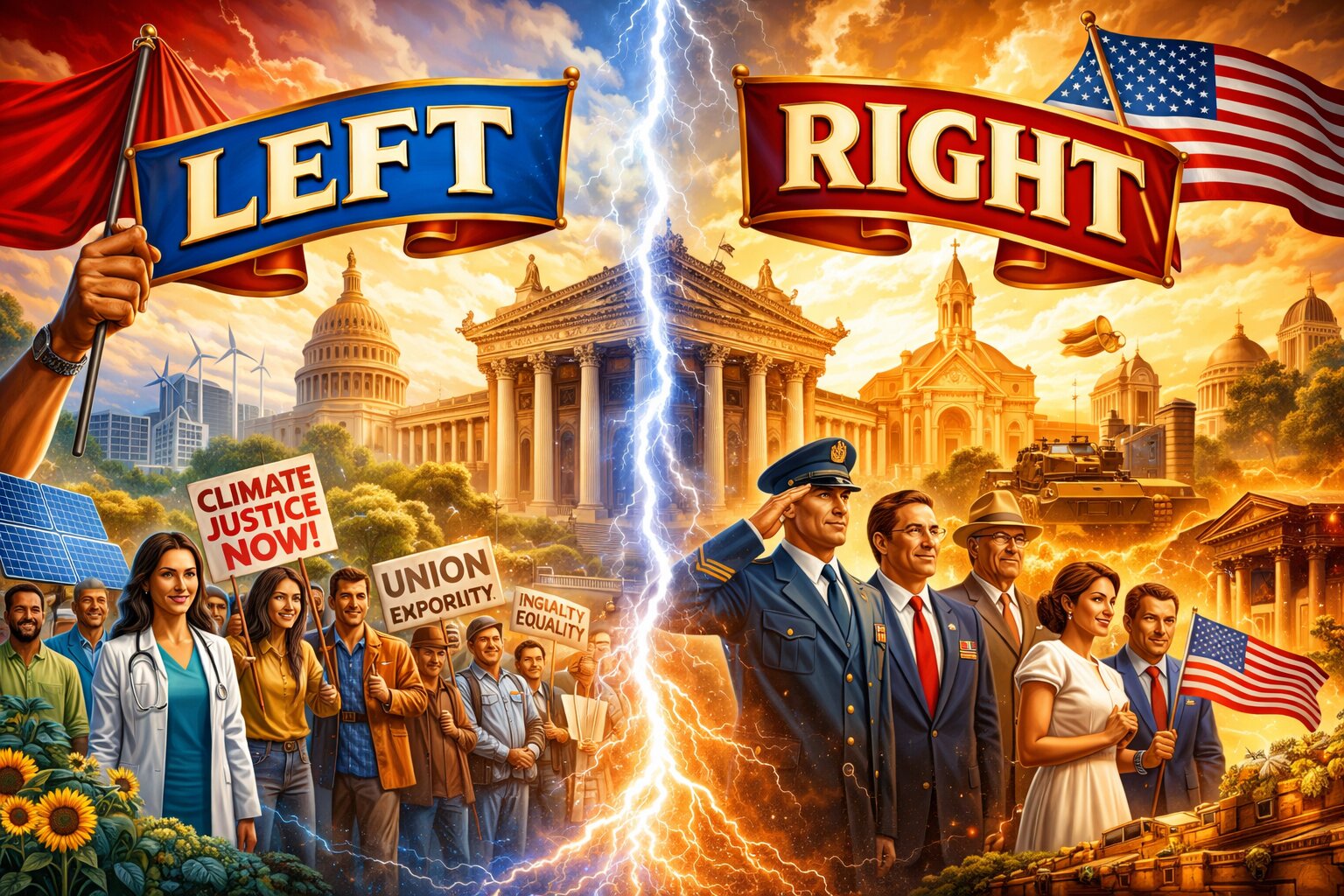
The terms “Left-wing” and “Right-wing” began during the French Revolution, when people with different political beliefs literally sat on opposite sides of the assembly.
Over time, that physical division turned into a powerful way of describing two competing visions of society.
One vision places greater importance on equality, collective welfare, and reform.
The other places greater importance on liberty, tradition, personal responsibility, and limited government.
Although real-world politics is often more complicated than simple labels, the Left-Right divide still helps explain many of the biggest arguments in modern public life.
From taxation and healthcare to religion, crime, culture, and national identity, much of politics can still be understood through this enduring ideological split.
Left-Wing Politics
The case for equality, social justice, and an active state
Left-wing politics begins with the belief that society naturally produces unfair inequalities unless institutions step in to correct them.
For that reason, the Left places strong emphasis on reducing economic and social inequality.
This often means support for progressive taxation, welfare programs, universal healthcare, and public education.
To the Left, freedom is not just the absence of restraint, but the presence of real opportunity.
A person is not truly free, in this view, if poverty, discrimination, illness, or lack of education keeps them from living with dignity.
That is why Left-wing politics is closely tied to social justice.
Civil rights, anti-discrimination laws, inclusivity, and protection for marginalized communities are central parts of Left-leaning thought.
The Left also believes government should play an active role in the economy.
Markets, while useful, are seen as imperfect and often dangerous when left unchecked.
Without regulation, the Left argues, wealth concentrates, exploitation grows, and ordinary citizens lose protection against corporate power.
Collectivism is another important principle of the Left.
This does not always mean opposition to individuality, but it does mean that the needs of society as a whole are often treated as more important than private gain.
A Left-wing society is usually judged not by how much wealth it creates at the top, but by how fairly it spreads security and opportunity across the population.
The Left is also associated with progressive values.
It tends to embrace change, reform, and innovation in both social norms and public policy.
That is why Left-wing movements often champion environmental protection, labor rights, gender equality, and broader civil liberties.
Secularism is another major feature of the Left.
In general, Left-wing politics prefers a strong separation between religion and the state.
Public policy, in this view, should be based on civic values, universal rights, and rational debate rather than religious doctrine.
Typical Left-wing policies include universal healthcare, subsidized or free college, labor union support, climate regulation, and higher taxes on the wealthy.
Right-Wing Politics
The case for individual liberty, tradition, and limited government
Right-wing politics begins from a different instinct about human society.
Rather than focusing first on inequality, the Right focuses first on liberty, responsibility, stability, and order.
It emphasizes individualism, which means people should be free to shape their own lives with as little government interference as possible.
To the Right, self-reliance is a virtue, and too much dependence on the state weakens both character and society.
This helps explain the Right’s support for small government.
Government, in this view, should do fewer things, especially in economic life.
Lower taxes, less regulation, and a greater role for private enterprise are seen as the best way to encourage growth, innovation, and entrepreneurship.
Right-wing politics is therefore closely connected to free-market capitalism.
The market is viewed as a more efficient and natural way to organize economic life than large state systems.
Where the Left sees regulation as protection, the Right often sees it as an obstacle.
Traditional values are also central to many Right-wing ideologies.
Cultural customs, religion, family structure, and inherited moral frameworks are often seen as stabilizing forces that give society meaning and continuity.
Because of this, the Right is often more conservative on social issues.
It tends to approach rapid cultural change with suspicion, arguing that not every reform leads to progress.
Law and order is another defining feature of the Right.
Crime prevention, strong policing, military strength, and national security are typically treated as essential duties of the state.
The Right often argues that freedom cannot survive in a society that loses control of crime, disorder, or external threats.
Nationalism also plays a prominent role in Right-wing politics.
This does not always mean hostility to others, but it usually does mean a strong emphasis on sovereignty, border control, patriotism, and national identity.
In many Right-wing movements, immigration is viewed not only as an economic issue but as a cultural and security issue as well.
Typical Right-wing policies include tax cuts, deregulation, tough-on-crime laws, strong military spending, and in some cases opposition to abortion or same-sex marriage.
Why most people live somewhere between the extremes
The political spectrum is not simply a clash between two rigid camps.
Most individuals, parties, and governments fall somewhere between the far Left and the far Right.
The far Left includes ideologies such as communism, which seek radical equality through collective ownership and deep structural change.
Closer to the center, socialism and center-left liberalism usually support redistribution, labor rights, and social protections while still working within democratic systems.
The center tends to balance individual liberty with public responsibility.
Center-right politics often supports markets, private property, and traditional institutions while accepting democratic norms and moderate reform.
The far Right includes authoritarian and ultra-nationalist ideologies that can elevate hierarchy, exclusion, and centralized power to dangerous levels.
This spectrum matters because it reminds us that politics is not always black and white.
People may be Left-wing on economic issues and Right-wing on cultural issues.
Others may believe in free markets but also support strong welfare systems.
Real political life is often a blend of competing instincts rather than a perfect ideological category.
Conclusion
Why the argument between Left and Right never disappears
The reason the Left-Right divide has survived for so long is that it speaks to genuine and permanent tensions in human life.
People want equality, but they also want freedom.
People want security, but they also want independence.
People want justice, but they also fear excessive power.
The Left worries that unchecked wealth, privilege, and social hierarchy will crush fairness and dignity.
The Right worries that unchecked government, cultural decline, and weakened institutions will crush freedom and stability.
Both sides are responding to real dangers, which is why the conflict remains so powerful.
In the end, Left-wing and Right-wing politics are not just about policy.
They are two different answers to the same timeless question: what kind of society allows human beings to live best together.
That is why a political vocabulary born in the French Revolution still shapes debates across the modern world.