Walk into a grocery store and scan the produce aisle.
You’ll see red tomatoes.
Green spinach.
Orange carrots.
Yellow bananas.
Purple eggplants.
But where is the blue?
Aside from blueberries — and even those are more purple than blue — nature seems strangely reluctant to serve us sky-colored food.
This isn’t an accident. It’s chemistry. It’s evolution. And it’s psychology.
Let’s unpack why blue is the rarest color on your plate.
1. Blue Is Chemically Difficult
In nature, blue is surprisingly hard to manufacture.
Red, yellow, and brown pigments are chemically simple. Plants and animals produce them using relatively straightforward molecules like carotenoids and melanin.
True blue? That’s different.
Most blue in animals isn’t pigment at all. It’s structural coloration — microscopic physical structures that bend and scatter light so that blue wavelengths are reflected.
The dazzling wings of the Morpho butterfly.
The feathers of a blue jay.
Certain tropical frogs.
They aren’t “blue” in the traditional pigment sense. They are engineered to appear blue through physics.
That’s biologically expensive. And evolution only keeps expensive traits when they’re necessary for survival or reproduction.
For food plants? Blue simply wasn’t necessary.
2. Plants Had No Evolutionary Need to Be Blue
Most plant colors come from three pigment systems:
- Chlorophyll (green)
- Carotenoids (yellow/orange)
- Anthocyanins (red to purple)
Anthocyanins can sometimes appear bluish depending on acidity, which is why blueberries and purple cabbage exist. But they’re chemically closer to red than true blue.
From an evolutionary standpoint, plants use color for two main reasons:
1. Attract pollinators
2. Signal ripeness to animals
Red and yellow stand out sharply against green leaves — perfect for attracting attention. Blue does not offer a strong advantage in that ecological context.
So evolution optimized for visibility and efficiency — not aesthetic diversity.
3. Your Brain Is Wired to Distrust Blue Food
Here’s where evolutionary psychology enters.
For most of human history:
- Red meant ripe fruit.
- Brown meant cooked meat.
- Green meant edible plants.
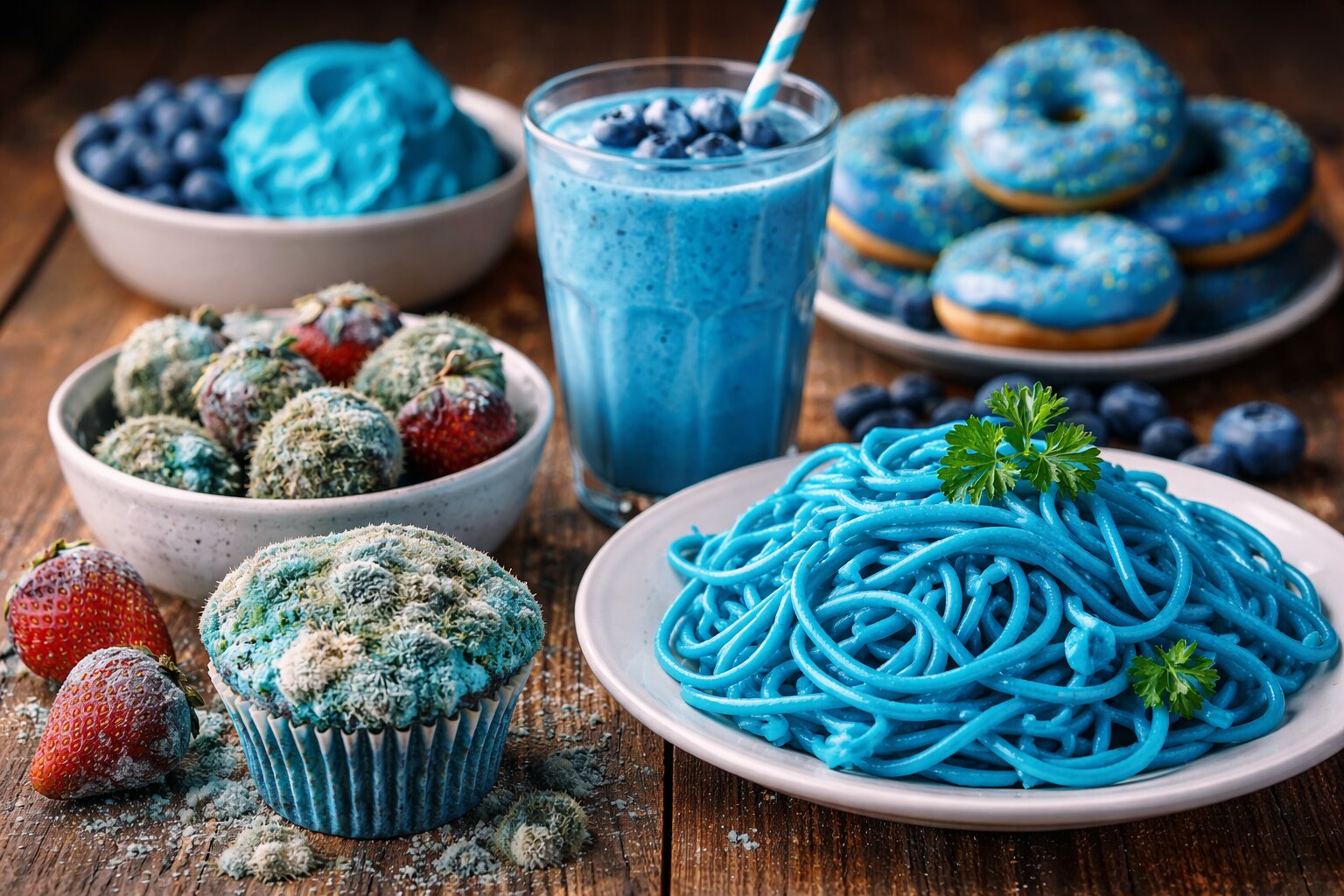
- Blue often meant mold, rot, or the sky.
Blue food was rare in ancestral environments. And rare often means risky.
Over thousands of generations, humans developed subtle biases toward colors associated with calories and safety. Warm colors signal energy. Cool colors signal caution.
This may explain why:
- Fast-food chains avoid blue branding.
- Blue plates suppress appetite in experiments.
- Artificial blue candy feels “unnatural.”
Your brain evolved long before food dye existed.
4. Evolution Invests Only Where It Must
Evolution is economical. It does not innovate unless pressured.
For animals, blue might help attract mates or warn predators.
For edible plants, survival depends more on:
- Efficient photosynthesis
- Seed dispersal
- Protection from herbivores
Blue pigment offers little advantage in those arenas.
So nature didn’t spend the biochemical budget on it.
5. The Exception Proves the Rule
Yes, blueberries exist. So do purple sweet potatoes and blue corn.
But even these aren’t truly blue in pigment chemistry. They rely on variations of red/purple anthocyanins interacting with cellular structure and pH.
True sky-blue pigment molecules remain extraordinarily rare in biology.
The color of the sky is abundant.
The color of the ocean is abundant.
But the color of food? Almost never.
The Bigger Insight
When you notice that blue food feels “wrong,” you’re not being irrational.
You’re experiencing ancient evolutionary programming.
Nature optimized for survival signals:
- Red = sugar (Fruits)
- Yellow = calories
- Green = plants
- Brown = protein
Blue didn’t fit the survival equation.
So it remained scarce.
The Next Time You Eat
Look at your plate.
It’s a map of evolutionary history — a palette shaped by chemistry, survival, and psychological wiring stretching back tens of thousands of years.
And somewhere in that story, blue simply never made the cut.