In On the Origin of Species, Charles Darwin explained one of biology’s most powerful ideas:
New species arise when populations become reproductively isolated and evolve independently.
It sounds clinical. Technical. Academic.
But in the real world, speciation is dramatic. It is geographic accidents, ecological pressures, and evolutionary improvisation unfolding over thousands of years.
Few examples illustrate this better than the fate of one unforgettable bird:
The Dodo.
A Lost Traveler Lands on an Empty Island
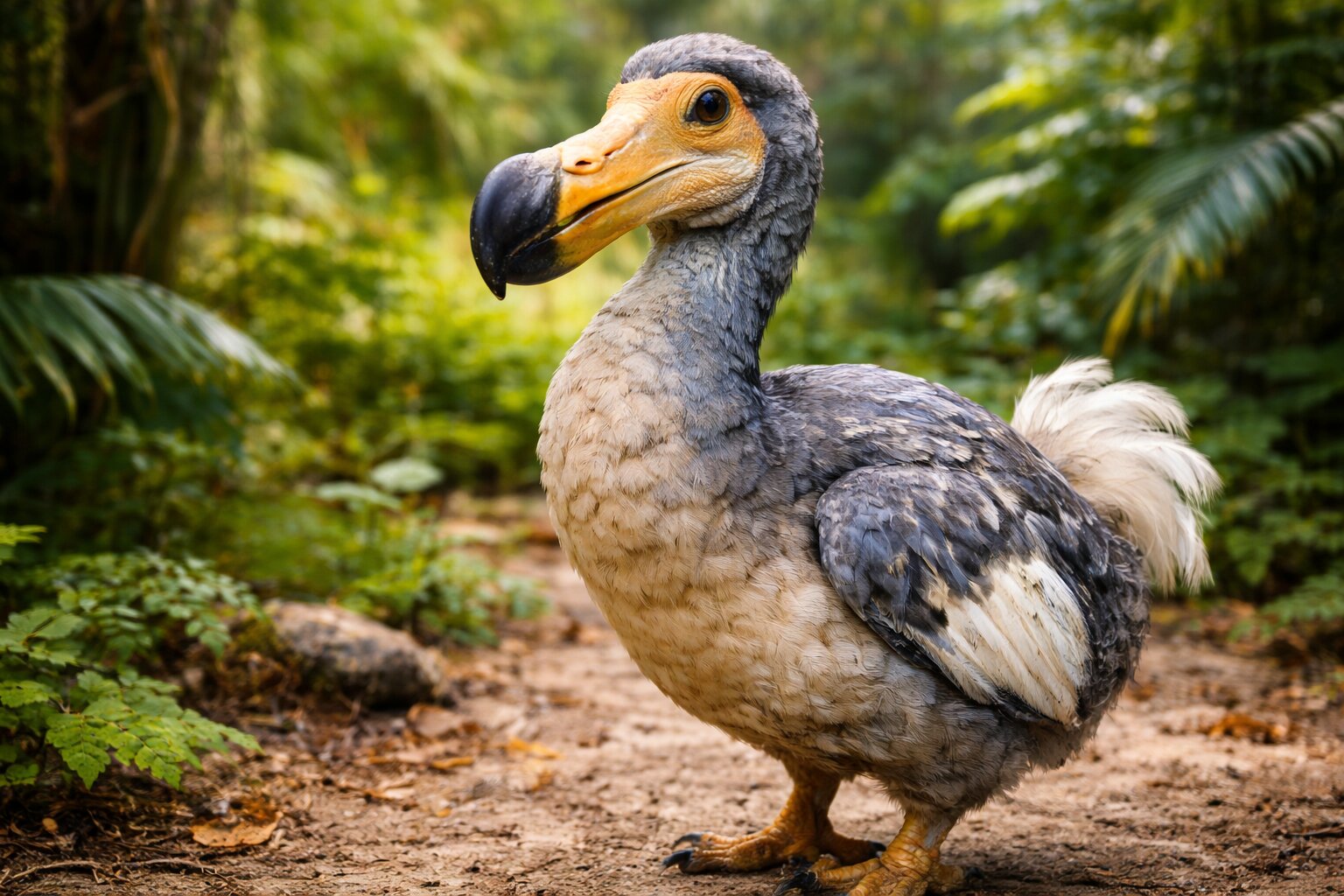
The dodo (Raphus cucullatus) once lived exclusively on the island of Mauritius, a volcanic island in the Indian Ocean.
Its closest living relative? The Nicobar pigeon — a perfectly capable flier.
That tells us something important.
The ancestors of the dodo could fly.
At some point, a small population of pigeon-like birds was blown off course and landed on Mauritius. Once there, something profound happened.
They became isolated.
Step One: Geographic Isolation
Mauritius was remote. No land bridges. No predators. No mammals hunting birds.
The stranded pigeon population could no longer breed with mainland relatives.
This is the first ingredient of speciation: reproductive isolation.
Separated from the parent population, the island birds began evolving independently.
No dramatic change at first. Just small genetic differences accumulating generation after generation.
Step Two: Evolution in a Predator-Free Paradise
On Mauritius, flight was no longer essential.
Flying requires energy. Large breast muscles. Lightweight bones.
If predators are absent, those traits become less critical.
Over thousands of years, natural selection (and genetic drift) nudged the population in a new direction:
- Bodies grew larger
- Wings became smaller
- Flight muscles shrank
- Bones became heavier
- Behavior became tamer
The birds were adapting to their environment.
Gradually, they became flightless.
And at some point, they were no longer just isolated pigeons.
They were dodos.
When Is a New Species Born?
Speciation is not a sudden event. There’s no evolutionary ribbon-cutting ceremony.
Instead, the split becomes official when two populations can no longer interbreed successfully.
If a Nicobar pigeon somehow met a dodo, reproduction would no longer be viable.
Too much divergence had accumulated.
The isolation had done its work.
A new species had emerged.
Island Evolution: Nature’s Laboratory
Islands are powerful engines of speciation.
Darwin later observed similar patterns in the Galápagos Islands — finches adapting different beaks, tortoises developing varied shell shapes.
Isolation creates evolutionary experiments.
Each island becomes a separate laboratory.
Mauritius produced the dodo.
Other islands produced their own unique forms of life.
The Tragic Twist: Specialization Cuts Both Ways
Speciation produces diversity. But it also produces vulnerability.
The dodo evolved without predators.
It nested on the ground.
It showed little fear.
It had no need for flight.
When humans arrived in the 1500s — bringing rats, pigs, dogs, and hunting pressure — the dodo’s evolutionary advantages became liabilities.
Within less than a century, the species vanished.
The same isolation that created it had left it defenseless.
The Deeper Lesson of the Dodo
The dodo is often mocked as a symbol of stupidity.
But evolutionarily speaking, it was perfectly adapted to its environment.
Speciation had shaped it precisely for Mauritius.
The tragedy wasn’t poor design.
It was environmental change happening faster than evolution could respond.
Speciation Is Ongoing
The story of the dodo reminds us:
- Species are not fixed.
- Isolation reshapes life.
- Evolution is context-dependent.
- Adaptation is never future-proof.
Speciation is not rare. It is constant. Quiet. Gradual.
Every time a population becomes cut off — by geography, behavior, or ecology — evolution begins drafting a new blueprint.
Sometimes that blueprint flourishes for millions of years.
Sometimes, like the dodo, it flickers briefly and disappears.
The Paradox of Isolation
Isolation creates uniqueness.
But it also limits resilience.
The dodo existed because a small group of birds was cut off from the world.
It vanished because it remained cut off — unable to adapt quickly when the world changed.
Speciation is neither heroic nor tragic.
It is simply evolution’s way of exploring possibility.
And on a quiet island in the Indian Ocean, it once produced a bird that forgot how to fly — because, for a while, it didn’t need to.