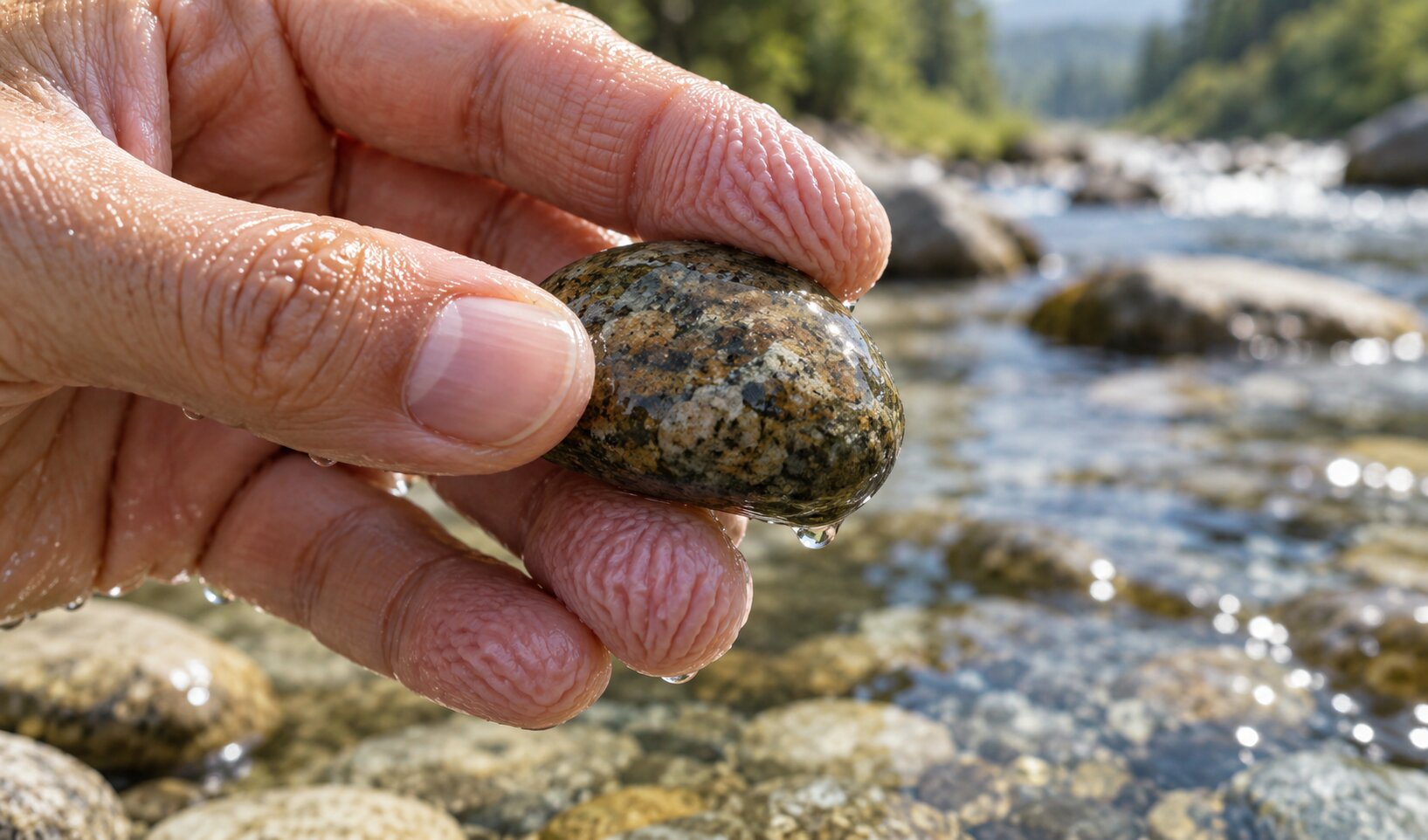
After a long bath, your fingertips develop little ridges and channels. One intriguing hypothesis suggests these wrinkles help you grip wet objects—rather like tire treads on a rainy road.
Well supported: water-induced wrinkling depends on the sympathetic nervous system. It is more than skin simply soaking up water. That makes an adaptive explanation worth investigating, though nervous-system control alone does not prove a useful function. PLOS One
The strongest supporting evidence comes from a 2021 experiment measuring grip force. Participants with wet, wrinkled fingers used less force to hold an object than participants whose fingers were wet but unwrinkled. Their grip force approached the level needed with dry fingers. This supports a specific benefit: more efficient gripping under wet conditions. Study PubMed
But the evidence is mixed. A 2014 study of 40 participants found that wrinkles did not improve the speed of transferring wet objects or measured touch sensitivity. Grip efficiency and task speed are different outcomes; a benefit in one need not improve the other. Study PLOS One
Plausible but debated: natural selection favored wrinkling because it helped ancestors gather food or handle objects in streams and rain. Experiments can demonstrate present-day benefits, but they cannot establish which pressures originally shaped the response.
Your bath-time fingers may offer better wet-weather traction. Whether that advantage explains their evolutionary origin remains an open question.


