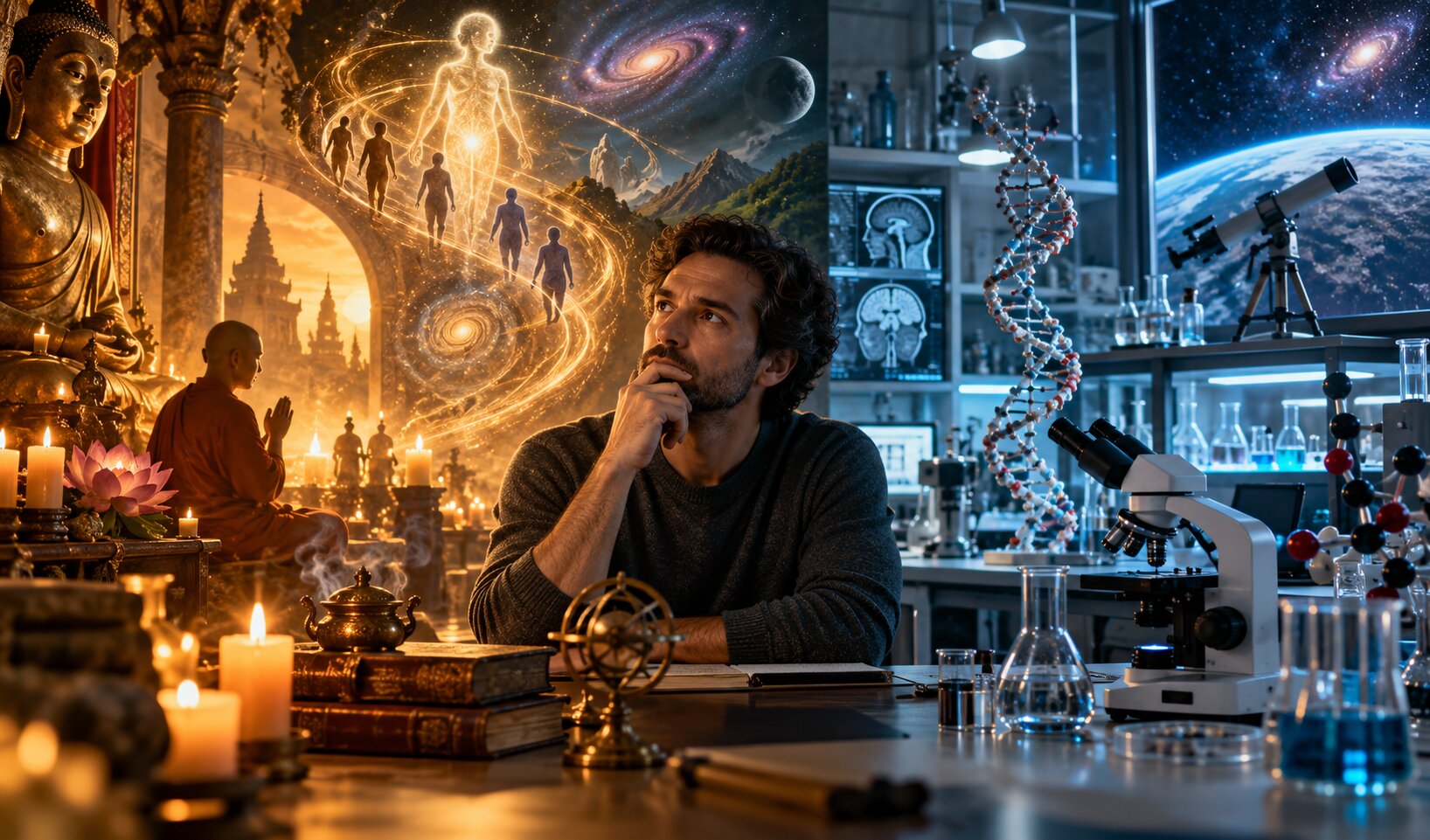
There is nothing wrong with believing in:
God.
Karma.
Reincarnation.
Soul.
Heaven.
Ghosts.
Afterlife.
Believe whatever makes sense to you.
But there is an important difference between:
“I believe this is true.”
and
“Science has established this as true.”
Those are NOT the same thing.
Science works through evidence, observation, measurement, testing, prediction, and independent verification.
If someone says:
“I believe the soul survives after death.”
Fine.
That is a belief.
But if someone says:
“Science proves the soul survives after death.”
Now we have to ask:
Where is the evidence?
The same applies to karma.
If by karma you mean:
“If I treat people badly, eventually people may stop trusting me.”
Sure.
That can be explained through psychology and social behavior.
But if you mean:
“The universe keeps an invisible account of everything I do and rewards or punishes me, perhaps even in another lifetime…”
That is a completely different claim.
Where is this mechanism?
How is it detected?
How is it measured?
How do we test it?
Calling it energy, frequency, vibration, or electromagnetic force does not magically make it scientific.
Scientific words are not scientific evidence.
The same problem exists with reincarnation.
There are interesting stories about people claiming memories of previous lives.
But stories alone are not proof.
Before concluding reincarnation is real, we have to rule out things like:
Coincidence.
Suggestion.
Cultural influence.
False memory.
Information learned indirectly.
Selective reporting.
Fraud.
And this is where people often respond:
“But science doesn’t know everything!”
Correct.
Science does NOT know everything.
But here is the important distinction:
“We don’t know yet”
is NOT the same as:
“Therefore my explanation may be true.”
Imagine saying:
“We don’t know what caused this disease, therefore evil spirits may have caused it.”
That doesn’t follow logically.
Ignorance is not evidence.
Another common argument is:
“Science has been wrong before.”
Absolutely.
Science has been wrong thousands of times.
But what corrected science?
Better science.
Better evidence.
Better experiments.
Better instruments.
The fact that science was wrong about something 200 years ago doesn’t automatically make astrology, reincarnation, ghosts, or supernatural karma more likely to be true.
Every claim has to provide its OWN evidence.
And here is perhaps the most important point:
POSSIBILITY IS NOT PROBABILITY.
Can I prove with absolute certainty that reincarnation is impossible?
No.
Can I prove that an invisible soul definitely does not exist?
No.
Can I prove that there is absolutely no God anywhere in existence?
No.
But inability to disprove something does not establish it.
I also cannot prove that an invisible dragon isn’t sitting beside me right now.
That doesn’t give me a good reason to believe there is one.
So the intellectually cautious position is very simple:
“Right now, I don’t see enough evidence to believe it.”
And equally important:
“If strong evidence appears tomorrow, I am willing to change my mind.”
That is not closed-mindedness.
That is exactly how rational thinking should work.
Your confidence in a belief should roughly match the strength of the evidence supporting it.
So believe in God if you want.
Believe in karma.
Believe in reincarnation.
Believe in souls.
Or don’t believe in any of them.
But please remember:
Personal belief ≠ Scientific evidence
Possibility ≠ Probability
Anecdote ≠ Proof
“We don’t know” ≠ “Therefore my belief is true”
And perhaps the most intellectually honest sentence any of us can say is:
“I don’t know.”
Sometimes that is far wiser than pretending to have an answer.