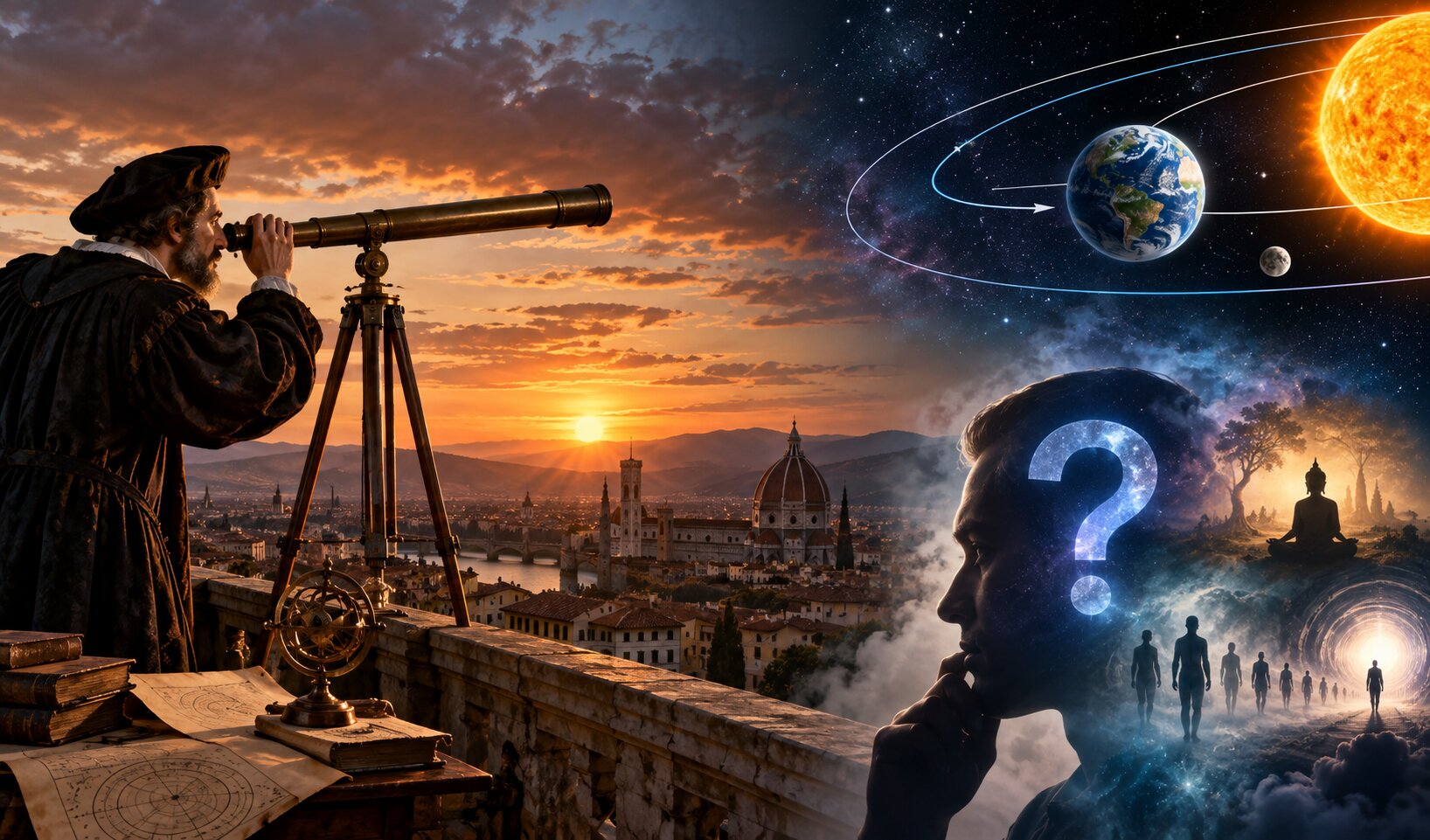
Several centuries ago, imagine standing outside and looking at the sky.
The Earth feels perfectly still.
But the Sun rises in the east, moves across the sky, and sets in the west.
What would you believe?
Obviously, the Sun is moving around the Earth!
And for a very long time, that’s exactly what people believed.
Today we know that’s wrong.
So here’s an uncomfortable question:
What are we absolutely certain about TODAY that people 500 years from now might laugh at?
And this gets particularly interesting when we talk about God, karma, reincarnation, the soul, consciousness and life after death.
Someone could reasonably ask:
“You say there’s no scientific evidence for reincarnation today. But people once believed the Sun revolved around the Earth. What if science discovers reincarnation, karma or something we currently call ‘God’ centuries from now?”
Fair question.
But there’s a subtle logical trap here.
The key distinction is between:
“We don’t know yet.”
and
“Therefore this claim may be true.”
The first is reasonable.
The second needs evidence.
Science being wrong in the past doesn’t automatically make today’s unproven beliefs tomorrow’s scientific discoveries.
Otherwise, practically ANY claim could be defended by saying:
“Well… science might prove it someday.”
That’s not evidence.
At the same time, skeptics can make exactly the opposite mistake.
They might say:
“We don’t currently have scientific evidence for reincarnation, therefore reincarnation definitely does not exist.”
That’s also too strong.
Absence of convincing evidence today doesn’t automatically give us knowledge about what humanity could discover centuries from now.
And this is where I think both believers and non-believers can become dogmatic.
One says:
“I know it’s true.”
The other says:
“I know it’s impossible.”
But sometimes the most rational answer is much simpler:
“I don’t know.”
That’s essentially what good scientific thinking requires.
A belief doesn’t have to wait until we possess perfect evidence. Almost none of our beliefs have perfect evidence.
Instead,
the confidence we place in a belief should roughly correspond to the strength of the evidence supporting it.
Strong evidence → strong confidence.
Weak evidence → weak confidence.
Insufficient evidence → “I don’t know.”
And if better evidence comes tomorrow?
Change your mind.
This cuts both ways when discussing God, karma or reincarnation.
It would be too strong to argue:
“We don’t currently have scientific evidence for reincarnation, therefore reincarnation definitely does not exist.”
But it’s also too strong to argue:
“Science has been wrong before, therefore reincarnation may be something science will eventually prove.”
The intellectually cautious position is:
“I don’t currently see sufficient evidence to believe it, but I don’t claim that future evidence could never change my mind.”
And THAT, to me, is genuine open-mindedness.
The history of astronomy teaches us something incredibly important: epistemic humility.
In simple English:
We should always leave room for the possibility that we are wrong.
Our present understanding can be incomplete.
But that doesn’t tell us which currently unverified ideas will eventually turn out to be true.
Maybe future science will discover something extraordinary about consciousness.
Maybe something survives death.
Maybe what ancient people called the “soul” will eventually have an entirely different explanation.
Maybe karma or reincarnation will acquire some scientific basis.
Or maybe none of them will.
We simply don’t know.
And there’s absolutely nothing wrong with saying that.
The lesson from history isn’t:
“Believe strange things because science might prove them someday.”
Nor is it:
“Reject everything FOREVER science cannot currently explain.”
The better lesson is:
Believe according to the evidence available today.
But always leave enough room in your mind for tomorrow’s evidence to prove you wrong.
Because perhaps the most dangerous sentence in human thinking isn’t:
“I don’t know.”
It’s:
“I know I’m right.”