You walk into Costco planning to buy three things:
Milk.
Eggs.
Toilet paper.
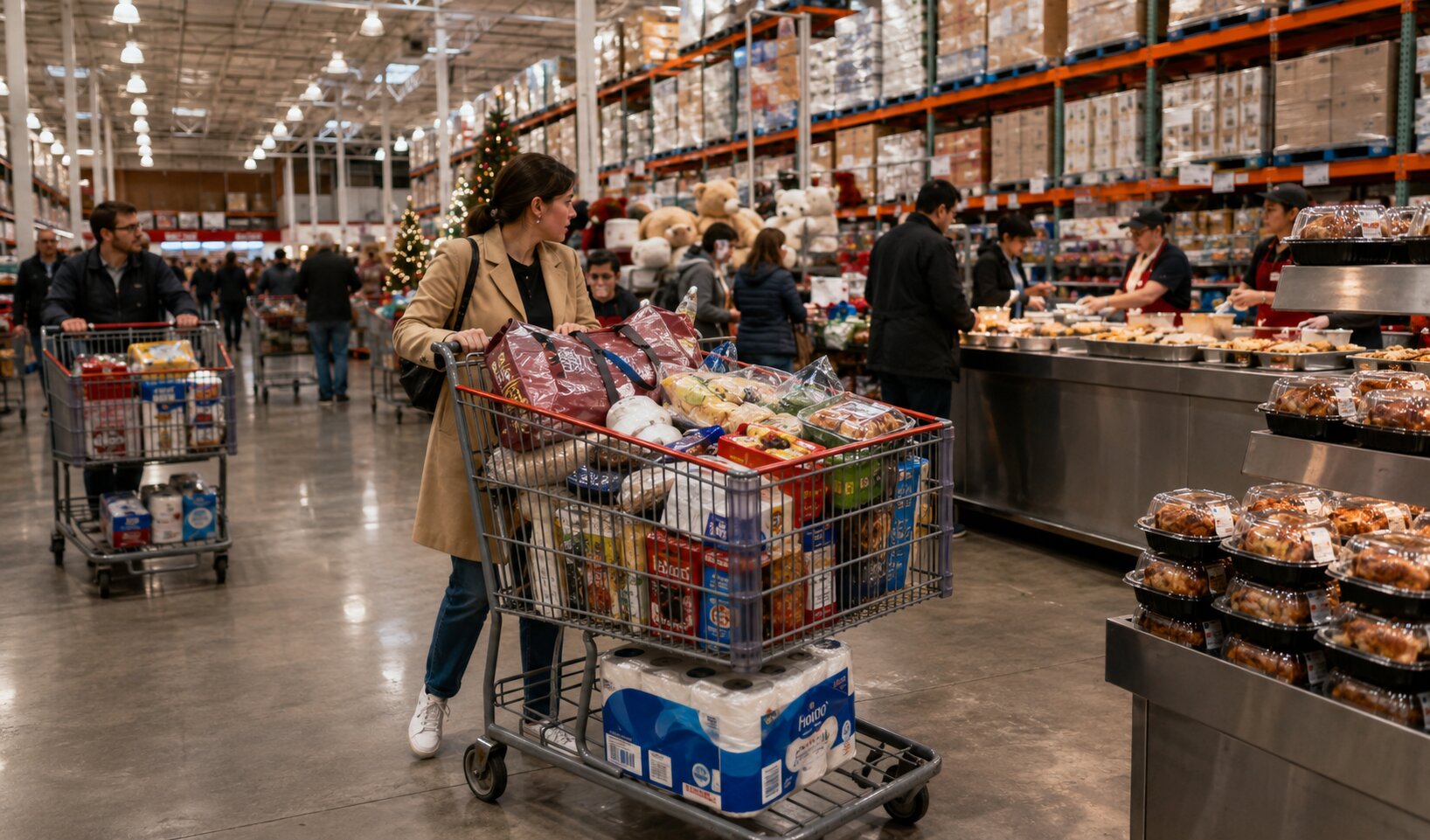
An hour later, you walk out pushing a cart loaded with a rotisserie chicken, a 30-pack of sparkling water, a giant bag of almonds, a new jacket, vitamins, mangoes, a box of croissants, and perhaps a patio chair you had absolutely no intention of buying.
Your bill: $287.
And somehow, you still feel like you saved money.
That is the brilliance of Costco.
Costco doesn’t necessarily need to aggressively “sell” things to you. Instead, the warehouse is designed in ways that encourage you to explore, discover, sample, compare, justify—and ultimately buy more than you planned.
Welcome to the Costco Trap.
1. Costco Wants You to Wander
Traditional supermarkets make shopping relatively easy.
Aisles are clearly organized. There are signs saying:
“Cereal.”
“Bread.”
“Cleaning Supplies.”
“Frozen Foods.”
Costco is much less interested in helping you execute a surgical shopping mission.
The warehouse feels enormous, and finding a particular item can sometimes require walking through large sections of the store.
That wandering is valuable.
Because every additional minute you spend walking through Costco is another opportunity for something to catch your eye.
You came looking for olive oil.
But on the way you encounter:
A $299 television.
A giant cheesecake.
A camping chair.
A 12-pack of socks.
And suddenly your brain starts asking:
“Do I need this?”
That question never would have occurred to you if Costco hadn’t put the product in front of you.
2. The Famous Costco “Treasure Hunt”
Costco is famous for frequently rotating merchandise and changing displays.
An item you found in one location last month may not necessarily be sitting in exactly the same place next time.
This creates what retailers sometimes call a treasure-hunt experience.
You start thinking:
“I wonder what Costco has today.”
Shopping becomes less like completing a grocery list and more like exploring.
And exploration is dangerous for your wallet.
If everything were predictable, you could walk directly to the item you wanted and leave.
Unpredictability forces you to look around.
And looking around creates temptation.
3. The Entrance Is Designed to Attack Your Shopping List
Notice what often greets you near the entrance.
Televisions.
Electronics.
Jewelry.
Seasonal merchandise.
Furniture.
Expensive appliances.
These aren’t necessarily the things you came to buy.
But they immediately expand your thinking from:
“I’m here for groceries.”
to:
“What else might I need?”
You haven’t even reached the food section, and Costco has already turned a grocery trip into a general shopping trip.
4. The Giant Shopping Cart
Costco carts are enormous.
There is a psychological consequence to this.
When your cart contains four items, it can still look practically empty.
An empty-looking cart subtly makes you feel as though you haven’t bought very much.
Put the same products into a small grocery basket and it might already look full.
Large carts normalize large purchases.
Before long, you’re pushing around enough food to feed a small restaurant.
5. Everything Is BIG
Costco’s entire business model revolves around bulk.
You don’t buy six rolls of toilet paper.
You buy enough toilet paper to survive a minor civilization collapse.
You don’t buy a small jar of peanut butter.
You buy two enormous jars.
The genius is that the price per unit often looks excellent.
And mathematically, it may indeed be excellent.
But there is another number that matters:
How much money did you actually spend?
Saving 20% per ounce doesn’t necessarily help if you bought three times more than you otherwise would have.
6. “It’s Cheaper Per Unit” Becomes a Powerful Excuse
Costco encourages a very interesting form of rationalization.
You see a giant package and think:
“It’s only $1.40 per pound!”
That sounds like savings.
But your bank account doesn’t pay per pound.
It pays the full price at checkout.
A customer may therefore spend $25 to obtain a theoretically excellent unit price when they might normally have spent $8.
This is one of the fascinating contradictions of warehouse shopping:
You can simultaneously get a good deal and spend too much money.
7. Free Samples Are Not Really About Feeding You
Then comes one of Costco’s most powerful weapons:
Free samples.
You taste a small piece of pizza.
Or cheese.
Or sausage.
Or chocolate.
Two psychological forces begin working.
First is simple temptation.
A product that looked ordinary suddenly tastes delicious.
But there is another force:
Reciprocity
Someone smiled at you.
They prepared something.
They handed it to you for free.
Humans naturally feel a slight urge to reciprocate when somebody gives us something.
You certainly don’t feel obligated to buy it—but the tiny social interaction lowers the barrier.
Before tasting:
“I don’t need this.”
After tasting:
“Actually… that’s pretty good.”
And into the cart it goes.
8. The $1.50 Hot Dog Is Psychological Warfare
Costco’s famous inexpensive hot-dog-and-drink combination is legendary.
So is the relatively inexpensive rotisserie chicken.
These products create an important perception:
“Costco keeps prices low.”
Economists call unusually cheap products used to attract customers loss leaders, although the economics of individual Costco products can be more complicated than simply selling them at a loss.
The psychological effect is what matters.
You see a huge chicken for a very low price and think:
“Everything here must be a bargain.”
But while you’re saving a few dollars on chicken, you may be spending $150 on everything surrounding it.
9. The Cheap Chicken Is Usually Not Waiting at the Entrance
The rotisserie chickens are typically located deep inside the warehouse.
That means getting one may require passing dozens—or hundreds—of products.
The chicken may be the destination.
The merchandise you pass is the opportunity.
It’s the retail equivalent of placing a pot of gold at the end of an obstacle course.
Except the obstacles are televisions, cookies, wine glasses, jackets and giant tubs of cashews.
10. They Don’t Give You Normal Shopping Bags
At checkout, Costco generally relies heavily on customers using boxes, reusable bags, or loading purchases directly into their vehicles.
One interesting side effect is visibility.
You can easily see what other shoppers are buying.
And humans are intensely social creatures.
Someone walks past with a giant box of strawberries.
Your brain notices.
Another person’s cart contains a product you’ve never seen.
You start wondering:
“What is that?”
Other customers unintentionally become Costco’s advertisements.
This is a form of social proof.
If everybody seems to be buying something, we become more interested in it.
11. Scarcity: “Buy It Now Because It Might Disappear”
Costco’s rotating inventory creates another powerful effect.
You see something you like.
But you aren’t sure whether it will still be there next week.
Suddenly waiting feels risky.
Your internal conversation changes from:
“Do I really need this?”
to:
“What if it’s gone next time?”
Scarcity creates urgency.
And urgency kills careful decision-making.
12. Seasonal Products Create Artificial Deadlines
Walk into Costco before summer and you may see:
Patio furniture.
Grills.
Swimming pools.
Camping equipment.
A few months later:
Halloween decorations.
Then Thanksgiving.
Then Christmas.
Seasonal merchandise naturally contains a deadline.
You don’t think:
“I’ll consider that Christmas decoration sometime next year.”
You think:
“If I want it, I should probably get it now.”
Another item enters the cart.
13. Membership Creates the “I Need to Get My Money’s Worth” Effect
You paid for a Costco membership.
Now psychologically, Costco isn’t merely a store.
It is a club you paid to access.
That creates another subtle incentive:
“Since I’m already paying for Costco, I should shop there.”
The more frequently you shop there, the easier it becomes to justify the membership.
And the more frequently you enter the warehouse, the more opportunities Costco has to sell you something.
The membership fee creates loyalty before you’ve purchased a single product.
14. Membership Also Makes You Feel Like an Insider
There is something psychologically attractive about buying from a members-only warehouse.
The environment subtly communicates:
“These aren’t ordinary retail prices. These are special prices available to members.”
That feeling can reduce skepticism.
Instead of asking:
“Is this actually cheaper?”
you may automatically assume:
“It’s Costco. It must be a good deal.”
Often Costco does offer excellent value.
But no retailer deserves automatic trust on every single purchase.
15. The Limited Selection Reduces Decision Fatigue
A normal supermarket might offer 30 brands of ketchup.
Costco might offer only a few.
That can actually make shopping easier.
Instead of spending five minutes comparing twenty options, you think:
“Costco selected this one, so it must be good.”
This simplifies decision-making.
And simpler decisions are faster decisions.
Faster decisions often mean more products entering the cart.
16. Kirkland Signature Builds Trust Across Categories
Once customers develop confidence in Costco’s Kirkland Signature brand, something powerful happens.
Trust transfers.
You liked Kirkland olive oil.
Then you try Kirkland nuts.
Then batteries.
Then cheese.
Then clothing.
Eventually the brand itself becomes a shortcut for decision-making.
Instead of evaluating every product from zero, the brain says:
“It’s Kirkland. It’s probably good.”
Brand trust dramatically lowers purchase resistance.
17. Price Anchoring Makes Expensive Things Look Cheap
Imagine seeing an expensive television for $1,500 near the entrance.
Ten minutes later you see a kitchen appliance for $199.
The appliance suddenly doesn’t seem so expensive.
This is called anchoring.
The first number your brain sees can influence how later prices feel.
Costco sells everything from bananas to diamond jewelry.
That enormous price range can subtly distort your perception of what counts as “expensive.”
After walking past $2,000 televisions and $1,000 patio sets, a $39.99 impulse purchase feels harmless.
18. The Price Tags Feel Precise and Calculated
Prices such as:
$14.99
$27.99
$39.99
feel considerably smaller than:
$15
$28
$40
Logically, the difference is almost meaningless.
Psychologically, our brains often focus disproportionately on the left-most digits.
Retailers everywhere use this technique, and Costco is no exception.
$19.99 doesn’t emotionally register exactly like $20—even though your wallet knows better.
19. The Warehouse Atmosphere Makes Everything Feel Like Wholesale
Products sit on pallets.
Goods are stacked high.
Shelves look industrial.
There isn’t much fancy decoration.
This aesthetic communicates:
“We’re not wasting money making the store beautiful. We’re giving you wholesale prices.”
The environment itself reinforces the bargain narrative.
Interestingly, an inexpensive-looking store can actually encourage customers to spend more because they assume they are getting better deals.
20. Fewer Traditional Salespeople Can Make You Buy More
Costco generally doesn’t feel like a department store full of salespeople constantly approaching you.
That reduces pressure.
And strangely, reducing sales pressure can improve sales.
You feel as though you are discovering products yourself rather than being sold something.
That distinction matters.
People resist being persuaded.
They love believing they made their own decision.
21. The Bakery Smells Are Doing Their Job
Fresh bread.
Pizza.
Rotisserie chicken.
Cookies.
Food aromas stimulate appetite.
And hungry people don’t make particularly conservative grocery shoppers.
Suddenly that giant cheesecake looks much more reasonable.
This is why one of the oldest pieces of shopping advice remains useful:
Don’t grocery shop when you’re hungry.
22. The Checkout Line Gives Costco One Last Chance
Even when you’ve finally decided to leave, the selling isn’t necessarily finished.
Small, convenient or tempting products around the front of the warehouse can still catch your attention.
By this point you have already psychologically committed to spending hundreds of dollars.
Another $10 or $15 feels insignificant.
This is sometimes called the denomination effect or simply a consequence of relative comparison.
After spending $250, an additional $12 barely feels like spending.
The Most Brilliant Part of the Costco Trap
Here is what makes Costco especially fascinating.
Most of these techniques don’t require Costco to trick you into buying bad products.
Many Costco products really are excellent.
Many really are inexpensive.
Many families genuinely save substantial amounts of money shopping there.
That is exactly why the system works so well.
The danger isn’t necessarily:
“Costco is expensive.”
The danger is:
“Costco makes spending feel like saving.”
You buy something you weren’t planning to buy.
But because the unit price was excellent, you tell yourself:
“Look how much money I saved!”
The better question might be:
“Would I have bought this at all if I hadn’t walked into Costco?”
If the answer is no, you didn’t save $20.
You spent $80.
How to Escape the Costco Trap
The simplest defense is to enter Costco with rules.
Make a shopping list before entering.
Don’t shop hungry.
Know roughly what competing stores charge.
Ask whether you will actually consume a bulk quantity before it expires.
And perhaps most importantly, whenever you discover an unexpected bargain, ask yourself:
“Did I come here wanting this—or did Costco make me want it?”
Because Costco’s greatest product may not be rotisserie chicken, toilet paper or televisions.
Its greatest product is the feeling that:
the more you spend, the more you save.
And once a retailer gets you thinking that way, getting you to fill an enormous shopping cart becomes surprisingly easy.