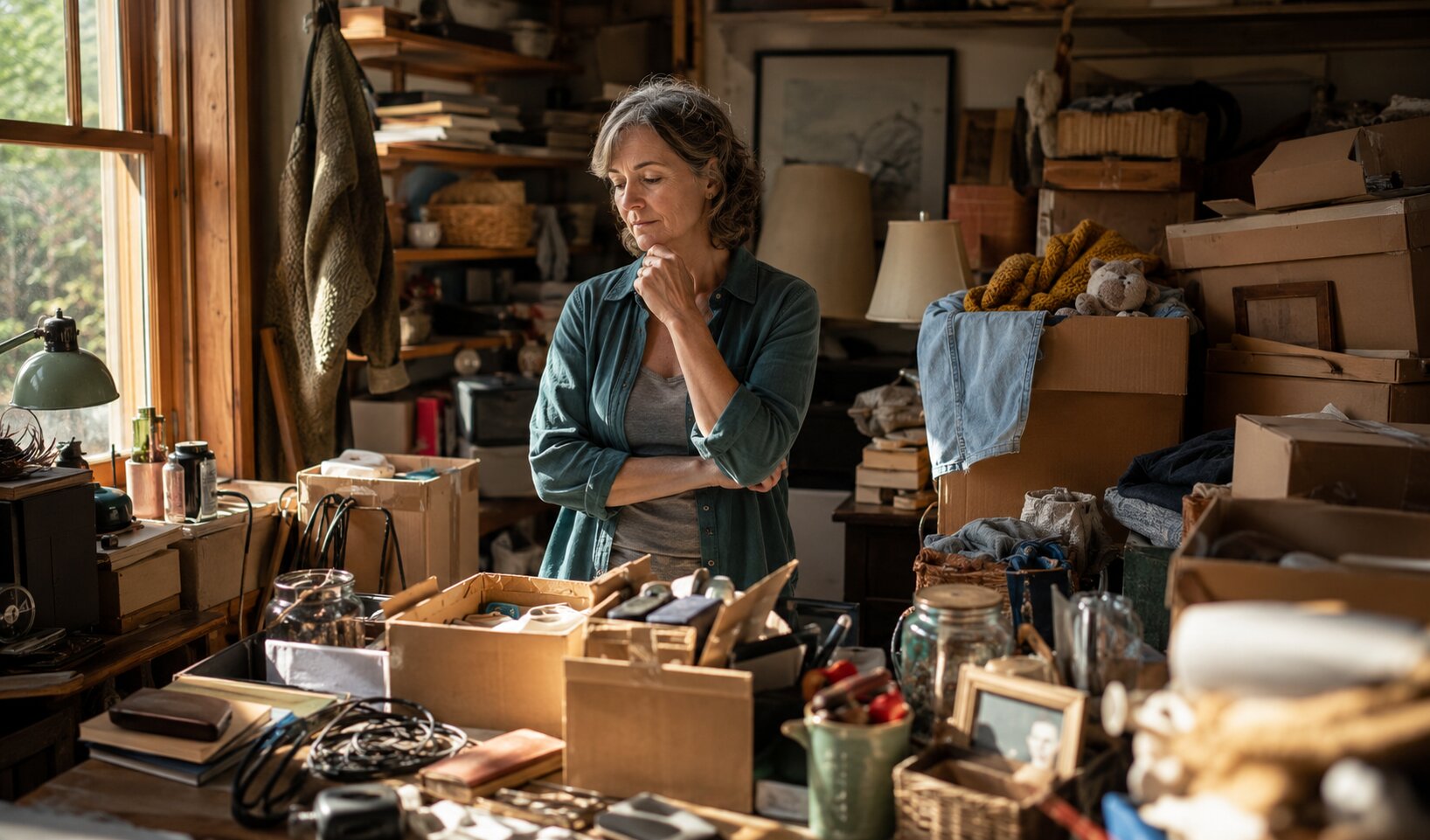
Open a closet in almost any home and you will probably find something familiar.
A box of old cables.
Clothes that haven’t been worn in years.
A broken appliance that might be useful “someday.”
Plastic containers with no matching lids.
Old phones, newspapers, furniture, tools, receipts, books, jars, bags, and dozens of other objects that somehow survived every attempt at cleaning.
Why is it so hard to throw things away?
The answer may go much deeper than laziness or disorganization.
Humans appear to have a natural tendency to save resources, accumulate useful things, and resist giving up what we already own. In the modern world, that instinct can sometimes turn into clutter. But thousands of years ago, the same instinct may have helped keep our ancestors alive.
The Ancient Rule: “You Might Need This Later”
Imagine living 20,000 years ago.
There are no supermarkets.
No Amazon.
No hardware stores.
No pharmacies.
No guarantee that tomorrow’s hunt will succeed.
Food may be plentiful this week and scarce next week. A useful stone tool may take hours to replace. Animal skins, firewood, weapons, containers, and preserved food can make the difference between comfort and hardship—or even survival.
Under those conditions, throwing away something useful would be foolish.
Nature would therefore favor a very simple psychological rule:
“If this might be valuable later, keep it.”
That instinct still lives inside us.
The problem is that the world around us has changed much faster than our brains have.
Today, most of us can replace a coffee mug, shirt, screwdriver, or charging cable within hours.
Our brains, however, can still react as though throwing something away means losing a potentially precious resource forever.
The Powerful Fear of Scarcity
Humans are especially sensitive to scarcity.
If we believe something may become difficult to obtain, its value immediately rises in our minds.
This explains why people stockpile supplies before hurricanes, rush to buy groceries before storms, or suddenly want a product when they hear the words:
“Only three left.”
Retailers understand this instinct extremely well.
“Limited edition.”
“While supplies last.”
“Final sale.”
“Almost sold out.”
All of these messages activate the ancient fear that an opportunity may disappear.
And once we possess something, another psychological force appears.
We Hate Losing Things We Already Own
Psychologists call this loss aversion.
In general, losing something feels more painful than gaining something of equal value feels pleasurable.
Suppose you find $100 on the sidewalk.
You feel good.
But imagine losing $100 from your wallet.
For most people, the pain of losing the money feels stronger than the pleasure of finding it.
The same principle applies to possessions.
When you look at an old jacket you haven’t worn for five years, logically you may know you don’t need it.
But throwing it away still feels like losing something.
So your brain invents a reason to keep it.
“I might wear it someday.”
“I paid a lot for this.”
“They don’t make these anymore.”
“I could give it to someone.”
“I’ll decide later.”
And back into the closet it goes.
The Strange Power of Ownership
There is another psychological phenomenon called the endowment effect.
Once we own something, we tend to value it more highly simply because it belongs to us.
Imagine seeing an old coffee mug at a garage sale.
You might think it is worth fifty cents.
But if it is your old mug—the one you used during college, your first job, or an important period of your life—it may suddenly feel priceless.
The object itself has not changed.
Its psychological meaning has.
This is why possessions can become surprisingly difficult to discard.
We are not always throwing away an object.
Sometimes we feel as though we are throwing away a memory.
Objects Become Pieces of Our Identity
Humans don’t merely own things.
We attach stories to them.
A concert ticket may represent youth.
A child’s toy may represent parenthood.
An old laptop may represent the beginning of a career.
A piece of furniture may remind someone of their parents.
Books can symbolize intelligence.
Tools can symbolize competence.
Clothes can represent a younger version of ourselves.
Suddenly, discarding an object feels much more complicated than simply cleaning the house.
You are not throwing away an old shirt.
You may feel that you are throwing away the person you used to be when you wore it.
That emotional attachment can make even objectively worthless objects psychologically valuable.
“What If I Need It Someday?”
Perhaps the most powerful sentence in the history of clutter is:
“I might need this someday.”
Notice how difficult that statement is to argue with.
Could you need the object someday?
Technically, yes.
You might need that twelve-year-old HDMI cable.
You might lose twenty pounds and wear those jeans again.
You might repair that broken chair.
You might someday discover a brilliant use for the seventeen glass jars sitting in the garage.
The probability may be tiny.
But the possibility is enough.
Humans dislike uncertainty, so keeping the object feels safer than risking future regret.
Throwing it away creates an irreversible decision.
Keeping it allows us to postpone the decision indefinitely.
And procrastination is remarkably comfortable.
But Our Ancestors Couldn’t Hoard Everything
There is an interesting evolutionary contradiction here.
Although saving resources could be valuable, our ancestors—particularly mobile hunter-gatherers—could not simply accumulate unlimited possessions.
Everything had a cost.
If your group moved regularly, someone had to carry what you owned.
An unnecessary object was not merely clutter.
It was weight.
Imagine having to carry everything in your garage whenever you moved to another neighborhood.
You would become a minimalist very quickly.
So evolution probably did not create a simple instinct that says:
“Collect everything.”
It likely created something closer to:
“Keep useful resources when their future availability is uncertain.”
That distinction matters.
Humans may naturally be resource preservers, but that does not necessarily mean we are natural extreme hoarders.
Then the Modern World Arrived
Modern civilization radically changed the equation.
We now live in an environment our ancestors could barely imagine.
Goods are cheap.
Storage is abundant.
Transportation is easy.
Homes are larger.
Credit cards allow immediate purchases.
Online shopping makes acquisition nearly frictionless.
A product can arrive at your doorstep without you even leaving the sofa.
Most importantly, we no longer have to physically carry our possessions everywhere we go.
So the ancient cost of accumulation has largely disappeared.
But the ancient instinct to keep useful things remains.
The result?
Closets fill up.
Garages become storage rooms.
Storage rooms become storage units.
And sometimes people pay hundreds of dollars every month to store possessions they haven’t used in years.
In a strange way, modern society has created the perfect environment for an ancient resource-saving instinct to run out of control.
Shopping Adds Another Layer
Keeping possessions is only half the story.
Acquiring things can also be rewarding.
Buying something new creates anticipation.
Finding a bargain feels like winning.
Collecting can provide satisfaction and completion.
Sales make us feel clever.
Scarcity makes products feel desirable.
And once something enters our possession, loss aversion and the endowment effect make it harder to remove.
The psychological cycle can look like this:
See → Want → Buy → Own → Value → Keep.
Repeat this process hundreds or thousands of times over decades, and the result is predictable.
Accumulation.
Saving Is Normal. Hoarding Disorder Is Different.
It is important, however, to distinguish ordinary saving from hoarding disorder.
Most people have possessions they struggle to discard.
That is normal.
Hoarding disorder is much more serious. It involves persistent difficulty getting rid of possessions, often regardless of their actual value, to the point that clutter interferes with normal living spaces or daily functioning.
So someone keeping an old box of cables is not necessarily a hoarder.
Someone whose possessions make rooms unusable may be experiencing something quite different.
Your Garage May Contain an Evolutionary Museum
The next time you stand in front of a cluttered closet wondering why you can’t throw something away, remember what may be happening inside your brain.
Part of you may be performing an ancient calculation.
Could this be useful later?
What if I can’t replace it?
What if I regret throwing it away?
For our ancestors, those were sensible questions.
In today’s world, they often produce closets full of things that can be replaced with a fifteen-minute trip to a store.
Human psychology evolved in a world of scarcity.
We now live in a world of abundance.
And sometimes the mismatch between those two worlds ends up sitting quietly in our garages.
Perhaps humans are not naturally born hoarders.
But we may be born with something very close to it:
a deep reluctance to surrender resources that might someday become useful.
And that is why one of the hardest sentences for the human brain to resist remains:
“Better keep it. You never know.”