For decades, fat had a terrible reputation.
People avoided avocados, skipped nuts, threw away egg yolks, and bought anything labeled “fat-free,” believing that eliminating fat was the secret to better health.
Ironically, during the same period, supermarket shelves filled with fat-free cookies, sugary cereals, and processed snacks—and obesity and diabetes continued to rise.
Today, nutrition science tells a very different story.
The problem was never fat itself.
The problem was the wrong kinds of fat.
In fact, one category of fat may be one of the best friends your heart has ever had.
It’s called unsaturated fat.
What Is Unsaturated Fat?
Unsaturated fat is a healthy type of dietary fat found primarily in plants, nuts, seeds, and oily fish.
Unlike saturated fat, its chemical structure contains one or more double bonds, making it liquid at room temperature.
You don’t need to remember the chemistry.
Just remember this:
Unsaturated fats help your body.
Two Types of Unsaturated Fat
1. Monounsaturated Fat (MUFA)
These fats contain one double bond.
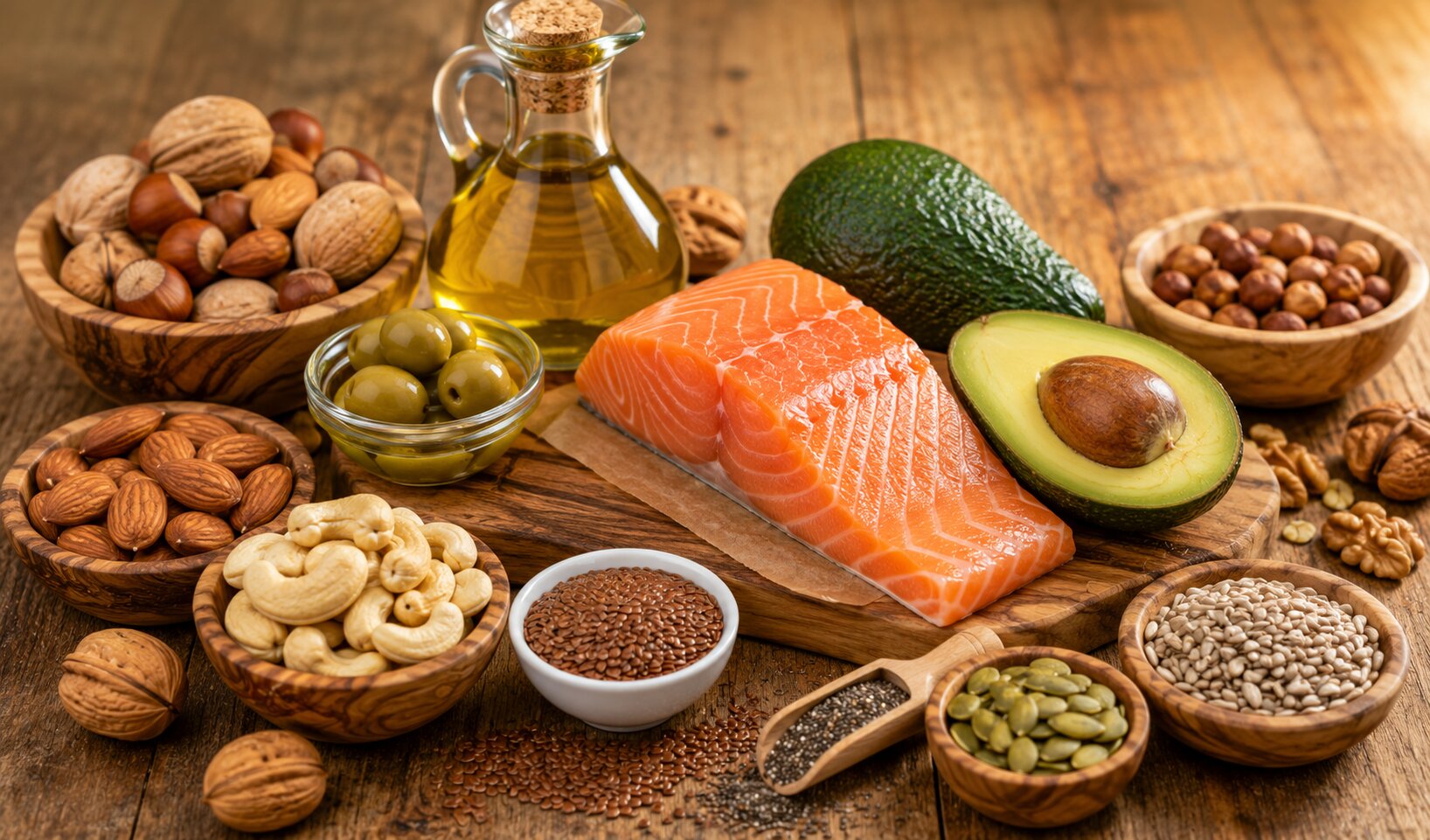
They’re found in:
- Extra virgin olive oil
- Avocados
- Almonds
- Cashews
- Peanuts
- Pistachios
Monounsaturated fats are famous for supporting heart health and improving cholesterol levels.
2. Polyunsaturated Fat (PUFA)
These contain two or more double bonds.
This group includes the essential Omega-3 and Omega-6 fatty acids.
Good sources include:
- Salmon
- Sardines
- Mackerel
- Walnuts
- Flaxseeds
- Chia seeds
- Sunflower seeds
Unlike many nutrients, your body cannot make omega-3 fatty acids.
You must obtain them from your diet.
Why Does Your Body Need Unsaturated Fat?
Healthy fats aren’t just fuel.
They’re involved in nearly every major system in your body.
❤️ Protecting Your Heart
Unsaturated fats help:
- Lower LDL (“bad”) cholesterol
- Maintain or improve HDL (“good”) cholesterol
- Reduce inflammation
- Improve blood vessel function
This lowers the risk of heart attacks and strokes over time.
🧠 Feeding Your Brain
Nearly 60% of your brain is made up of fat.
Omega-3 fats, especially DHA, are vital for:
- Memory
- Learning
- Brain development
- Healthy nerve cells
Researchers continue studying their role in maintaining cognitive health as we age.
👀 Supporting Healthy Eyes
The retina contains high concentrations of omega-3 fatty acids.
Getting enough healthy fats may help maintain normal eye function throughout life.
🦴 Helping Your Body Absorb Vitamins
Four important vitamins require fat for absorption:
- Vitamin A
- Vitamin D
- Vitamin E
- Vitamin K
Without dietary fat, your body can’t absorb these vitamins efficiently.
🧬 Building Every Cell
Every cell membrane in your body contains fat.
Healthy unsaturated fats help keep these membranes flexible and functioning properly.
Can Healthy Fat Help Lower Cholesterol?
Surprisingly…
Yes.
Imagine replacing a tablespoon of butter with the same amount of olive oil.
Both contain similar calories.
But they behave very differently inside your body.
Olive oil’s monounsaturated fats can help lower LDL cholesterol while preserving HDL.
That’s why the Mediterranean diet consistently ranks among the healthiest eating patterns in the world.
The Mediterranean Secret
People living around the Mediterranean Sea have long enjoyed diets rich in:
- Olive oil
- Fish
- Nuts
- Beans
- Vegetables
- Fruits
- Whole grains
Despite consuming a moderate amount of fat, these populations historically experienced lower rates of heart disease than many Western countries.
The secret wasn’t eating less fat.
It was eating better fat.
Does Eating Fat Make You Fat?
Not necessarily.
Weight gain occurs when you consume more calories than your body burns, regardless of whether those calories come from carbohydrates, fat, or protein.
Healthy fats are calorie-dense, providing about 9 calories per gram, compared with 4 calories per gram for carbohydrates and protein.
That means portion size still matters.
A handful of almonds is healthy.
An entire bag every day probably isn’t.
Best Foods Rich in Unsaturated Fat
Fill your kitchen with foods like:
🥑 Avocados
🫒 Extra virgin olive oil
🥜 Almonds
🌰 Walnuts
🥜 Pistachios
🥜 Cashews
🐟 Salmon
🐟 Sardines
🐟 Mackerel
🌱 Flaxseeds
🌱 Chia seeds
🌻 Sunflower seeds
These foods provide healthy fats along with fiber, vitamins, minerals, antioxidants, and plant compounds that work together to support overall health.
What About Saturated Fat?
Saturated fat isn’t poison.
Your body can handle moderate amounts.
However, replacing some saturated fat with unsaturated fat has consistently been shown to improve cholesterol levels and reduce cardiovascular risk in many people.
That doesn’t mean you have to eliminate butter forever.
It simply means olive oil deserves the starring role in your kitchen.
The Bottom Line
Fat isn’t the villain it was once made out to be.
In fact, the right kinds of fat can become powerful allies for your heart, brain, and overall health.
Unsaturated fats nourish your cells, help absorb essential vitamins, support healthy cholesterol levels, and provide your body with nutrients it simply can’t make on its own.
So the next time someone says they’re “avoiding all fat,” remember:
It’s not about eating less fat.
It’s about eating smarter fat.
Sometimes, one of the healthiest choices you can make is adding a drizzle of olive oil to your salad, slicing an avocado onto your toast, or enjoying a handful of nuts.
Your heart just might thank you for it.