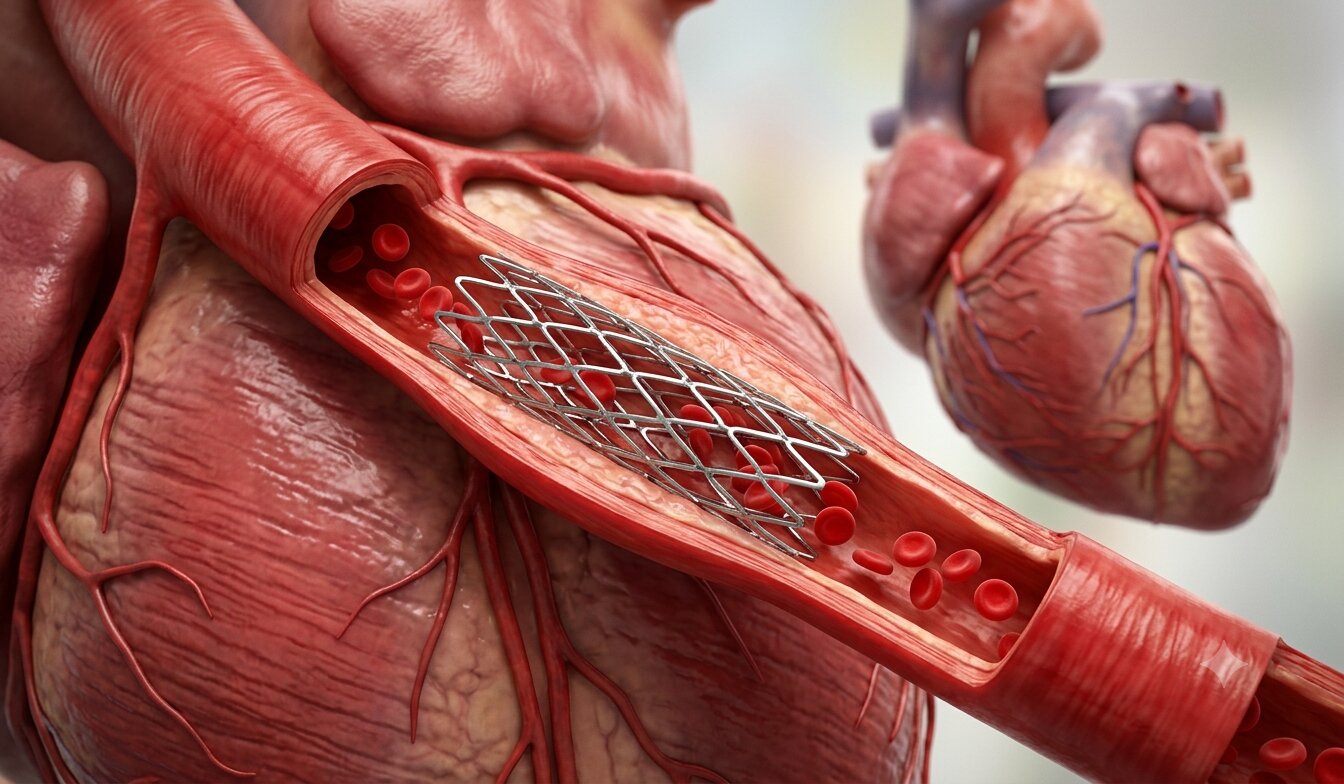
In cardiovascular medicine, a stent is a tiny, expandable wire mesh tube. It is used to prop open an artery that has become severely narrowed or blocked by plaque buildup, immediately restoring healthy blood flow to the heart muscle.
Cardiologists use stents in two primary situations: emergencies and planned, non-emergency cases.
1. The Emergency Scenario: An Active Heart Attack
This is the most critical and life-saving reason a stent is used.
-
When it happens: If a soft piece of plaque in a heart artery ruptures, your body instantly forms a blood clot over it, entirely cutting off the blood supply to a section of the heart muscle.
-
The Stent’s Role: The patient is rushed to the hospital’s cardiac catheterization lab. The cardiologist feeds a tiny balloon catheter directly into the blockage, inflates it to push the clot and plaque against the artery wall, and deploys a stent to keep the vessel wide open. Getting a stent in this window stops the heart attack in its tracks and prevents permanent muscle damage.
2. The Planned Scenario: Severe, Unmanageable Angina
Stents are also used in non-emergency situations for individuals with advanced Coronary Artery Disease (CAD).
-
When it happens: A person may have a severe, chronic plaque blockage (often 70% or greater) that physically chokes off blood flow during physical exertion. This causes angina—severe chest pain, pressure, or shortness of breath when walking, exercising, or under stress.
-
The Stent’s Role: If optimal medical therapies (like beta-blockers, nitroglycerin, and high-dose statins) and lifestyle changes fail to control the chest pain, a stent is planned. It mechanically widens the narrowed section, immediately relieving the painful symptoms and dramatically improving the patient’s quality of life.
When is a Stent Not Used?
It is equally important to understand when a stent is bypassed in favor of other treatments:
-
Mild or Moderate Plaque: If an artery has a 30%, 40%, or 50% blockage but blood is still flowing smoothly and the patient has no symptoms, a stent is not used. Inserting a metal object into an otherwise stable artery introduces unnecessary risk. Instead, doctors use aggressive medical management (like statins) to freeze and shrink that plaque safely from the inside out.
-
Severe, Widespread Blockages: If a patient has severe blockages across multiple different arteries or in the critical Left Main artery, a stent may not be enough. In these complex cases, a cardiothoracic surgeon will perform Coronary Artery Bypass Graft (CABG) surgery—using a healthy blood vessel from the leg or chest to completely reroute blood around the blocked pathways.
A stent is ultimately a mechanical fix for a plumbing problem. While it does a phenomenal job of opening up a clogged pipe during an emergency or relieving severe chest pain, it doesn’t cure the underlying disease. This is why even after someone gets a stent, they must still take cholesterol-lowering medications to keep the rest of their arterial system completely clean and protected.