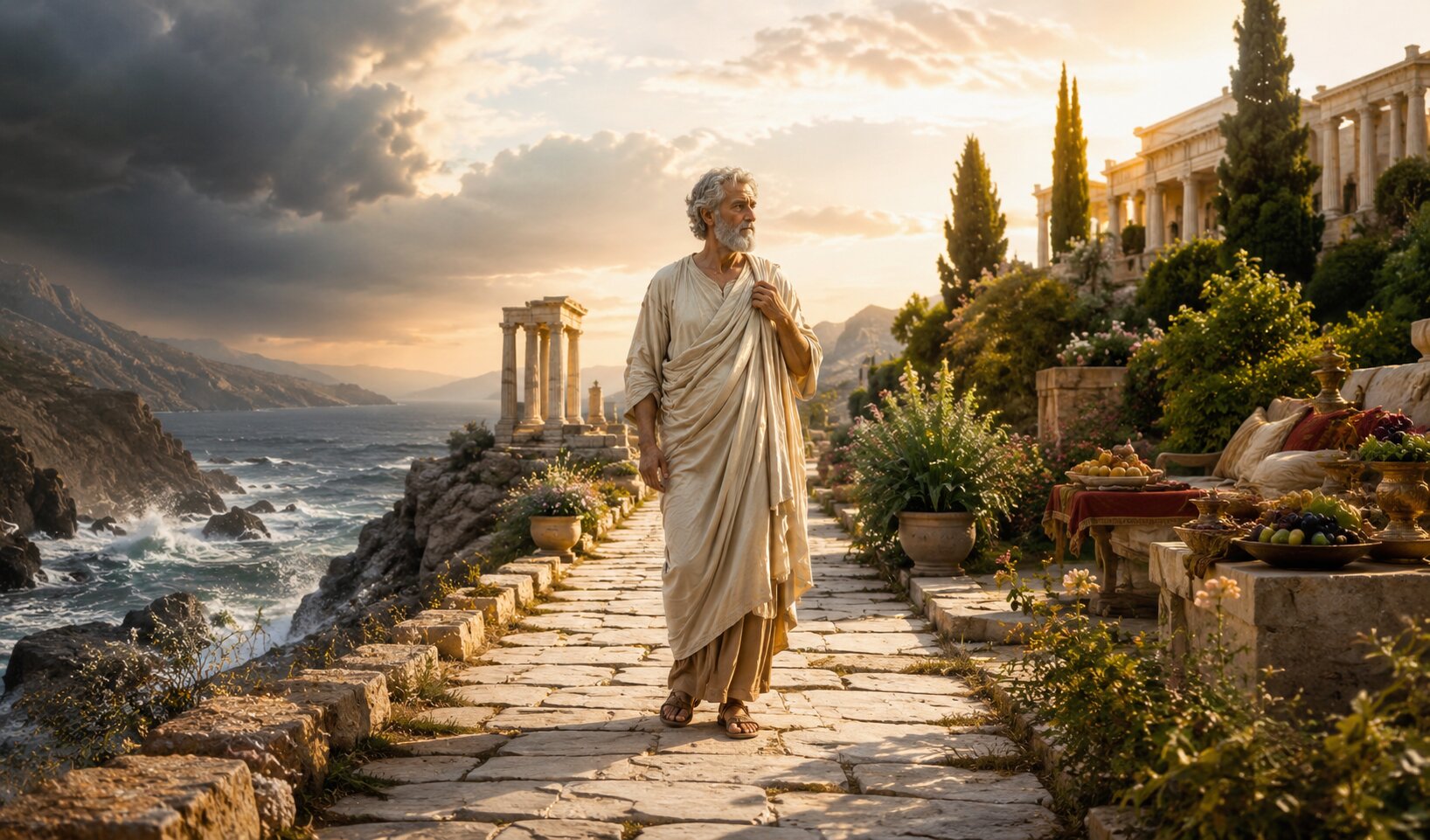
The Art of Living with Balance and Wisdom
In almost every area of life, human beings are tempted by extremes. Some people mistake courage for recklessness. Others mistake caution for wisdom. Some pursue pleasure without restraint, while others deny themselves even the healthy joys of life. Aristotle, one of the greatest philosophers of ancient Greece, believed that a good life is not found at either extreme. It is found in the disciplined, thoughtful, and balanced space between them.
This idea is often called the doctrine of the mean, or more simply, Aristotle’s Middle Path. It teaches that virtue is not a rigid rule or a mechanical formula. Instead, virtue is the wise ability to choose the right action, in the right way, at the right time, for the right reason.
Aristotle’s Middle Path remains deeply relevant even today. Whether we are making personal decisions, handling relationships, managing emotions, leading others, or shaping our character, his philosophy offers a practical guide to living well.
1. The Golden Mean: Virtue Between Extremes
At the heart of Aristotle’s ethical thought is the idea of the Golden Mean. According to Aristotle, virtue usually lies between two extremes: one of excess and one of deficiency.
For example, courage is the virtue that stands between cowardice and recklessness. A coward runs away from every danger, even when action is necessary. A reckless person rushes into danger without thought. A courageous person, however, understands fear, respects danger, and still acts rightly when the situation demands it.
This is the beauty of Aristotle’s Middle Path. It does not ask us to be passive or average. It asks us to be balanced, thoughtful, and morally strong.
2. Virtue Ethics: Becoming a Better Person
Aristotle’s philosophy is not merely about obeying rules. It is about becoming the kind of person who naturally chooses what is good. This is why his ethical system is called virtue ethics.
Virtues such as courage, temperance, generosity, honesty, patience, and justice are not accidental qualities. They must be cultivated. A person becomes brave by practicing brave actions. A person becomes generous by repeatedly choosing generosity. A person becomes just by acting fairly, even when it is inconvenient.
The Middle Path helps us develop these virtues by warning us against imbalance. Too little confidence becomes weakness. Too much confidence becomes arrogance. Too little generosity becomes stinginess. Too much generosity may become irresponsibility. Virtue lies in the wise and disciplined balance between these extremes.
3. The Middle Path Is Not the Same for Everyone
One of the most sophisticated aspects of Aristotle’s thought is that the Middle Path is not a fixed mathematical midpoint. It is not the same for every person in every situation.
For example, the right amount of food for an athlete may be too much for someone with a different lifestyle. The right level of boldness for a soldier in battle may not be appropriate for a teacher in a classroom. The right expression of anger in the face of injustice may be very different from anger over a minor inconvenience.
This is why Aristotle emphasizes practical wisdom, or phronesis. Practical wisdom is the ability to judge what is appropriate in a particular situation. It is not enough to know that moderation is good. We must also know how moderation should look in real life.
4. Avoiding Excess and Deficiency
Aristotle believed that moral failure often comes from falling into one of two extremes: excess or deficiency.
Take the virtue of temperance. A person who indulges every desire without restraint falls into excess. A person who rejects all pleasure and treats every joy as dangerous falls into deficiency. The temperate person enjoys life’s pleasures in a healthy and disciplined way.
The same principle applies to many virtues. Truthfulness lies between boastfulness and false modesty. Friendliness lies between being quarrelsome and being overly pleasing. Generosity lies between wastefulness and greed.
This approach makes Aristotle’s ethics remarkably practical. He does not simply say, “Be good.” He shows us how goodness is shaped by balance.
5. Context Matters
Aristotle understood that human life is complex. What is moderate in one culture, age, profession, or circumstance may not be moderate in another. A leader, a parent, a student, a soldier, and a judge may all need to express virtues differently.
This does not mean morality is meaningless or completely relative. Rather, it means that ethical judgment requires sensitivity to context. A wise person does not apply virtue blindly. He or she considers the circumstances, the people involved, the consequences, and the purpose of the action.
For Aristotle, moral excellence is not mechanical. It is intelligent, alert, and deeply human.
6. Moral Virtues and Intellectual Virtues
Aristotle distinguished between moral virtues and intellectual virtues.
Moral virtues are qualities of character. These include courage, temperance, generosity, patience, and justice. They are developed through habit and practice.
Intellectual virtues are qualities of the mind. These include wisdom, understanding, knowledge, and sound judgment. They are developed through learning, reflection, and experience.
The Middle Path applies mainly to moral virtues because it guides how we act, feel, and respond. However, intellectual virtue is also necessary because we need wisdom to recognize the right balance. Without clear thinking, even good intentions can lead us into error.
7. The Need for Self-Examination
To follow the Middle Path, a person must be willing to examine himself honestly. We must ask: Am I acting from courage or from ego? Am I being patient or merely passive? Am I being generous or trying to impress others? Am I being firm or simply harsh?
This kind of self-examination is difficult because people often justify their own extremes. A reckless person may call himself brave. A stingy person may call himself careful. An angry person may call himself honest.
Aristotle’s Middle Path demands moral honesty. It asks us to look beyond appearances and examine the true motive, proportion, and effect of our actions.
8. Education and Habit Shape Character
Aristotle believed that virtue is formed through habituation. We are not born fully virtuous. We become virtuous by repeatedly choosing the right actions until they become part of our character.
This is similar to learning a skill. A musician becomes skilled through practice. An athlete becomes strong through training. In the same way, a person becomes morally excellent by practicing virtue again and again.
Education also plays a major role. Good guidance, good examples, and good communities help shape character. A society that praises greed, anger, vanity, or excess will produce people who imitate those qualities. A society that honors wisdom, discipline, justice, and moderation will help people grow toward virtue.
For Aristotle, character is not built in a single moment. It is built through repeated choices.
9. Eudaimonia: The Goal of a Flourishing Life
The ultimate goal of Aristotle’s ethics is eudaimonia, often translated as happiness, flourishing, or living well. But Aristotle does not mean temporary pleasure or emotional excitement. Eudaimonia is a deeper form of fulfillment.
It is the condition of a human life lived according to reason and virtue. A flourishing person is not merely rich, popular, or comfortable. A flourishing person has developed good character, uses reason well, acts justly, and fulfills his or her human potential.
The Middle Path leads toward eudaimonia because it helps us avoid the chaos of extremes. A life of excess eventually becomes unstable. A life of deficiency becomes narrow and incomplete. A life of virtue, however, becomes balanced, meaningful, and inwardly strong.
10. A Practical Guide for Everyday Life
One reason Aristotle’s Middle Path remains powerful is that it can be applied to everyday situations.
In speech, the Middle Path teaches us to be truthful without being cruel.
In ambition, it teaches us to strive without becoming obsessed.
In relationships, it teaches us to love without possessiveness.
In anger, it teaches us to respond to injustice without losing self-control.
In pleasure, it teaches us to enjoy life without becoming enslaved by desire.
In leadership, it teaches us to be firm without becoming tyrannical.
This is not a philosophy for abstract debate alone. It is a philosophy for daily living.
Conclusion: Balance Is Not Weakness
Aristotle’s Middle Path is sometimes misunderstood as a call for compromise in every situation. But Aristotle is not asking us to be mediocre, timid, or neutral. He is asking us to become wise.
The Middle Path is not weakness. It is disciplined strength. It is the ability to resist both impulsive excess and fearful deficiency. It is the wisdom to know when to act, when to wait, when to speak, when to remain silent, when to be gentle, and when to be firm.
In a world that often rewards extremes, Aristotle’s philosophy reminds us that the best life is not built on impulse, indulgence, or denial. It is built on character, judgment, moderation, and purpose.
To live the Middle Path is to live with balance. To live with balance is to live with wisdom. And for Aristotle, a life guided by wisdom and virtue is the highest form of human flourishing.