Democracy is often celebrated as one of humanity’s greatest political achievements.
It gives people a voice, protects individual rights, and offers a system in which power can change hands without violence.
Yet democracy has always had its critics, and one of the earliest was Socrates.
He distrusted democracy because he believed a government is only as wise as the people who choose it.
If voters are uninformed, impulsive, or easily manipulated, they may elect leaders who reflect those same weaknesses.
His fear was not abstract.
Socrates himself was sentenced to death by a jury in democratic Athens, a decision that has echoed through history as a warning about the dangers of majority rule without wisdom.
This raises an uncomfortable question.
What happens when freedom is widely celebrated, but responsibility, discipline, and civic understanding are not?
The Great Tension Between Freedom and Function
Freedom is one of the most cherished ideals in modern political life.
People want the right to speak, act, choose, dissent, and live as they please.
But freedom, when stretched to its extreme, can also create disorder.
A society cannot function if every collective decision is endlessly obstructed, every rule is treated as tyranny, and every public duty is viewed as an attack on personal liberty.
That is the central tension at the heart of modern democracy.
How much freedom can a society sustain before it begins to undermine its own ability to govern effectively?
This question becomes especially visible when large public projects stall for years.
In places like California, massive infrastructure efforts such as high-speed rail have become symbols of democratic complexity.
Projects move slowly through layers of political opposition, agency review, legal challenges, public hearings, and land negotiations.
In theory, these checks exist to protect rights and ensure accountability.
In practice, they can make action painfully slow.
Meanwhile, more centralized systems often complete enormous projects with remarkable speed.
Countries with stronger state control can build dams, bridges, rail systems, and cities without the same level of public resistance or procedural delay.
To critics of democracy, this comparison seems damning.
They ask whether too much freedom has made democratic societies incapable of decisive action.
When Rights Become Obstacles
One of the strongest criticisms of democracy is that people often use rights not for constructive participation, but for obstruction, spectacle, and chaos.
Public debate can devolve into noise.
Media can inflame conflict rather than inform.
Social platforms can magnify ignorance faster than reason.
And political systems can become trapped between competing factions, each pulling in a different direction while little gets done.
This problem became especially visible during the COVID-19 pandemic.
Public health measures that were meant to reduce harm often became ideological battlegrounds.
In many democratic societies, even temporary restrictions were interpreted by some as intolerable assaults on liberty.
Instead of a shared social response, there were often endless arguments, conspiracy theories, defiance, and confusion.
To critics, this exposed a painful truth.
A society that values freedom but lacks discipline may struggle most when discipline is urgently needed.
By contrast, more authoritarian systems were able to impose quarantines, restrictions, and compliance with much greater force.
Whatever one thinks of such methods, their ability to act swiftly highlighted the contrast between command and debate, between obedience and argument, between centralized power and democratic resistance.
The Appeal of the “Benevolent Autocrat”
When democracy appears chaotic and ineffective, the idea of a benevolent autocrat becomes tempting.
The logic is simple.
What if a strong ruler could impose order, silence destructive conflict, push through necessary reforms, and maintain peace and prosperity?
Supporters of this view often point to examples such as Lee Kuan Yew’s Singapore or to the efficiency of highly centralized states.
They argue that social harmony sometimes requires limits on speech, stricter media control, and reduced tolerance for divisive public behavior.
In this view, too much freedom does not create enlightenment.
It creates fragmentation.
The state, therefore, must become the referee, the disciplinarian, and sometimes the silencer.
There is an undeniable appeal in this argument.
Many people would gladly trade a portion of abstract liberty for clean streets, public order, efficient infrastructure, low corruption, and social peace.
For citizens exhausted by polarization, dysfunction, and endless ideological conflict, order can feel more valuable than unrestricted expression.
But this solution comes with a serious danger.
The word benevolent does enormous work in the phrase benevolent autocrat.
History shows that concentrated power rarely remains benevolent forever.
A ruler who silences hatred today may silence truth tomorrow.
A government that controls the media to stop unrest may also control it to hide corruption.
The efficiency of authoritarianism is real, but so is its potential for abuse.
The Nordic Alternative
If authoritarian efficiency is too dangerous, but democratic dysfunction is too frustrating, then perhaps the better question is this: can democracy be reformed rather than replaced?
This is where the Nordic countries offer an intriguing model.
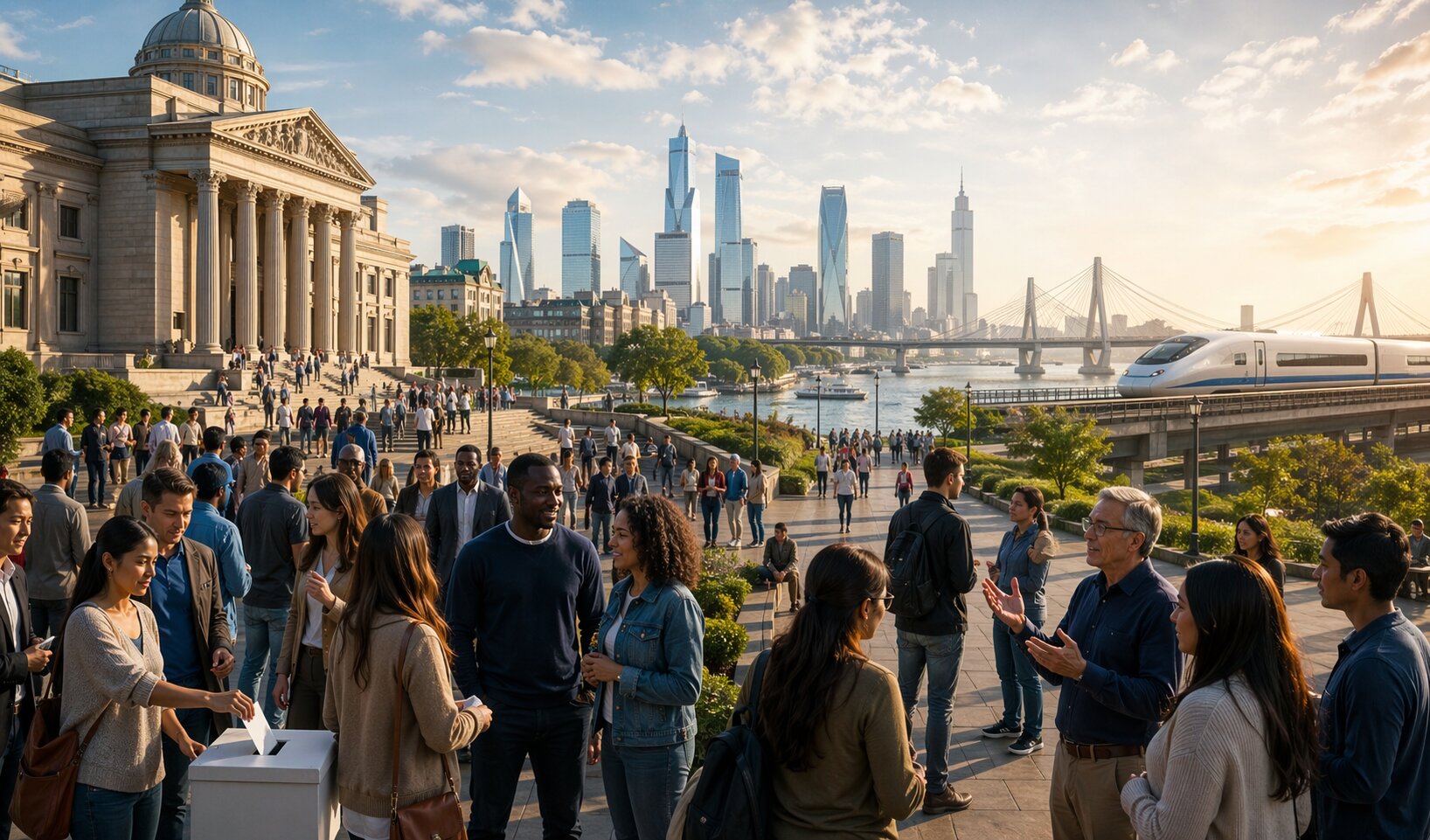
Nations such as Sweden, Norway, Denmark, Finland, and Iceland demonstrate that democracy does not have to mean chaos.
These countries remain politically free while also maintaining high levels of social trust, public welfare, stability, and prosperity.
Their success suggests that democracy works best not merely when people vote, but when institutions are trusted, corruption is low, education is strong, and inequality is kept in check.
The Nordic model is not magic.
It is built on discipline, civic culture, functional institutions, and a broad social agreement that government should serve the common good.
For countries like the United States, this model may offer a more realistic path than either democratic complacency or authoritarian longing.
Several reforms are often proposed in that spirit.
Here are some measures the USA could take to mimic the Nordic model:
- Remove the Electoral College. It creates uneven representation. California has two senators representing 39 million people, while Wyoming has two senators representing 500,000 people. How can they be equally represented? Presidents who win the popular vote may not be elected.
- Eliminate lobbying and campaign financing. Lobbying fosters corruption, as wealthy individuals influence politicians to create laws that support their interests.
- Implement universal healthcare, free education, and strong social safety nets. These measures create social mobility and reduce inequality.
- Enforce strong immigration laws. This would help eliminate the influx of illegal immigrants who drain resources without contributing.
- Build greater trust in the government by eliminating corruption. This would increase public confidence in the government and reinforce the belief that it works for the people.
- Promote civic education so that citizens actively participate in their civic duties, such as electing their representatives.
- Strengthen labor rights to eliminate the wage gap and reduce income inequality.
- Eliminate guns. Such rights are detrimental to society, as they contribute to the loss of lives, including those of our children.
These reforms would not eliminate political conflict.
But they could create a healthier democracy, one in which freedom is paired with competence, and rights are balanced by responsibility.
Can Freedom and Prosperity Coexist?
Between Prosperity and Freedom, one shouldn’t have to choose one or the other.
It is a provocative argument, and it explains why so many people, disappointed by democratic disorder, begin to admire more controlled systems.
But the real issue may not be freedom itself.
It may be whether a society has built the cultural and institutional strength needed to handle freedom well.
Freedom without civic virtue becomes noise.
Freedom without trust becomes suspicion.
Freedom without responsibility becomes paralysis.
Yet order without liberty can become oppression.
Prosperity without freedom can become spiritual suffocation.
The challenge, then, is not simply to choose between liberty and order.
It is to build a society mature enough to sustain both.
That is extraordinarily difficult.
But it may be the only political task worth pursuing.
Final Thoughts
Democracy is messy, frustrating, slow, and often deeply flawed.
It can empower wisdom, but it can also amplify ignorance.
It can protect liberty, but it can also obstruct action.
That is why thinkers from Socrates to modern critics have questioned whether freedom alone can hold a civilization together.
And yet the answer may not lie in abandoning democracy for strong rulers.
It may lie in creating a better kind of democracy, one shaped by civic education, social trust, institutional integrity, and a culture that values responsibility as much as rights.
The real question is not whether democracy is perfect.
It is whether citizens are willing to become the kind of people a healthy democracy requires.